
Sarah Guppy show and women in STEM panel discussion recorded for schools

Posted on

Back in November, Show of Strength‘s production about Sarah Guppy – engineer, inventor, campaigner, designer, reformer, writer, environmentalist and business woman – opened to great reviews.

These included comments such as:

“You won’t look at Isambard Kingdom Brunel or the Clifton Suspension Bridge in quite the same way ever again after seeing this piece.”

and:

“An inspiring and witty homage to someone who deserves a far more central place in Bristol’s – and Britain’s – commercial and industrial history.”

and crucially:

“Please find a way of getting this into every school in Bristol.”

Which is what Show of Strength, in collaboration with UWE Bristol, Future Quest, Clifton Suspension Bridge and the SS Great Britain, did yesterday.

Girls from Bristol Brunel Academy and Bristol Metropolitan Academy, coordinated by Future Quest’s Gemma Adams, attended an exclusive showing of Sarah Guppy: The Bridge, The Bed, The Truth in UWE’s filming studio at the university’s Bower Ashton campus. The performance was filmed, thanks to UWE’s Abigail Davies, and followed by a panel discussion on women in STEM (Science, Technology, Engineering and Maths) which was also recorded so that both elements of yesterday’s production can be shown in schools.

The panel discussion was chaired by UWE’s Dr Madge Dresser, an expert in social and cultural British history, who recently put Sarah Guppy forward for inclusion in the Oxford Dictionary of National Biography. On the panel were civil engineeer Trish Johnson (the first female Bridgemaster of Clifton Suspension Bridge), mechanical engineer Nicola Grahamslaw (Conservation Engineer for the SS Great Britain), mechanical engineer Rachel Gollin (who has extensive experience of engineering various sectors across the world), Dr Laura Fogg Rogers (Senior Research Fellow at UWE; Women Like Me), Dr Laura Hobbs (Research Fellow at UWE; Women Like Me) and Miriam Cristofoletti (Robotics student at UWE’s Bristol Robotics Laboratory.

“It’s still not great for women in STEM but at least we’re allowed to be engineers and scientists now!”

Dr Laura Fogg Rogers, UWE Bristol

Discussion ranged from why girls don’t choose STEM subjects to the best thing about an engineer and back again, via conversation about what engineers can expect to earn, how to get into engineering and more.

Feedback was positive – Future Quest described hearing from a panel of women in STEM and their thoughts and advice about their careers as

“both inspiring and thought provoking”

And it is hoped that the film will inspire many more school students in future.

Header image shows left to right: Trish Johnson (Clifton Suspension Bridge), Nicola Grahamslaw (SS Great Britain), Rachel Gollin, Kim Hicks as Sarah Guppy, Dr Laura Fogg Rogers (UWE Bristol), Dr Laura Hobbs (UWE Bristol), Miriam Cristofoletti (UWE Bristol), Sheila Hannon (Producer, Show of Strength), Dr Madge Dresser (UWE Bristol) and Gemma Adams (UWE Bristol/Future Quest).

Universities Minister tours enterprise zone and robotics lab on visit to UWE Bristol

Posted on

On 22nd March , Chris Skidmore MP, Minister of State for Universities, Science, Research and Innovation, toured Bristol Robotics Laboratory (BRL) and the University Enterprise Zone (UEZ) as part of a visit to UWE Bristol.

He received a guided tour of the UEZ  and a tour of the Assisted Robotics Laboratory, Nuclear Decommissioning Suite and Driverless Car Workshop and Simulator.

Read more on the UWE Bristol news page.

Future Impact webinar – ‘Should we fear the robots?’

Posted on

12:00 – 13:00 Tuesday 2 April 2019

Online Webinar

Join Dr Jo Michell, Associate Professor in Economics, Professor Alan Winfield, Professor of Robot Ethics and Professor Sanja Dogramadzi, Professor in Medical Robotics, as they discuss the rise and rise of robots in the workforce. How will this impact on our economy? What ethical questions are raised by the robot revolution and how far away are we from a post-work society?

The Bristol Business Engagement Centre at the Bristol Business School aims to address these questions, amongst others, and leave you with a better understanding of the impact artificial intelligence could have on our society and the business of being human.

For more information see the UWE Bristol event listing.

How’s my pig? Using facial recognition technology to improve animal wellbeing

Posted on

The work of Professor Melvyn Smith and Professor Lyndon Smith of the Centre for Machine Vision, Bristol Robotics Laboratory has been featured in the news this week.

They are using facial recognition technology to assess the emotional state of pigs, with hopes that the project, based at the Rural College (SRUC) Pig Research Centre in Scotland, will lead to improvements in animal wellbeing.

Pigs communicate with each other using facial expressions, so researchers are now capturing 3D and 2D facial images of the breeding sow population to be analysed at UWE’s Centre for Machine Vision, where techniques for automatic identification of a range of emotions are under development.

“Machine vision technology offers the potential to realise a low-cost, non-intrusive and practical means to biometrically identify individual animals on the farm.

“Our work has already demonstrated a 97% accuracy at facial recognition in pigs. Our next step will be, for the first time, to explore the potential for using machine vision to automatically recognise facial expressions that are linked with core emotion states, such as happiness or distress, in the identified pigs.”

Professor Melvyn Smith, UWE Bristol

Lyndon has been filmed by the BBC this week, giving a simulated demo of pig face recognition using deep learning, while the story has been featured online by the BBC, The Times, the Daily Mail, the Metro, the Irish Times and the Irish Examiner, among others and covered on Radio 4’s Farming Today (starting at 9:47).

IWD2019 – FARSCOPE blog on being a woman in STEM

Posted on

Laura Gemmell, a student on the joint UWE Bristol and University of Bristol doctoral programme FARSCOPE, has written a blog post all about being a woman in STEM, in celebration of International Women’s Day.

“Now we can all agree we need women, how do we get more women into industries where they are under-represented, like robotics?”

Read the post, “Superwomen – Putting the human in superhuman”, here!

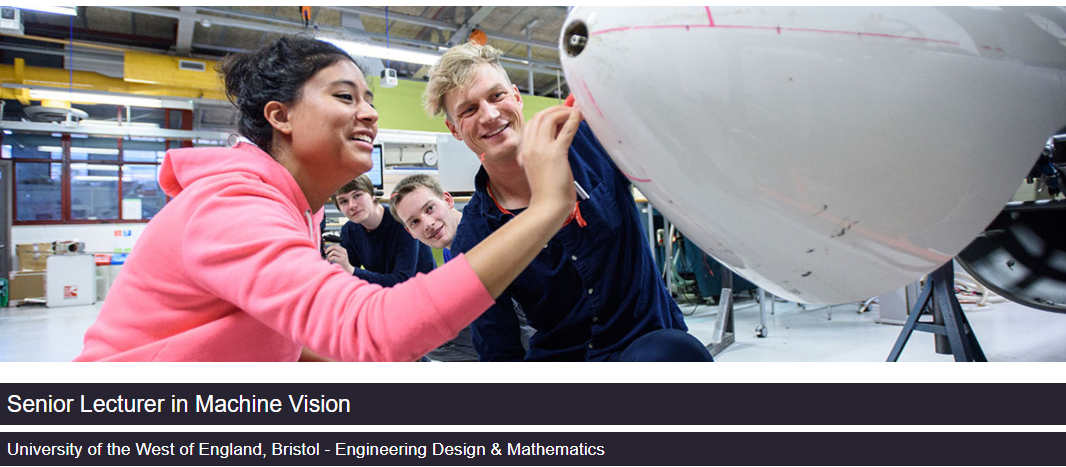
Join UWE Bristol as a Senior Lecturer in Machine Vision

Posted on

UWE Bristol are advertising an exciting new post for a Senior Lecturer in Machine Vision, with the first three years to be split 50:50 between research and teaching.

Working in the Department of Engineering Design and Mathematics and linking into the Centre for Machine Vision (CMV) within the Bristol Robotics Laboratory, this post will ‘twin-track’ research in machine vision and teaching roles. You will be expected to devote your time, energy and enthusiasm equally between research and teaching. 

This is a permanent academic appointment as Senior Lecturer. For more information and to apply, please see the job listing.

Open Bionics named sixth most innovative company in Europe

Posted on

Open Bionics, a start-up that developed in Bristol Robotics Laboratory (BRL), has been named in a prestigious annual list of the world’s most innovative companies for 2019.

The list, published by American business magazine Fast Company, honours the companies making the most profound impact on both industry and culture. Half of the businesses on this year’s list of 50 innovative organisations are appearing for the first time. Open Bionics has been ranked sixth in the list’s Europe category.

Read more in the UWE Bristol news article.

Leaders Award prototype team ready to visit designer’s school

Posted on

Our team of engineers, including our Women Like Me engineer Katy, are busy building one of the winning designs from last year’s Leaders Award. Designed by Philippa Griffiths of Hugh Sexey CE Middle School in Somerset, the Red Line Braking System (RLBS) displays red lights to alert other drivers of the severity of the braking and levels of attention needed, with the aim of reducing fatalities on our roads. The team are due to visit Philippa’s school tomorrow, as Miriam Cristofoletti of the build team tells us here.

Today we had a very productive meeting, preparing our 2-hour session to Philippa’s school. We’ll have about 20-25 KS3 pupils and we will run a series of very interactive activities. We want to inspire them, and show them what the Engineering World looks like, through quizzes, games and a final practical session, building circuits and writing code! 

Philippa’s design is an incredible idea, and the Engineering principle behind it is actually quite straightforward: a pressure sensor and many LED strips lit up depending on the intensity of the force applied on it. We want her to fully experience her own design and with our practical session next Wednesday, she’ll be able to do so. We’ll also have a chat with her, and see whether we’re all on the same page for the project and what are her suggestions. It’s gonna be fun!

Come and join UWE as a Research Associate in Responsible Robotics

Posted on

UWE Bristol are currently advertising for the role of Research Associate in Responsible Robotics, based in the Bristol Robotics Laboratory (BRL).

The BRL is seeking a research assistant with experience of experimental robotics, to work in new EPSRC funded project: Developing Responsible Robots for the Digital Economy. The overall aim of the project is to embed responsible innovation (RI) into technology developers’ practices and to create positive cases of RI in action. The project will focus on the domain of social robots, those that interact with people and make decisions about what to do on their own accord.

For more information and to apply, please see the UWE Bristol job listing.

First prototype complete in Leaders Award design build

Posted on

A team of engineers from UWE Bristol is bringing to life one of the winning designs from last year’s Leaders Awards. Designed by Philippa Griffiths of Hugh Sexey CE Middle School in Somerset, the Red Line Braking System (RLBS) displays red lights to alert other drivers of the severity of the braking and levels of attention needed, with the aim of reducing fatalities on our roads. Here Miriam Cristofoletti of the build team shares their latest prototype progress.

In this first prototype, we installed a pressure sensor inside what looks like a break pedal of a car (but instead is an old sewing machine’s pedal!), and we build and programmed a circuit to control a strip of LEDs. This is the basic principle behind the final design. We will then make it bigger and we’ll attach it to a frame to fit around the car’s back windshield. We’d also like to add a Bluetooth system in order not to have wires running from one side of the car to another.