
UWE academics help on conservation plan which could help endangered primates in Africa

Posted on

A project co-led by the University of the West of England (UWE Bristol), Bristol Zoo and West African Primate Conservation Action is set to help protect nine species of primate found across Africa. A five-year plan that will be sent to the International Union for the Conservation of Nature (IUCN), and which begins in 2020, sets out measures to protect the endangered Mangadrills.

Mangadrills include nine groups of African monkeys: seven within the genus Cercocebus, also known as mangabeys, and three within Mandrillus, including the mandrill and the two sub-species described as drills. These primates inhabit an area that stretches from Senegal and Gabon in West Africa, all the way to the Tana River Delta in Kenya. Yet despite the wide range of their habitats, they are among some of the world’s most threatened monkeys.

Dr David Fernandez, senior lecturer in conservation science at UWE Bristol who is co-leading the project, said: “These species are one of the least known primates, as there are very few people working on them. They are classed as ‘endangered’, except one ‘critically endangered’ and one ‘vulnerable’ by the IUCN. Although we know that in most cases their numbers are going down, for many we still don’t know exactly where the populations are or how many are left.”

The plan lists a set of actions that could help conserve these monkeys, which live in forest areas. Although the measures are still being finalised, one could be to protect the Bioko drill (Mandrillus leucophaeus poensis)species from hunters on Bioko Island, in Equatorial Guinea, by blocking off access routes to protected areas, which are used by hunters.

Said Dr Fernandez: “Most hunters enter the Caldera de Luba Scientific Reserve, a protected area in the South of Bioko where most Bioko drills live, using the only existing paved road. Setting up a checkpoint on it would help control poaching in that area and might constitute a plan that is achievable and could be highly effective.”

Another suggested action is to go into communities where primates raid sugar cane crops and are sometimes killed in retaliation. A solution, as set out in the plan, is to help communities to build appropriate fences to prevent this from happening.

As well as identifying what needs to happen to protect these animals, another goal of the action plan is to highlight the existence and plight of these animals.

One action is to set up ecotourism tours in locations like Bioko Island, where the primates have their habitats. Tourists would be able to spend the night in a tropical forest and go with local guides to view the monkeys up close.

Dr Grainne McCabe, head of Field Conservation and Science at Bristol Zoological Society, said: “This action plan is a genuine step forward in trying to save Mangadrill monkeys and we are really pleased to be working with the University of the West of England.

“Together we hope to promote awareness of these threatened species and encourage researchers, conservationists and governments to take the necessary actions to protect them.”

Blog originally appeared on the UWE Bristol website.

Launch Space Business Bunk to receive funding from Nationwide

Posted on

A start-up funded by our alumni, that grew out of Launch Space within the University Enterprise Zone has received investment from Nationwide Building Society:

Nationwide Building Society yesterday announced its latest venturing fund investment in Bunk, a digital lettings agency. Bunk uses the latest technology, including Open Banking, to help improve the rental market for both landlords and renters – something the Society, which both represents landlords, as a major buy to let lender, and tenants with over two million members who themselves rent their home, has campaigned on. 

The investment is the latest deal from the £50 million Venturing Fund set up just over a year ago to create partnerships enabling the Society and start-ups to share knowledge and expertise. As part of the fund, Nationwide is making strategic investments in and partnering with early stage start-ups exploring innovative products and services that could provide real benefits for the Society’s members in the future.

Around half of all landlords choose to run their rental businesses on their own. In a market where regulations change frequently, landlords often need support in ensuring they comply with the rules. Bunk can automatically list a landlord’s property on reputable sites, verify tenants as well as providing peace of mind to tenants by verifying the landlord proof of ownership.

The service allows landlords to list a property within minutes, which can then be viewed by potential tenants on their website and app as well as on major portals such as Rightmove and Zoopla. Bunk can make a landlord’s life easier by processing tenants’ references and completing the tenancy set up within the site. Once the properties are listed, landlords can view them on a dashboard, which also notifies them when a deposit and rent has been paid, saving the need to review their current account statements. Bunk also allows tenants and landlords to correspond within the site, so enquiries such as expressing an interest in renting a property and maintenance requests will go directly to them, providing transparency giving landlords and tenants peace of mind.

To ensure landlords are up to date with their responsibilities and able to comply with the latest regulation, Bunk offers prompts and smart insight. For example, landlords are unable to take more than five weeks’ rent as a deposit and the system will not progress if they try to take more than this. In addition, Bunk also offers support and advice for those who have become accidental landlords. Bunk have also partnered with Experian, so tenants who make regular rent payments on time will see this reflected in their credit file, something which starts to redress the balance between renters and homeowners, who’s regular mortgage payments already make up part of the credit file.

Tony Prestedge, Deputy Chief Executive at Nationwide Building Society, said: “Nationwide is one of the biggest Buy-to-Let lenders in the UK and we have long campaigned to improve standards within the rental sector for both tenants and landlords. Bunk is combining the latest digital technology backed up with human service to not only offer a seamless digital experience but also reduce friction in the rental market between tenants and landlords. Many landlords choose to manage their portfolio on their own, the service that Bunk offers could support them, ensuring they’re on top of their obligations and providing a better service to their tenants. They are a natural fit for our Venturing Fund investment, which seeks to fund start-ups that are focussed on making people’s lives easier through smart insights and fair practice.”

Tom Woollard, CEO at Bunk, said: “We want to build something the rental market has never seen before. Landlords are facing reduced margins coupled with increased regulation and there has never been a better time to make their lives easier through the use of technology. Bunk is there to make the process less stressful and more enjoyable for both renters and landlords. Bunk’s mission is to make renting work for everyone and we’re thrilled to have a partner like Nationwide backing our vision.” 

Mark Corderoy, Incubation Manager at Launch Space, said “Bunk is a great example of a business that has thrived through the support provided by UWE’s Launch Space incubator. During their time in Launch Space, Bunk grew from a team of 3 graduates to 11 staff, got through to the finals of Pitch@Palace, and successfully developed and executed their current funding round.”

Launch Space’s role is to provide support, guidance and experience for companies like Bunk as they embark on their entrepreneurial journeys. They provide free desk space and business support for graduate start-up businesses in the heart of the UWE Bristol University Enterprise Zone.

To find out more about Bunk visit their website.

Launch Space will receive up to £2,000,000 of funding from the European Regional Development Fund (ERDF), as part of the European Structural and Investment Funds (ESIF) Growth Programme 2014-2020. The Ministry of Housing, Communities and Local Government (MHCLG) is the programme’s Managing Authority. Established by the European Union, the ERDF helps local areas stimulate their economic development by investing in projects that support innovation, businesses, job creation and local community regeneration.

UWE research finds people taking fewer flights for environmental reasons but want leadership to provide stronger guidance

Posted on

People who are flying less often for environmental reasons want more visible leadership from environmental organisations and green employers to overcome expectations that ‘flying is normal’. That is the conclusion of a study investigating the views of flying ‘reducers’ conducted by two researchers at the University of the West of England (UWE Bristol).

The study found the ‘reducers’ were driven to act by strong ethical reasons, particularly concern about climate change. But they told researchers that they faced barriers in reducing their flights including social factors, such as ridicule from people around them and tension within families, including partners. Most of the respondents found it relatively easy to reduce their flying, but some mentioned high costs of international rail travel, and difficulties with booking, ticketing and making connections.

The two-year project surveyed members, supporters and staff of 80 organisations involved in environmental campaigning or sustainable development based in the UK. The study was conducted before the recent upsurge in awareness about aviation and climate change, and the ‘flight shaming‘ movement, which has reduced flying in Sweden. In total 153 people completed the online survey, with in-depth interviews conducted with 13 of them.

The study was conducted between 2016 and 2018 as part of Paul Purnell’s MSc in Sustainable Development in Practice at UWE Bristol. Paul works as a management consultant, specialising in general and environmental management systems for small engineering companies. The project was supervised by Dr Steve Melia, a Senior Lecturer in Transport and Planning, who has written and lectured about aviation and climate change.

Dr Melia said: “Several people in this study said they avoided talking about flying, to avoid conflict or embarrassing other people. Others described some difficult conversations with people around them.”

The study concluded that a ‘vanguard’ of flying ‘reducers’ could help to boost alternatives, such as ferry connections and long-distance sleeper trains, which have been eroded in recent years. This will require more leadership from environmental organisations and other organisations with a commitment to sustainability, the researchers found.

The full research paper, published in World Transport Policy and Practice, is available here. Originally appeared on the UWE website here.

UWE Bristol shortlisted for three Times Higher Awards 2019

Posted on

The University has been shortlisted in recognition of our outstanding achievements over the last 12 months in three categories: Outstanding Entrepreneurial University award; Business School of the Year; and Outstanding Strategic Planning Team of the Year.

Widely regarded as the ‘Oscars of higher education’, this year’s awards will see the biggest celebration yet of UK universities, recognising outstanding work across a wide-range of HE activity.

Our innovative approach to enterprise has been recognised by making the shortlist of the Outstanding Entrepreneurial University award.

UWE Bristol has enterprise and entrepreneurship at its heart which assessors recognised as a huge contribution to our award of TEF Gold.

Our submission highlighted the leadership culture across the institution, creating an enterprising and ‘can-do’ attitude amongst students and staff. Through the Enterprise 2020 strategic programme, the University has embedded enterprise in over 300 programmes across all faculties – from Aerospace and Animation, to Law, Nursing and Wildlife Ecology.

The submission also highlights our state-of-the-art facilities that bring enterprise alive including the University Enterprise Zone. Home to budding entrepreneurs and generating hundreds of jobs, the UEZ has contributed over £50m to the local economy.

The Bristol Business School has also made it onto the shortlist for Business School of the Year for the third year running. We hope to go one better this year, building a submission around impactful research, engagement with business and innovation in entrepreneurship.

The final award the University has been shortlisted for is Outstanding Strategic Planning Team of the Year.

Our submission centres on how our strategic approach has seen the University achieve its highest ever student satisfaction ratings.

Programme Leader for UWE Bristol’s BA(Hons) Business and Management programme Paul Bennett and Lecturer Mubarak Mohamud are presented with the award of Most Significant Positive Impact in the NSS award 2018 by Deputy Vice-Chancellor Jane Harrington and Chair of UWE Bristol Governors Sonia Mills

Focussing on our taskforce approach that shares best practice with programmes and areas requiring support, this has led to quickly resolving issues of performance and identify trends across the University. This culture of institutional performance has led to our highest ratings in the National Student Survey (NSS) and Postgraduate Taught Experience Survey (PTSE), placing the University in the top 10 of higher education institutions for student satisfaction in the country.

You can read the full stories of each submission on the THE awards 2019 website.

UWE Bristol appoints Sarah White as new Knowledge Transfer Partnership Manager

Posted on

UWE Bristol have appointed Sarah White as the new Knowledge Transfer Partnership Manager (KTP) within the Research, Business and Innovation Team.

Sarah has lived and worked in Bristol for over 30 years. She brings a wealth of knowledge of delivering projects, most recently with the NHS and pharmaceutical companies to jointly deliver service improvement schemes in hospitals.

Sarah commented, “The opportunity to work in Knowledge Transfer came up at UWE and I jumped at it, as it represents the very best of collaborative and innovative working across the public and private sectors. It is exciting to have joined a dynamic and diverse team that deliver excellent results”

Tracey John, Director of Research Business and Innovation at UWE Bristol commented, “We are delighted to have Sarah on board with us to manage our KTP office. She has already made a huge impact on the team and has helped us to secure another KTP with Reusabook, bringing our number of KTP’s to 11. We have ambitious plans to double this number over the coming year and I look forward to seeing how Sarah and the RBI team can work with all our faculties and with businesses in the region to achieve this.”

The KTP scheme helps businesses in the UK to innovate and grow. It does this by linking them with an academic or research organisation and a graduate.

A KTP enables a business to bring in new skills and the latest academic thinking to deliver a specific, strategic innovation project through a knowledge-based partnership. Find out more here.

Sarah has replaced Clare Rowson who retired in March after 20+ years at UWE.

KTP Case Study: Viper Innovations

Posted on

The Company

Since their foundation in 2007, Viper Innovations Ltd have provided innovative technology solutions within the oil and gas sector. Their technology-leading product, CableGuardian®, can monitor and identify the location of faults along cables and has helped Viper win several awards (2018 PwC SW Business of the Year, Queens Award for Enterprise, IET 2018 Intelligent Systems Innovation Award). Viper set out to transfer this success to new industry sectors, specifically rail, and sought collaboration with the University of the West of England (UWE) to innovate their market engagement models.

The Challenge

Viper recognised its technology had potential for sectors outside of subsea oil and gas, and a new opportunity in rail highlighted the need for a new market engagement model for the company.

Utilising the expertise from UWE, the project tackled the challenge of gaining visibility and credibility within the rail sector. UWE transferred the necessary knowledge to implement a sales and marketing plan for their CableGuardian product. Furthermore, through workshops and training sessions, staff at Viper Innovations were taught innovative methods, to secure future growth in various sectors both within the UK and globally.

“We would like to thank our Academic Partners at UWE for their invaluable contribution and dedication to this project. The KTP has proven to be an excellent vehicle for transferring and embedding a level of knowledge and understanding to the business”

Max Nodder, Business Development Director at Viper Innovations 

The Project

Fundamentally, the work of the team and knowledge exchange from UWE clarified the companies’ diversification strategy and, as a result, its future growth opportunity. Through extensive research of 29 market sectors across 18 countries, the project identified methods to optimise the CableGuardian routes to market. Furthermore, by taking a step change in its approach to product development, Viper now works a lot more closely with partners and stakeholders, which has ensured alignment to the needs of their clients, reduced development costs and time to market.

The Associate working on the project brought outstanding marketing skills and experience, and her proactive approach fuelled the success of the project. The KTP provided an opportunity for the Associate to conduct global research and produce journal articles which aided in her recruitment to an Associate Lecturer role at UWE.

Key Facts

  • Provided Viper’s employees with the knowledge to commercialise their technology in different markets
  • Led to collaborative testing with Network Rail
  • Established global visibility and brought an invitation to the Trade Mission to Malaysia, Singapore and Australia as well as leads from key organisations within the rail sector (AMEY, East West Rail, Alliance, Siemens, Alstom)

This partnership received financial support from the Knowledge Transfer Partnerships programme (KTP).  KTP aims to help businesses to improve their competitiveness and productivity through the better use of knowledge, technology and skills that reside within the UK knowledge base.  This successful Knowledge Transfer Partnership project, funded by UK Research and Innovation through Innovate UK, is part of the government’s Industrial Strategy.

The startup using tech to deliver a personal message

Posted on

Taken and adapted from The Pitch. Author: Hannah Jolliffe

UWE Bristol Enterprise Zone residents, The Handwriting Company, are currently taking part in The Pitch, a competition to identify top start-ups:

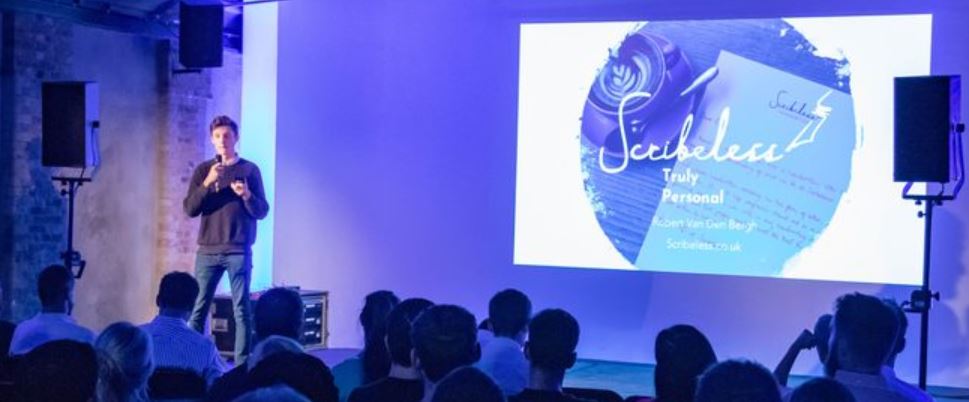
Robert Van Den Burgh is co-founder of The Handwriting Company, a startup that helps organisations better engage with their customers through the power of the handwritten letter. But, while the name suggests a gang of people scribbling away, the reality couldn’t be further from the truth.

“We’ve created technology that can mimic handwriting. It can then be printed at scale on a good quality office printer or on robotics based in our facility. So instead of an organisation hiring 100 people to handwrite notes and pay a huge amount of money, we can fully automate the process.”

Do your research first

As with most innovators, the idea was born out of a realisation that a solution was needed to fix a broken system.

Van Den Burgh was on a marketing internship two and a half years ago when his manager got him involved in a handwritten marketing campaign.

“I was the fool who took three weeks writing out all the letters,” he laughs. “But it was one of the most successful marketing campaigns they’d ever run.”

This prompted Van Den Burgh to research the market. He found about 30 companies offering a similar service, but they all had people writing letters by hand. “I could see that the economics behind it didn’t make sense and it just wasn’t efficient enough to make it an effective tool.”

I could see that the economics behind it didn’t make sense

Van Den Burgh joined forces with Alex Robinson, an AI engineer with a background in computer science. The two founded Scribeless, which has since been renamed The Handwriting Company.

Together they began a huge research piece to see if they could use technology to optimise and automate the process of handwriting using AI, algorithms and robotics. It took time, but they developed a programme that could learn someone’s handwriting at a level that was indiscernible from human writing.

They then equipped robots with classic fountain pens and ink that can even mimic the physics of pen pressure and variation and deliver thousands of letters in hours.

Taking a punt at entering The Pitch

The pair reached the stage where they had a rough idea of the market needs, technology and where they wanted to take the business, when a friend recommended that they enter The Pitch.

The pair reached the stage where they had a rough idea of the market needs, technology and where they wanted to take the business, when a friend recommended that they enter The Pitch.

“It was about this time last year. I thought we didn’t really stand a chance because we were still a very new company, but we gave it a go. We were lucky enough to get to the semi-final and then the final!”

I thought we didn’t really stand a chance because we were still a very new company

For Van Den Burgh, the day at the boot camp helped them to better understand how to articulate what they offer.

“The format of pitching is very short and sharp and about getting your main points across. We spent a day discussing our concept with the boot camp coaches. They gave us feedback to really help us understand how to better articulate our story, the problem and how we could help solve that problem.”

Staying ahead of their own game

It’s been a busy year for the company since then. The model has moved on from robotics to Advanced Printing Technology, which can print a handwritten note indiscernible from human handwriting. It’s helped them create handwriting campaigns at scale.

The company’s client base includes banks, churches, charities and corporate gifting companies across the UK, US and Germany. They’ve also established their place within the greetings card space. Things are looking healthy, but one of the biggest hurdles they still need to overcome is funding.

It’s really hard to do everything on a shoestring budget

“Until now we’ve been fully self-funded. It’s been really hard to do everything on a shoestring budget. It’s part of being a startup, but it has been a strain on resources – only having 10% of the funds you need is difficult.”

This has led The Handwriting Company to raise investment, with the aim of building the team and scaling into the US.

“We’re just about to close our investment round, with a mixture of angels and investment capitalists, so we’d like that to fund five or six new people across sales, tech and marketing to allow us to keep innovating and build a more scalable model.”

It’s important for Van Den Burgh to get more competitive and to “out-innovate” their own technology. His key objectives are to make sure they can deliver quickly and at an affordable rate. At the moment, it takes a couple of days for the software to mimic handwriting, but the aim for the near future is to get this working in real-time.

Original post can be viewed here

UWE Bristol secure new Knowledge Transfer Partnership with Reusaworld

Posted on

UWE Bristol Knowledge Transfer Partnership (KTP) team have secured another KTP with Reusaworld and the Centre for Machine Vision. The new KTP means that UWE Bristol now has 11 live KTPs. The KTP which is based in Gloucester will see innovative changes to the world of second hand books.

This KTP will be with Reuseabook, a part of Reusaworld.

Reuseabook was founded in 2008 by Rob Hollier and Ami Hollier with the following mission: NEVER to allow a single book to go to landfill.

Strong believers in conscientious capitalism, they wanted to create an earth-friendly sustainable business model while helping others. After much hard work what emerged was the Reuseaworld group: an award-winning, ethical, environmentally-friendly and technology-savvy enterprise that uses the internet to sell second-hand books worldwide.

Working with the Centre for Machine Vision, the aim of the 30 month KTP is to develop innovative machine vision techniques and deep learning methodologies to test the viability of data outputs of a 3D Book Vision System and its application to the book grading process. Ultimately, increasing the speed and quality of inbound book sorting, in-house data management and book cataloguing.

The UWE Lead for the KTP is Professor Lyndon Smith and the Academic Supervisor is Dr Abdul Farooq, who are both part of the Centre for Machine Vision at UWE Bristol. The Centre for Machine Vision is part of the Bristol Robotics Laboratory (BRL). They solve real-world practical computer vision problems. Their  particular excellence lies in three-dimensional reconstruction and surface inspection.

Innovate UK scored the proposal very highly (4th out of 60 applications) so congratulations to all involved!

This partnership received financial support from the Knowledge Transfer Partnerships programme (KTP).  KTP aims to help businesses to improve their competitiveness and productivity through the better use of knowledge, technology and skills that reside within the UK knowledge base.  This successful Knowledge Transfer Partnership project, funded by UK Research and Innovation through Innovate UK, is part of the government’s Industrial Strategy.

UWE developed Pee Power technology returns to Glastonbury Festival for fourth year

Posted on

Technology developed at UWE Bristol that converts urine into electricity is set to be showcased at Glastonbury Festival for a fourth year.

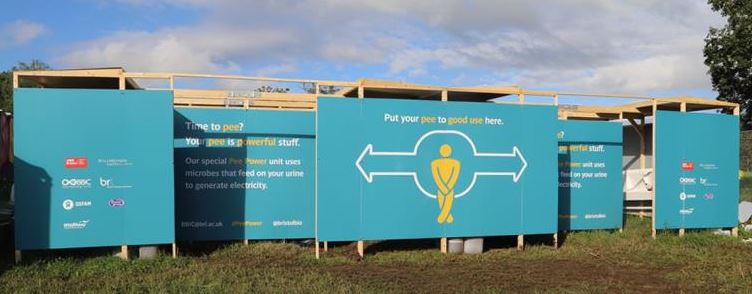
An installation of a large 40-person urinal will return to a prominent location near the Pyramid Stage to raise awareness of the system, which is being commercialised as announced last year and introduced to off-grid areas in the developing world.

The PEE POWER® system can turn organic matter such as urine into enough electricity to power lighting or charge mobile phones. At the same time, it sanitises urine and produces plant fertiliser as a natural by-product.

Energy produced at the event will power lighting in the urinal block at night, while a new feature ‘Pee to Play’ will see festival goers playing retro games on Game Boys powered by the system. Visitors can rate their PEE POWER experience via an electronic display and give survey feedback to academic staff available to explain how the technology works.

The PEE POWER urinals – among 5,500 toilets at the festival – have been a fixture at the event since 2015 and used by thousands of people each day. In previous years, they have powered information displays, and helped charge phones and provide urinal lighting.

Professor Ioannis Ieropoulos, Director of the Bristol BioEnergy Centre at Bristol Robotics Laboratory, said: “It’s a great pleasure to be welcomed back to this wonderful event for a fourth year and to be part of the festival’s environmentally-conscious sanitation campaign.

“There’s been much activity with our technology since our appearance in 2017, with the introduction of PEE POWER to schools in Uganda and Kenya supporting our aim to improve safety and sanitation in the world’s poorest communities including in refugee camps and slums. Our system is being refined and made more efficient, and for the first time we will be powering some of the applications directly, which means no batteries. We even hope to be generating surplus electricity, especially during the busiest times at the festival.

“As team of scientists, we’re hoping for greater interaction with the public this year and it’s the first time we’ll be recording public feedback on the system.”

Dr Xavier Walter, one of the main researchers in the team, added: “We hope our retro gaming exhibit will resonate with the audience and attract festivals goers to have a look at our technology and ask questions.”

Ahead of the festival, the microbial fuel cell technology will be demonstrated at a Family Day event at Heathrow Airport, where the system is being considered as part of a commitment from Heathrow and waterless urinal technology company WhiffAway to zero emissions and sustainability.

The team’s presence at Glastonbury is the result of a close collaboration with partners Oxfam, log cabin and garden building specialists Dunster House and WhiffAway in a collective effort to improve lives in refugee camps and areas of the world with no sanitation or electricity.

Chris Murphy, Owner and Managing Director of Dunster House, said: “It’s truly amazing what Ioannis Ieropoulos and his team have achieved over the past years. We feel proud and honoured to be part of this project every year since the earliest field trial back in 2015. From that single raised latrine placed outside the University, we are now providing a structure ready to accommodate up to 40 people. We’re glad to be back at Glastonbury 2019 collaborating in a life-changing project that can help people all around the world.”

James McLean, Group CEO of WhiffAway Group, said: “It’s an honour and a privilege to be combining our cutting edge technologies at this wonderful event. By putting our heads together we hope to continue making a difference to the wider community and help change the world for the better.”

The PEE POWER demonstration is the flagship research project of a formal partnership between Glastonbury Festival and UWE Bristol signed in 2017 focusing on sustainability projects including waste reduction and energy efficiency.

How PEE POWER® works

PEE POWER® is generated when microbial fuel cells (MFCs) work by employing live microbes which feed on urine (the fuel) for their own growth and maintenance. The MFC taps a portion of the biochemical energy used for microbial growth, and converts that directly into electricity or PEE POWER®. This green technology also cleans the urine so that the by product can be used as a crop fertiliser.

The Pee Power project is funded by the Bill & Melinda Gates Foundation. Originally appeared on the UWE website.

KTP Case Study: Gloucester Wildlife Trust

Posted on

The Knowledge Transfer Partnerships (KTP) scheme is a UK-wide programme helping businesses to improve competitiveness and productivity. A recent graduate is placed within an organisation to help solve a business problem, with access to our academic expertise.

The below case study is from our KTP with Gloucester Wildlife Trust:

Key Facts

  • Shortlisted for Best Knowledge Transfer Partnership Award at the KTP Best of the Best Awards 2019
  • Won the Sir Peter Hall Award for Wider Engagement in the Royal Town Planning Institute’s Research Excellence Awards in 2018
  • Delivery of the first ever green infrastructure benchmark, ‘Building with Nature’ (BwN)
  • BwN benchmarked new developments totaling over 30,000 homes
  • Publication of technical guidance documents and articles in trade publications
  • New subsidiary company created to monetise GWT’s expertise

KTP Benefits

KTP’s are designed to benefit everyone involved:

  • Businesses acquire new knowledge and expertise
  • KTP Associates gain business based experience and personal and professional development opportunities
  • Universities, colleges or research organisations bring their expertise and enhance the business relevance of their research and teaching

The Challenge

Recognising the challenge in delivering the green infrastructure policy alongside the need to build over 200,000 new homes every year, this KTP was designed to develop a commercially viable model to support the delivery of new homes without compromising the quality of the natural environment
and the well-being of citizens. Whilst GWT had a wealth of expertise in the green infrastructure agenda, they wanted to explore ways to enhance their influence on the quality of the built and natural environment.

The Company

Gloucester Wildlife Trust is the leading organisation working to protect wildlife, providing expertise in everything from wildlife advice to ecological consultancy. Gloucester Wildlife Trust manages 60 nature reserves in the South West, covering 1011 hectares of land.

GWT believes that “Nature has the power to enrich and improve our lives. We believe nature has much to offer us and holds the solution for many of the issues we are dealing with today. Making it more resilient has benefits not only for wildlife, but also for people, communities, businesses, planners, developers, health and social care services in the county. If we look after it, it will look after us.

Even when there is no obvious benefit to people, we will stand up for wildlife when key habitats and species are threatened. We will improve housing and commercial developments for wildlife using our Green Infrastructure Benchmark, Building with Nature.

By 2022 ten new developments will have achieved the Benchmark, our initiative to recognise developers who benefit wildlife in their planning.”

The Project

The KTP aimed to formalise GWT’s role in advising Local Authorities and the development sector on the impact of development on nature conservation. The project established a new benchmark for green infrastructure offering consistent technical information on key features, and a quality rating to incentivise and reward developers for high quality green infrastructure.

The KTP Associate Dr Gemma Jerome, supported by Professor Danni Sinnett, Director of the Centre for Sustainable Planning and Environments, collated evidence and expertise from researchers, planners, developers, built environment professionals and ecologists to create standards, technical guidance, implementation framework and award criteria. The “Building with Nature” (BwN) benchmark was piloted in several developments, including Gloucester Motorway Services and housing schemes, and with Local Authority policies. Building with Nature was launched in November 2017.

The KTP has had a transformational impact on GWT. It has triggered a complete turnaround in its approach to the built environment and the quality of its engagement with planners and developers. The Trust has morphed from being largely reactive to proactively engaging with the development community.

Additionally, BwN has been used in developments in Scotland, Cornwall, Devon, London and Hampshire, far beyond GWT’s own geographical area and the new BwN subsidiary company is currently working with numerous local authorities to develop green infrastructure planning policies.

“The KTP process has been transformative for our Company, creating products and services that support delivery of our core mission”

Roger Mortlock, CEO, Gloucester Wildlife Trust

Download the full case study here:

This partnership received financial support from the Knowledge Transfer Partnerships programme (KTP).  KTP aims to help businesses to improve their competitiveness and productivity through the better use of knowledge, technology and skills that reside within the UK knowledge base.  This successful Knowledge Transfer Partnership project, funded by UK Research and Innovation through Innovate UK, is part of the government’s Industrial Strategy.