The University has put together an exciting package of support to help businesses grow and recover through these uncertain times. This includes a £1m Digital Innovation Fund, support for business transformation, and the UWE Business Network.
UWE Bristol is committed to helping businesses navigate through the Covid-19 crisis and beyond.
The Digital Innovation Fund: UWE Bristol £1m Covid-19 Recovery Fund
£1m fund open to SME businesses in any sector within the Bristol, Bath & North East Somerset, North Somerset or South Gloucestershire region looking to find digital solutions and innovate in response to Covid-19.
Offers eligible businesses innovation grants from £10,000 to £40,000 to fund 35% of project costs.
Application Deadline: 8 July 2020. We will be announcing a 2nd round of funding soon.
Funding and support for small and large collaborative projects that help transform your business
Tailored advice and support to help develop collaborative projects and funding applications.
Leadership and management practices; innovative business models; research and implementation; and technology development.
UWE Business Network
Discounts on CPD courses
Regular funding and community updates
Innovation roundtables
Networking events
Pro Vice Chancellor for Research and Enterprise Martin Boddy commented: “UWE Bristol is delighted to open its Digital Innovation Fund, a £1m pot of grant funding to support businesses in the West of England to tackle new challenges caused by Covid-19.
Alongside this, SMEs can also access a suite of funding and support for collaborative projects of any size. Our experienced and dedicated Business Development Team can help businesses shape projects and develop applications.
We are also launching the UWE Business Network, providing access to regular updates and events across all of the University’s business facing activities.
In a time of unprecedented change, UWE Bristol is proud of the role it can play to support the region’s SMEs in responding to the pandemic and financial crisis.”
To find out more about the Digital Innovation Fund please see here. To find out more about everything else please see here.
The Digital Innovation Fund funded by the European Regional Development Fund.
Notes to editors:
European Regional Development Fund:
The project (has received) £1,900,000 of funding from the England European Regional Development Fund as part of the European Structural and Investment Funds Growth Programme 2014-2020. The Ministry of Housing, Communities and Local Government is the Managing Authority for European Regional Development Fund.
Established by the European Union, the European Regional Development Fund helps local areas stimulate their economic development by investing in projects which will support innovation, businesses, create jobs and local community regenerations. For more information visit https://www.gov.uk/european-growth-funding.
West of England region: All organisations with a presence in Bristol, Bath, BANES and South Gloucestershire.
In response to Covid-19, UWE Bristol is launching a Digital Innovation Fund to help businesses to innovate during these turbulent times.
UWE’s Digital Innovation Fund provides business support and £1m in grants for small and medium sized business in the West of England.
The scheme, funded by the European Regional Development Fund (ERDF), offers eligible businesses innovation grants from £10,000 to £40,000 to fund 35% of project costs.
Grants are open to businesses in any sector that want to innovate and address new challenges that have arisen from Covid-19. Applicants must be small or medium sized enterprises (SMEs) and based in Bristol, Bath & North East Somerset, North Somerset or South Gloucestershire.
Pro Vice Chancellor for Research and Enterprise Professor Martin Boddy commented: “UWE Bristol is delighted to open its Digital Innovation Fund, £1m of grant funding to support businesses in the West of England to address new challenges caused by Covid-19.
Any SME in the area that is undertaking a digital innovation or research and development project should consider applying. We are offering a sliding scale of grants, from £10k to £40k, so hopefully there is a funding option for a range of businesses – from start-ups and micro enterprises, to more established organisations. The application process is straightforward and UWE Bristol staff are available to provide hands-on support through a series of confidential 1:1 drop-in sessions.
Digital Innovation Fund follows on from previous successful grant funding schemes run by the University, which has given £2m of grants to thriving businesses in the West of England, creating over 150 new jobs and over 100 new products and services. We are looking forward to this new fund delivering similar benefits to the local economy, and helping individual SMEs to innovate and grow.
In a time of unprecedented change, UWE Bristol is proud of the role it can play to support the region’s SMEs in responding to the pandemic and financial crisis.”
Now is the time to innovate.
The Digital Innovation Fund is funded by the European Regional Development Fund.
Notes to editors:
European Regional Development Fund:
The project (has received) £4,230,000 of funding from the England European Regional Development Fund as part of the European Structural and Investment Funds Growth Programme 2014-2020. The Ministry of Housing, Communities and Local Government is the Managing Authority for European Regional Development Fund.
Established by the European Union, the European Regional Development Fund helps local areas stimulate their economic development by investing in projects which will support innovation, businesses, create jobs and local community regenerations. For more information visit https://www.gov.uk/european-growth-funding.
West of England region: All organisations with a presence in Bristol, Bath, BANES and South Gloucestershire.
The Department of Architecture and the Built Environment within FET at UWE Bristol have seen great success in a recently launched CPD course on an “Introduction to Zero Carbon Buildings” designed and delivered by Patrick O’Flynn (BEng, MSc, FHEA).
Looking to continue to grow their established presence in
this remit with the new Massive Open Online Course (MOOC), the course had over
750 applicants for the first iteration and drew a wide audience from the UK and
internationally.
Course Leader Patrick O’Flynn said “In
times of such change, we wanted to ensure as a department we could support
our industry to transition to a future that embraces Zero Carbon building
design. Through offering this MOOC, it allowed both established and early
career professionals an opportunity to develop their knowledge and engage with
us as a department.”
Attendees came from across the construction industry
including Architects, Building Services Engineers, Civil and Structural
Engineers, Surveyors and well as those in other roles.
Delivered virtually, the course gave an introduction to a
number of zero carbon factors including:
Building physics;
Renewable Energy & Green Technology;
Energy simulation
Human factors.
The course worked its way through the topic using weekly
online session, preparation reading and follow up exercises to embed knowledge.
The course worked its way through the topic using weekly online session,
preparation reading and follow up exercises to embed knowledge.
Delegates could catch up in an online café space to discuss
the topics covered further.
This course provided an opportunity as a taster session in a
range of topics which UWE provides further opportunities to study at a deeper
depth.
The next run for this course is confirmed for 12 June. Find out more about the course here.
UWE Bristol Knowledge Transfer Partnership (KTP) team have secured a new KTP with Harris Evolution, increasing the KTP portfolio to 13 live projects. The project will see Harris Evolution work with the UWE Bristol Business School (BBS).
The application, led by Ellen Parkes from UWE Bristol, was funded under Innovate UKs Management Knowledge Transfer Partnership (MKTP) scheme, which was announced in 2019 following a £25m pledge in funding over the next three years from BEIS (Department for Business, Energy and Industrial Strategy).
Based in Kingswood, Bristol, Harris Evolution is a commercial refurbishment company, specialising in quick turnaround projects carried out whilst the buildings are still in occupation. Harris’ work is targeted within three main sectors; Education, Healthcare and Hotel/Leisure.
The 24-month KTP project aims to implement transformational innovation through an Advanced Services approach to contract development and development of leadership capacity and will be led by Dr Kyle Alves , Dr Mel Smith and Professor Gareth Edwards (BBS). Through the collaboration with UWE, Harris will move from a standardised service offer to implementing outcome-based service contracts, tailored around individual customer value.
This partnership received financial support from the Knowledge Transfer Partnerships (KTP) programme. KTP aims to help businesses to improve their competitiveness and productivity through the better use of knowledge, technology and skills that reside within the UK knowledge base. This successful Knowledge Transfer Partnership project, funded by UK Research and Innovation through Innovate UK, is part of the government’s Industrial Strategy.
Callum Jenkins at The Big Pitch. Photo credit: Deliveroo
Launch Space resident Callum Jenkins has secured funding from Deliveroo after pitching his business idea to the company’s chief executive and founder.
Callum set up his own business ESNO Media, a commercial drone services company, in 2018 and has been based in
Launch Space, part of the University Enterprise Zone since June 2019. Callum has been working as a
courierfor food delivery service Deliveroo alongside running his own business.
Callum entered and was successful in securing funding from Deliveroo’s The Big Pitch, which enabled their
riders to pitch their business ideas in a Dragons Den style competition.
Callum’s winning pitch focused on providing future
Drone services in new sectors and combining this with new forms of technology
such as AI and IoT.
Callum commented that “The Big Pitch’s investment will be hugely beneficial, enabling me to
expand ESNO faster and develop our new concept.”
He says the Deliveroo
funding will help him invest in “cutting-edge”
software, take on specialists and utilise market-leading drones.
This, in turn, will
help generate new revenue and expand the business into a technology-based drone
company.
Callum also said how helpful being part of the Launch Space has been in terms of broadening his knowledge of technology, as a brilliant sounding board for his business and helped him towards his personal development as an entrepreneur.
Congratulations to Callum on this great achievement.
Located in the new £16m University Enterprise
Zone on Frenchay Campus, Launch Space provides physical incubator space and
enterprise support for graduate start-up businesses.
Launch Space will receive up to £2,000,000 of funding from the European Regional Development Fund (ERDF), as part of the European Structural and Investment Funds (ESIF) Growth Programme 2014-2020. The Ministry of Housing, Communities and Local Government (MHCLG) is the programme’s Managing Authority. Established by the European Union, the ERDF helps local areas stimulate their economic development by investing in projects that support innovation, businesses, job creation and local community regeneration.
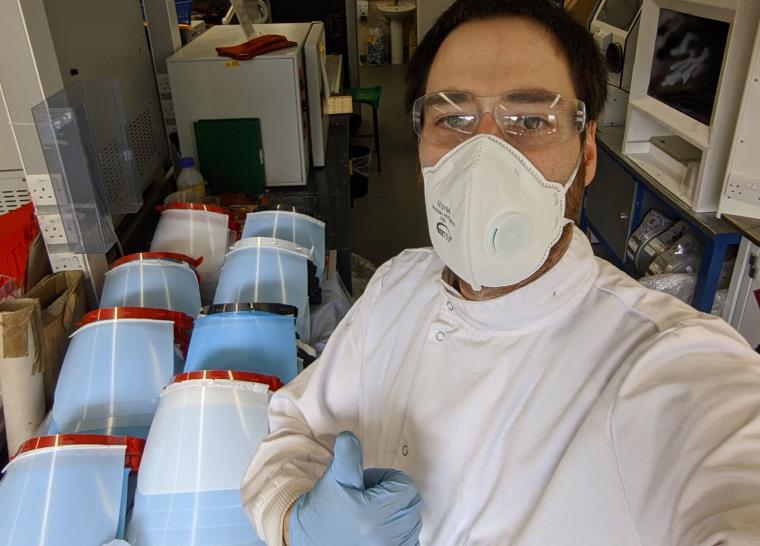
Technicians at Bristol Robotics Laboratory (BRL) are using laser cutting technology to produce protective visors for NHS staff during the coronavirus pandemic.
A team are manufacturing an initial batch of 200 for staff working at Avon and Wiltshire Mental Health Partnership (AWP) NHS Trust. They plan to expand production with the support of 3D printing facilities and technicians across three UWE Bristol faculties.
The cleanable visors are being created using an approved design by University College London. The team also plans to manufacture surgical mask straps, which help prevent masks rubbing against the ears of clinical staff.
Gareth Griffiths, a Senior Engineering Manager in BRL’s Robotics Innovation Facility (RIF), said: “The trust approached us asking if we could supply PPE and we were very happy to use our facilities and expertise to help with their request.
“The visors can be made very quickly, with the manufacture process taking about two-and-a-half minutes for each visor. They are made from smooth laser-cut plastic so they can be easily cleaned and reused if necessary.”
As a result of their expertise in Public Health, Emergency Medical Care, Knowledge Mobilisation, Maths and Computer Modelling, and other such related areas, a number of UWE researchers have been approached or volunteered in assisting with the country’s efforts to tackle Covid-19. A selection of these researchers can be found below. This is by no means an exhaustive list.
UWE Researchers and the Clinical Commissioning Groups
As part of UWE’s response to Covid-19,
researchers from UWE have been working with the local Clinical Commissioning
Groups (CCG) to provide evidence to support rapid decision making. The CCG are the people charged with making healthcare
decisions locally and they are currently grappling with things such as: what do
we need to do? where do we need to pool our resources? what types of treatment
are needed? how do we need to respond? The local CCG includes healthcare providers in Bristol, North Somerset and South
Gloucestershire.
Professor Nicki Walsh
Within the local CCG ‘cells’ have been established, acting as working groups purely in response to the impact that Covid-19 is having on current healthcare. Many issues have come up including: home monitoring of symptoms, impact on mental health and impact of healthcare workers’ absenteeism. These issues have come up as people look to manage problems most effectively and efficiently. The Clinical Effectiveness & Research Team at the CCG, along with Professor Nicki Walsh who works across UWE, the CCG and the Applied Research Collaborative (ARC-West) are working with the local commissioners to manage these requests. These important questions are then fed to the Applied Research Collaborative West team, who co-ordinate researchers from UWE and the University of Bristol, creating a rapid response team to retrieve and synthesise evidence, or provide other advice to support evaluation, healthcare modelling, statistics and economics.
The emphasis of this approach is the
rapid turnaround system. Most requests are processed within 48 hours from the point
of the CCG submitting a question, to the academic providing that support and
reporting back to the CCG. Nicki
is the overall co-ordinator
at UWE for all this because of her work across the different partner
organisations.
In place, there is now a
good pool of UWE and UoB researchers ready to respond to calls for assistance
as and when they come in. Nicki says the response from academics has been excellent
and hugely encouraging:
“This service requires academics to work in
such a different way. Because it’s quick and by necessity not as in depth as
traditional evidence reviews. Traditionally things can often progress quite
slowly, but it’s been a totally different response and things are getting
turned around quickly”.
Nicki explained in more
detail how resources were best pooled:
“All academics involved have suggested what
their skill set is so we have a really good idea who can do what. If it’s
something incredibly specific like health economics for example, there may only
be quite a small pool of people who can contribute to that. But for things like
evidence synthesis most academics are able respond to these requests. The
emphasis at the minute is ensuring that we’re able to provide good enough
evidence to help with decision making in a rapid responsive way.”
Nicki also suggested how
the work could benefit future collaborative research opportunities:
“I think it’s really innovative and supportive
to our NHS colleagues. It also potentially creates further questions that could
be researched later.”
The evidence syntheses are being regularly updated and are openly available here.
Professor Julie Mytton
Julie Mytton is a Professor of Child Health and a member
of HAS’s Centre for Health and Clinical Research. She has specialised in public
health research since 2006, with a particular interest in injuries and injury
prevention. She is also a qualified medic.
Julie is one of many other UWE academics working with the
Centre for Public Health and Wellbeing who are receiving calls for work from
the CCG (via Nicki Walsh). She has also been in contact with University
Hospitals Bristol NHS trust, and as a medic has joined their bank staff, providing
clinical care support as and when needed.
Julie also noted that there is a Public Health Registrar,
Alasdair Wood, based at UWE to offer further support.
Professor Jonathan Benger
Jonathan Benger, a Professor in Emergency Care
and a Consultant in Emergency
Medicine at the University Hospitals Bristol NHS Foundation Trust, has
been released from his current clinical and academic duties, at the request of
the National Medical Director, to assist in leading the national response to
Coronavirus in his role as interim Chief Medical Officer at NHS Digital.
Professor Jo Michell
Jo Michell is an Associate Professor in Economics. His
current research interests include macroeconomics, money and banking and income
distribution. As soon as the nationwide lockdown was announced, Jo co-wrote a paper
for the journal Autonomy outlining
how “in
orderto cope with the increasingly severe reduction in economic activity in
the UK, guaranteeing the incomes of all those who are eligible for in-work or
out-of-work benefits is rapidly becoming a necessary policy lever.”
This idea was picked up by
John McDonnell (the then Shadow Chancellor), and it’s possible it may have played
a role in influencing Rishi Sunak’s (the Chancellor) subsequent announcements. A
follow up letter by Jo and 97 other economists was penned to The Times, and published on Monday 23rd
March, “insisting that the government goes
significantly further in its economic response to the Covid-19 crisis.”
Professor Matthew Jones
Matthew Jones is Associate Professor in Public Health. His research specialises in the contribution that third sector and civil society initiatives make towards promoting public health and wellbeing. Mat and other colleagues in the Centre for Public Health and Wellbeing (CPHWB) have authored a report entitled Apart but not Alone: Neighbour Support and the Covid-10 Lockdown.
Carried out in Bristol and the West Country between 6th-12th April 2020, over 500 respondents reported back on neighbourhood initiatives during lockdown restrictions. A whole range have sprung up in recent weeks: social media support groups, food and medication collections, telephone calls, Zoom chats, leafleting. Interestingly, many neighbourhood groups were already in place before formal local/national efforts had been mobilised.
Of those who responded,
the overwhelming majority felt that neighbours were supporting each other well.
Mat Jones et.al did note however contrasting answers from those based in areas
of high social disadvantage, with an emphasis on such neighbours supporting
people with financial difficulties, those with disabilities or mobility issues,
and people without easy access to outdoor spaces.
Perhaps most noteworthy were the gender in-balance
responses (80% female):“an
important issue is whether the practical and emotional work of supporting
neighbours is falling disproportionately on women.”
Professor Sue Durbin
Sue Durbin is Professor in Human Resource
Management and is a member of the Centre for Employment Studies Research in
FBL. Sue has researched and written on gender and employment, specialising in
women who work in male dominated industries. She is a
co-founder, along with Airbus, the Royal Air Force and the Royal Aeronautical
Society, of the altamentoring scheme, a bespoke industry-wide mentoring
programme designed for women/by women. Mentors and mentees can connect to this mentoring
platform online or in person.
It is within the context of Covid-19 that alta can be seen to play a crucial role,
with existing and new members utilising its online tool. Indeed, the value of
online mentoring has never been so important, as Sue explains:
“It may become a time for mentors and mentees to
take stock of where they are in their careers and where they would like to go.
“Mentors
can therefore best be utilised via the alta platform, at a safe distance but
offering comfort and advice to women who may be feeling especially isolated,
vulnerable or lacking confidence if their roles have been furloughed. Or they
may simply want to reach out and turn the current situation into a more
positive one.
“During the current pandemic, the restrictions on movement and new ways
of working remotely have resulted in a physical disconnect from family, friends
and colleagues. For those who already have an established mentoring
relationship, this can be a crucial source of support, facilitating an
opportunity for both mentor and mentee to discuss concerns and keep connected
during this unprecedented time.”
Based in Bristol, Powerline Technologies Ltd deliver next generation Smart Grid distribution automation solutions to utilities and Distribution Systems/Network Operators (DSO/DNO) worldwide. Since starting in June 2019, the Knowledge Transfer Partnership with UWE Bristol has been working to create a novel simulator of electrical distribution assets for Smart Grid application development.
Minh Trang has been leading the project as the KTP Associate.
We spoke to Trang, 9 months into the project to find out how she has found the
KTP so far:
How long have you
been a KTP Associate?
I started the role in June 2019 so I’ve almost been in the post
for a year.
What attracted you to
the KTP role?
I came from a PhD and what I liked about the KTP was the
possibility of continuing to manage my own project whilst working for a local
company with the potential to be employed with the company on completion. The
KTP also offers great opportunities for continuing professional development
alongside the project via the £4,000 development budget.
How is the
partnership between UWE and the company working?
It’s been working really well. I’ve been learning a lot from
UWE Power Systems Research Laboratory about algorithms and methods for
analysing and driving the project and Powerline Technologies have been
supporting me with the practical knowledge for running the project more
efficiently.
What are the current
challenges of your role?
The challenges have mostly been technical, ensuring the
correct application of data, getting used to new software packages and
determining the most effective models for the project. However, I have been
supported by my company and academic supervisors throughout all of this, which
I’m really grateful for.
What do you enjoy
most about your job?
It would have to be the experience that I’m gaining in managing
a challenging, real-life project, which I think is a vitally important skill for
my future career plans.
What do you think about
the support available from UWE and the Company?
It’s been great, my Academic Supervisor (Hassan Nouri) is
really knowledgeable and has deepened my understanding of the field. I also
feel really engaged with the team at Powerline and enjoy being part of their
working environment.
To find out more about the Knowledge Transfer Partnership opportunities at UWE, visit our website
Knowledge Transfer Partnerships (KTPs) are funded by UKRI through Innovate UK with the support of co-funders, including the Scottish Funding Council, Welsh Government, Invest Northern Ireland, Defra and BEIS. Innovate UK manages the KTP programme and facilitates its delivery through a range of partners including the Knowledge Transfer Network (KTN), Knowledge Bases and Businesses. Each partner plays a specific role in the support and delivery of the programme.
The Grants 4 Growth programme (G4G) is an initiative which
helps to fund projects worth up to £10,000 for businesses looking to
collaborate with UWE Bristol researchers and access research facilities. It is
a joint application process between the business and the academic staff at UWE
Bristol.
The funding is available explicitly for projects that will
help lead to deeper university-business collaboration, as it is sourced from
the Government’s Industrial Strategy. Follow on projects could include
Knowledge Transfer Partnerships (KTPs) and InnovateUK collaborative R&D
calls.
Andy Ben-Dyke from LuJam Cyber talks about his experience
with the scheme below:
The UWE project was a
major milestone for LuJam Cyber. From a LuJam perspective, the work clearly
identified issues with our approach to protecting small to medium sized
business and helped us to pivot our solution to significantly better protect
our customers. This has helped us stay in business and, in fact, thrive. I cannot overstate how important this was for
our company.
The UWE work was
carried out in a timely and professional manner, and it was a pleasure to work
with the team. The approach taken throughout
the project was innovative and far exceeded what we could have achieved
in-house. We’d strongly recommend this
type of collaboration to other companies
This is an open call, therefore applications can be made to
this funding all year round. However the decision making panel will review
applications 4 times a year, so it is advisable to be aware of those timescales
when liaising with the business you hope to work with. Completed applications
should be sent 2 weeks before the decision panel meet.
If you’d like to find out more or would like help to be
paired up with an academic, get in touch today Grants4Growth@uwe.ac.uk
In January, the Research Impact team hosted a two day writing retreat for selected academics from UWE Bristol.
The retreat was the last one in a series of away days that have taken place since last June for the different faculties at UWE Bristol.
The two-day retreats allow academics to think about their research case studies away from campus enabling them the opportunity to fine tune and edit their work.
The impact team helps the academics to fine tune their work so that it is in a good position to submit for the Research Excellence Framework 2021.
All four retreats have been extremely well received, with glowing feedback from attendees:
“Very many thanks for organising and initiating for us such a brilliant retreat. It has made a huge difference to me – I would never have made this progress without it!” Participant A
“The experience has been really excellent (and I know others have said the same). The structure, information, advice, hospitality and good humour that the RBI team provided was exceptional. As a result it was possible – in bite-sized chunks – to get tuned into the specifics of what was needed and then review and revise the case study material as well as getting critical feedback on it in near real-time.” Participant B
“I found the structure and flow of activities well-structured and relaxed, which is exactly what was needed to get us talking to each other and working on our case studies. Thank you for not ‘forcing’ us into unnecessary “workshop standard” activities, which usually involve flip-charts, felt-tip pens and post-it notes! This is an element I’m always dreading in mandatory workshops/seminars and not having it, is what made me feel more comfortable and got me concentrating on the task at hand.” Participant C
Read some of UWE Bristol’s Research with Impact Case Studies here