Knowledge Transfer Partnerships: Agsenze Associate Spotlight

Posted on

(L-R) April Coombes (UWE), Professor Melvyn Smith (UWE), Dr Gytis Bernotas (UWE), Dr Mark Hansen (UWE), Geraint Jones (Innovate UK), James Theobald (Agsenze) pictured at the Agri-EPI Centre in Shepton Mallet.

Since April 2019, UWE have been collaborating on a Knowledge Transfer Partnership with Agsenze, a company focused on developing smart technology within agriculture. The two-year project intends to realise the functionality of a system for improved dairy herd management using novel animal monitoring technology.

We spoke to Gytis Bernotas, who obtained his BEng and PhD from UWE, and is now leading the project as the KTP Associate.

How long have you been a KTP Associate?

I started in April 2019, so almost a year.

What attracted you to the KTP role?

I was drawn to a KTP because of the opportunity to work with a company and university. It’s a very rewarding setup because you experience state-of-the-art research being immediately realised in real-world scenarios, rather than be hidden in the desk drawer.

How is the partnership between UWE and the company working?

The partnership is working very well. We are circulating the best thoughts and ideas from experts in academia and people from the business world. The company is benefitting from the expertise and novelty, while the university receives publicity and recognition with academic journal publications.

What are the current challenges of your role?

The biggest challenge is time! I’m working for a start-up company trying to establish itself in a market niche in a timely manner.

What do you enjoy most about your job?

I really enjoy the problem solving, but most importantly I really believe in the product and how it will revolutionise cattle welfare and, hopefully, other livestock in the future.

What do you think about the support available from UWE and the Company?

I get great support from the company, my academic supervisors and the UWE KTP Team. The KTP Team are always on hand to provide advice and project support. My supervisors provide opportunities and support to research different ideas that have potential for Agsenze’s business model, such as the developing tool positioning or its hardware alterations.

Knowledge Transfer Partnerships: B-hive Innovations Associate Spotlight

Posted on

Photo: (L-R) Dr Robin Thorn (UWE), Barbara Dos Santos Correia (UWE), Mark Wilcox (Branston Ltd), Vee Gururajan (B-hive Innovations)

Based in Lincoln, our Knowledge Transfer Partnership with B-hive Innovations is our longest distance project. Despite this the project, which is now halfway through its two years, continues to move from strength to strength led by our KTP Associate Barbara dos Santos Correia.

This ground breaking KTP is investigating gases emitted by fresh produce and aims to develop a marketable solution for early detection of internal defects, which will ultimately improve crop utilisation and reduce food waste. We caught up with Barbara to find out how she has found the experience so far.

How long have you been a KTP Associate?

I started in January 2019.

What attracted you to the KTP role?

I was fascinated by the project and the option to work in industry with all the academic support. Having access to a £4,000 personal development budget is also great.

How is the partnership between UWE and the company working?

It’s working very well, and I think that’s down to the constant and open communication across the team. The benefits of this knowledge transfer are clear, both between B-hive Innovations and UWE and the knowledge and experience I am gaining.

What are the current challenges of your role?

I’d say the main challenge is translating complex academic knowledge into an industrial solution. But my supervisors Dr Robin Thorn and Professor Darren Reynolds at UWE and Vee Gururajan and Claudia Celemin Pardo at the company are really supportive and we tackle the challenges together.

What do you enjoy most about your job?

No two days are the same! It’s really motivating to know that every day I am leading a project that will potentially solve a real and significant industrial problem.

What do you think about the support available from UWE and the Company?

The support I have from UWE and B-hive Innovations is incredible and so much better than I was expecting in my first industrial experience. UWE offers a wide range of expertise and facilities and B-hive Innovations provides the invaluable personnel and confidential information. I feel like the partnership really represents a competitive advantage within the industry.

To find out more about the Knowledge Transfer Partnership opportunities at UWE, visit our website


Knowledge Transfer Partnerships (KTPs) are funded by UKRI through Innovate UK with the support of co-funders, including the Scottish Funding Council, Welsh Government, Invest Northern Ireland, Defra and BEIS. Innovate UK manages the KTP programme and facilitates its delivery through a range of partners including the Knowledge Transfer Network (KTN), Knowledge Bases and Businesses. Each partner plays a specific role in the support and delivery of the programme. 


What is a Knowledge Transfer Partnership?

Posted on

Knowledge Transfer Partnerships have been helping UK businesses innovate and grow for over 40 years and are one of a range of funding initiatives made available through Innovate UK (the UK government’s Innovation Agency).  

Linking businesses with an academic or research organisation and a graduate, a KTP enables a business to bring in new skills and the latest academic thinking to deliver a specific, strategic innovation project through a knowledge-based partnership.

The academic or research organisation partner will help to recruit a suitable graduate, known as an Associate. They will act as the employer of the graduate, who then works at the company for the duration of the project.

A short video explaining Knowledge Transfer Partnerships and the benefits they could have for your business

The scheme can last between 12 and 36 months, depending on what the project is and the needs of the business.

All of the knowledge gained during this time is embedded in the business, providing a valuable base to build on long after the project has finished. (A very high percentage of Associates are retained as employees, demonstrating the value they bring to the business).

Knowledge Transfer Partnerships can benefit businesses of any size and in any sector looking to address a core strategic challenge.

For more information or to view case studies please visit the Government webpages on KTPs.

Knowledge Transfer Partnership news:

Management KTP (MKTP) – Innovate UK have announced there is additional funding available for Management KTPs. The focus is to increase management skills and embed management strategies into your business. For more information visit our website or contact us on KTP@uwe.ac.uk

KTN have launched a new website, where you can discover more about KTP and potential associate vacancies as well as access the latest information on the Management KTPs

Knowledge Transfer Partnerships: Craven Dunnill Jackfield Associate Spotlight

Posted on

[Photo (L-R): David Huson (UWE), Richard Lamb (Innovate UK), Jed Leonard-Hammerman (UWE), Dr Russ Bromley (Knowledge Transfer Network]

UWE Bristol are currently working on a twenty-seven month Knowledge Transfer Partnership (KTP) with Craven Dunnill Jackfield. Founded in 1872, Craven Dunnill Jackfield (CDJ) has since produced ceramic wall and floor tiles in the oldest surviving purpose-built tile factory in the world, based in Ironbridge.

The KTP will introduce a range of 3D digital fabrication technologies to innovate the design and modelling process for specialist ceramic tile production and architectural restorations. We spoke to Jed Leonard-Hammerman, who is the KTP Associate leading the project:

What attracted you to the KTP role?

Lots of things, but mostly the opportunity to work with a university whilst gaining paid experience with a company.

How is the partnership between UWE and the company working?

Really well! We meet monthly to discuss progress and I spend most of my time at the Company but visit UWE about once a month to use the facilities and catch up with my Supervisor. It’s great working alongside and learning from the experts at both UWE and Craven Dunnill Jackfield.

What are the current challenges of your role?

Implementing ideas that have never been tested is quite daunting but also really exciting!

What do you enjoy most about your job?

I love managing the project, having the freedom to direct it and plan how my time is spent as well as the budget. I get to visit a lot of trade shows and exhibitions and enjoy speaking to industry representatives about applying their technology to the ceramics industry.

What do you think about the support available from UWE and the Company?

It’s great! My project is split into three elements (3D printing and CAD/ceramics/finance and project management) and I get all the support I need from my Academic Supervisor, the team at CDJ and the KTP Team at UWE. I’ve also had a lot of extra support from the Centre for Fine Print Research at UWE, particularly Walter Guy who has given up his time to show me how to use technical equipment. 

To find out more about the Knowledge Transfer Partnership opportunities at UWE, visit our website

Knowledge Transfer Partnerships: ExtraCare Associate Spotlight

Posted on

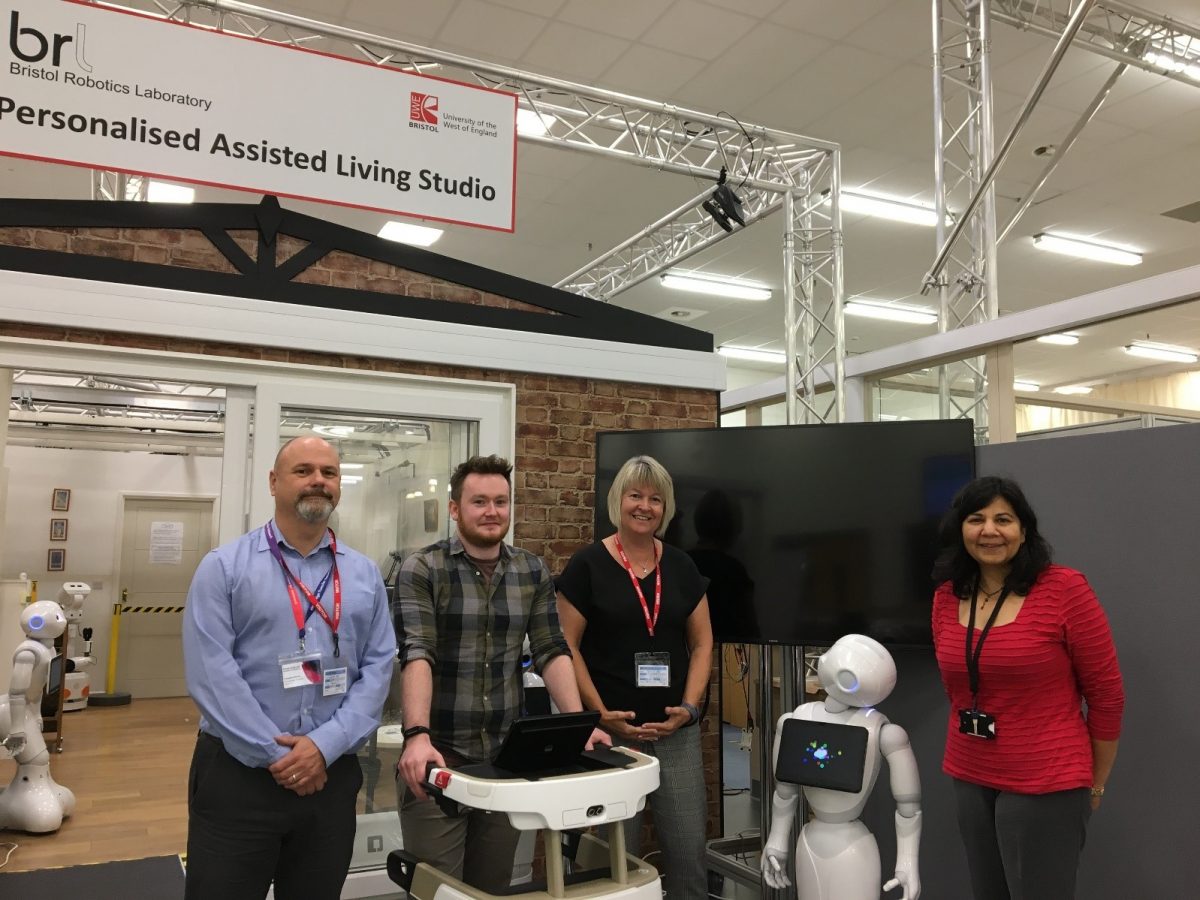
[Photo L-R: Dr Geraint Jones (Innovate UK), Alex Sleat (UWE Bristol), Shirley Hall (ExtraCare), Professor Praminda Caleb-Solly (UWE Bristol) attending the quarterly review meeting at Bristol Robotics Lab]

UWE Bristol has been working on a Knowledge Transfer Partnership (KTP) with ExtraCare Charitable Trust. Based in Coventry, with a village in Stoke Gifford, ExtraCare runs retirement villages and housing developments and currently has almost 4,000 homes available for older people.

This KTP aims to develop expertise in smart living technologies, such as intelligent sensing and socially assistive robots. The project aims to explore what technologies are capable of improving service provision, increasing productivity, generating revenue and upskilling staff. We spoke with Alex Sleat who has been leading the project as the KTP Associate:

What attracted you to the KTP role?

I’ve been a researcher in academia for some time, so it was interesting for me to get to see lab research being utilised in the outside environment. The KTP partnership between UWE and ExtraCare is a great opportunity for this.

How is the partnership between UWE and Extracare working?

The partnership is going well, there’s a good level of communication between the two partners, and a lot of additional activity towards finding opportunities for future collaboration.

What are the current challenges of your role?

The main reoccurring challenge is finding technology that fits into people’s lifestyles, trying to figure out how technology will work for an individual and then conducting research around their busy schedules and in their own homes. Getting people to try new technology is always tricky, so it’s important that explanations are simple and the technology is bespoke enough to prove beneficial.

What do you enjoy most about your job?

Sometimes it’s obvious to see the positive effects of new technologies. Often technology that might have been overlooked, because it’s not directly designed for a purpose, has a huge impact and allows people to improve their day-to-day lives, wellbeing, health and independence. I spend a lot of time inside the retirement village, so have enjoyed getting to know the residents and watching the community grow.

What do you think about the support available from UWE and the Company?

Both UWE and ExtraCare have made me feel part of the group, and support and guidance from both sides has been tremendous when I’ve needed it.

To find out more about the Knowledge Transfer Partnership opportunities at UWE, visit our website

UWE Bristol appoints Sarah White as new Knowledge Transfer Partnership Manager

Posted on

UWE Bristol have appointed Sarah White as the new Knowledge Transfer Partnership Manager (KTP) within the Research, Business and Innovation Team.

Sarah has lived and worked in Bristol for over 30 years. She brings a wealth of knowledge of delivering projects, most recently with the NHS and pharmaceutical companies to jointly deliver service improvement schemes in hospitals.

Sarah commented, “The opportunity to work in Knowledge Transfer came up at UWE and I jumped at it, as it represents the very best of collaborative and innovative working across the public and private sectors. It is exciting to have joined a dynamic and diverse team that deliver excellent results”

Tracey John, Director of Research Business and Innovation at UWE Bristol commented, “We are delighted to have Sarah on board with us to manage our KTP office. She has already made a huge impact on the team and has helped us to secure another KTP with Reusabook, bringing our number of KTP’s to 11. We have ambitious plans to double this number over the coming year and I look forward to seeing how Sarah and the RBI team can work with all our faculties and with businesses in the region to achieve this.”

The KTP scheme helps businesses in the UK to innovate and grow. It does this by linking them with an academic or research organisation and a graduate.

A KTP enables a business to bring in new skills and the latest academic thinking to deliver a specific, strategic innovation project through a knowledge-based partnership. Find out more here.

Sarah has replaced Clare Rowson who retired in March after 20+ years at UWE.

KTP Case Study: Viper Innovations

Posted on

The Company

Since their foundation in 2007, Viper Innovations Ltd have provided innovative technology solutions within the oil and gas sector. Their technology-leading product, CableGuardian®, can monitor and identify the location of faults along cables and has helped Viper win several awards (2018 PwC SW Business of the Year, Queens Award for Enterprise, IET 2018 Intelligent Systems Innovation Award). Viper set out to transfer this success to new industry sectors, specifically rail, and sought collaboration with the University of the West of England (UWE) to innovate their market engagement models.

The Challenge

Viper recognised its technology had potential for sectors outside of subsea oil and gas, and a new opportunity in rail highlighted the need for a new market engagement model for the company.

Utilising the expertise from UWE, the project tackled the challenge of gaining visibility and credibility within the rail sector. UWE transferred the necessary knowledge to implement a sales and marketing plan for their CableGuardian product. Furthermore, through workshops and training sessions, staff at Viper Innovations were taught innovative methods, to secure future growth in various sectors both within the UK and globally.

“We would like to thank our Academic Partners at UWE for their invaluable contribution and dedication to this project. The KTP has proven to be an excellent vehicle for transferring and embedding a level of knowledge and understanding to the business”

Max Nodder, Business Development Director at Viper Innovations 

The Project

Fundamentally, the work of the team and knowledge exchange from UWE clarified the companies’ diversification strategy and, as a result, its future growth opportunity. Through extensive research of 29 market sectors across 18 countries, the project identified methods to optimise the CableGuardian routes to market. Furthermore, by taking a step change in its approach to product development, Viper now works a lot more closely with partners and stakeholders, which has ensured alignment to the needs of their clients, reduced development costs and time to market.

The Associate working on the project brought outstanding marketing skills and experience, and her proactive approach fuelled the success of the project. The KTP provided an opportunity for the Associate to conduct global research and produce journal articles which aided in her recruitment to an Associate Lecturer role at UWE.

Key Facts

  • Provided Viper’s employees with the knowledge to commercialise their technology in different markets
  • Led to collaborative testing with Network Rail
  • Established global visibility and brought an invitation to the Trade Mission to Malaysia, Singapore and Australia as well as leads from key organisations within the rail sector (AMEY, East West Rail, Alliance, Siemens, Alstom)

This partnership received financial support from the Knowledge Transfer Partnerships programme (KTP).  KTP aims to help businesses to improve their competitiveness and productivity through the better use of knowledge, technology and skills that reside within the UK knowledge base.  This successful Knowledge Transfer Partnership project, funded by UK Research and Innovation through Innovate UK, is part of the government’s Industrial Strategy.


UWE Bristol secure new Knowledge Transfer Partnership with Reusaworld

Posted on

UWE Bristol Knowledge Transfer Partnership (KTP) team have secured another KTP with Reusaworld and the Centre for Machine Vision. The new KTP means that UWE Bristol now has 11 live KTPs. The KTP which is based in Gloucester will see innovative changes to the world of second hand books.

This KTP will be with Reuseabook, a part of Reusaworld.

Reuseabook was founded in 2008 by Rob Hollier and Ami Hollier with the following mission: NEVER to allow a single book to go to landfill.

Strong believers in conscientious capitalism, they wanted to create an earth-friendly sustainable business model while helping others. After much hard work what emerged was the Reuseaworld group: an award-winning, ethical, environmentally-friendly and technology-savvy enterprise that uses the internet to sell second-hand books worldwide.

Working with the Centre for Machine Vision, the aim of the 30 month KTP is to develop innovative machine vision techniques and deep learning methodologies to test the viability of data outputs of a 3D Book Vision System and its application to the book grading process. Ultimately, increasing the speed and quality of inbound book sorting, in-house data management and book cataloguing.

The UWE Lead for the KTP is Professor Lyndon Smith and the Academic Supervisor is Dr Abdul Farooq, who are both part of the Centre for Machine Vision at UWE Bristol. The Centre for Machine Vision is part of the Bristol Robotics Laboratory (BRL). They solve real-world practical computer vision problems. Their  particular excellence lies in three-dimensional reconstruction and surface inspection.

Innovate UK scored the proposal very highly (4th out of 60 applications) so congratulations to all involved!

This partnership received financial support from the Knowledge Transfer Partnerships programme (KTP).  KTP aims to help businesses to improve their competitiveness and productivity through the better use of knowledge, technology and skills that reside within the UK knowledge base.  This successful Knowledge Transfer Partnership project, funded by UK Research and Innovation through Innovate UK, is part of the government’s Industrial Strategy.

KTP Case Study: Gloucester Wildlife Trust

Posted on

The Knowledge Transfer Partnerships (KTP) scheme is a UK-wide programme helping businesses to improve competitiveness and productivity. A recent graduate is placed within an organisation to help solve a business problem, with access to our academic expertise.

The below case study is from our KTP with Gloucester Wildlife Trust:

Key Facts

  • Shortlisted for Best Knowledge Transfer Partnership Award at the KTP Best of the Best Awards 2019
  • Won the Sir Peter Hall Award for Wider Engagement in the Royal Town Planning Institute’s Research Excellence Awards in 2018
  • Delivery of the first ever green infrastructure benchmark, ‘Building with Nature’ (BwN)
  • BwN benchmarked new developments totaling over 30,000 homes
  • Publication of technical guidance documents and articles in trade publications
  • New subsidiary company created to monetise GWT’s expertise

KTP Benefits

KTP’s are designed to benefit everyone involved:

  • Businesses acquire new knowledge and expertise
  • KTP Associates gain business based experience and personal and professional development opportunities
  • Universities, colleges or research organisations bring their expertise and enhance the business relevance of their research and teaching

The Challenge

Recognising the challenge in delivering the green infrastructure policy alongside the need to build over 200,000 new homes every year, this KTP was designed to develop a commercially viable model to support the delivery of new homes without compromising the quality of the natural environment
and the well-being of citizens. Whilst GWT had a wealth of expertise in the green infrastructure agenda, they wanted to explore ways to enhance their influence on the quality of the built and natural environment.

The Company

Gloucester Wildlife Trust is the leading organisation working to protect wildlife, providing expertise in everything from wildlife advice to ecological consultancy. Gloucester Wildlife Trust manages 60 nature reserves in the South West, covering 1011 hectares of land.

GWT believes that “Nature has the power to enrich and improve our lives. We believe nature has much to offer us and holds the solution for many of the issues we are dealing with today. Making it more resilient has benefits not only for wildlife, but also for people, communities, businesses, planners, developers, health and social care services in the county. If we look after it, it will look after us.

Even when there is no obvious benefit to people, we will stand up for wildlife when key habitats and species are threatened. We will improve housing and commercial developments for wildlife using our Green Infrastructure Benchmark, Building with Nature.

By 2022 ten new developments will have achieved the Benchmark, our initiative to recognise developers who benefit wildlife in their planning.”

The Project

The KTP aimed to formalise GWT’s role in advising Local Authorities and the development sector on the impact of development on nature conservation. The project established a new benchmark for green infrastructure offering consistent technical information on key features, and a quality rating to incentivise and reward developers for high quality green infrastructure.

The KTP Associate Dr Gemma Jerome, supported by Professor Danni Sinnett, Director of the Centre for Sustainable Planning and Environments, collated evidence and expertise from researchers, planners, developers, built environment professionals and ecologists to create standards, technical guidance, implementation framework and award criteria. The “Building with Nature” (BwN) benchmark was piloted in several developments, including Gloucester Motorway Services and housing schemes, and with Local Authority policies. Building with Nature was launched in November 2017.

The KTP has had a transformational impact on GWT. It has triggered a complete turnaround in its approach to the built environment and the quality of its engagement with planners and developers. The Trust has morphed from being largely reactive to proactively engaging with the development community.

Additionally, BwN has been used in developments in Scotland, Cornwall, Devon, London and Hampshire, far beyond GWT’s own geographical area and the new BwN subsidiary company is currently working with numerous local authorities to develop green infrastructure planning policies.

“The KTP process has been transformative for our Company, creating products and services that support delivery of our core mission”

Roger Mortlock, CEO, Gloucester Wildlife Trust

Download the full case study here:

This partnership received financial support from the Knowledge Transfer Partnerships programme (KTP).  KTP aims to help businesses to improve their competitiveness and productivity through the better use of knowledge, technology and skills that reside within the UK knowledge base.  This successful Knowledge Transfer Partnership project, funded by UK Research and Innovation through Innovate UK, is part of the government’s Industrial Strategy.

KTP Case Study: Burleigh Pottery

Posted on

This partnership received financial support from the Knowledge Transfer Partnerships programme (KTP).  KTP aims to help businesses to improve their competitiveness and productivity through the better use of knowledge, technology and skills that reside within the UK knowledge base.  This successful Knowledge Transfer Partnership project, funded by UK Research and Innovation through Innovate UK, is part of the government’s Industrial Strategy.

Back to top