

Dr Maurizio Sibilla and Dr Ghada Karaki
Look around your city. Almost every building you see was designed for an energy world that is rapidly becoming outdated — one powered by fossil fuels, centralised power stations, and passive consumption. What if those same buildings could instead produce, share and manage clean energy?
We are living through a shift in how we think about energy – one that goes far beyond simply swapping fossil fuels for renewables. Three powerful forces will shape the future of our energy systems: decarbonisation, decentralisation, and digitalisation. But here’s the challenge: these forces must take root in cities that were never designed for them. Our urban landscapes are shaped by centuries of physical developments, buildings are renovated far too slowly, and the old ways of producing, distributing, and consuming energy remain deeply entrenched.
An innovative strand of work at CABER sits at the heart of this tension. It explores how cleaner, smarter and more localised energy systems can be integrated into our existing cities, transforming buildings and neighbourhoods from passive consumers into active participants in a sustainable energy future.
The shift – one building at the time isn’t enough
One building can save energy; a whole block (i.e., an aggregation of buildings) can begin to transform the energy system around it. This is why working one building at a time is no longer enough. Across Europe, three out of four buildings predate modern energy standards, yet the annual renovation rate remains barely 1%.. In England alone, more than half of homes still have an energy-efficiency rating of D or below, while fewer than one in 300 has reached the highest rating. The Climate Change Committee and the United Nations have both warned that the building sector is falling dangerously behind on our climate commitments.
The problem is not just speed – it is scale.
Neighbouring buildings have very different strengths and weaknesses: one may have a large sunny roof ideal for solar panels, another may be shaded or constrained by age, form or heritage protections. If we treat them separately, these differences become barriers. If we work at the block scale, they become opportunities.
A Positive Energy Block is a group of at least three connected buildings that together produce more energy than they consume.
Positive Energy Block allows energy demand, retrofit measures, solar generation, and future energy sharing to be planned as part of one local system, where one building’s surplus can compensate for a neighbour’s limitations. Blocks offer a practical middle ground: larger than a single building that lacks an infrastructural vision, faster and more flexible than the years of planning and investment that whole-district transformation demands.
Thus, Positive Energy Block brings together the technical and socio-economic changes we need for a low-carbon society. Instead of pouring money into ever-larger, centralised infrastructure, it focuses investment on micro-scale, neighbourhood-level solutions. In doing so, it links decarbonisation with renovation of existing buildings and the creation of new local energy market
models (i.e., peer-to-peer energy trading) – turning blocks of buildings and communities into active participants in the energy transition.
Stakeholders’ perceptions
Through the AHRC Impact Acceleration Account 26-27, between July and September 2026, we engaged a diverse group of stakeholders in a knowledge-exchange process. This enabled us to explore the relationships between their current activities and the potential applications of the proposed model and vision.
The stakeholder group included construction professionals, specialists in building and energy retrofitting, community energy practitioners, local authority representatives, and architectural and planning practices. We invited participants to reflect on the relevance, applicability, and potential value of the proposed approach. In particular, we asked questions such as:
· What is your initial reaction to the idea of building blocks?
· In which contexts or situations do you think the Positive Energy Block concept would be most relevant or valuable?
The concept of the Positive Energy Block was very well received and considered particularly applicable to the low- and medium-density contexts characteristic of villages across the United Kingdom. Stakeholders also recognised its potential to support locally responsive approaches to energy generation, efficiency, retrofit, and community resilience in these settings. This engagement provided valuable insights into how the model might be interpreted, adapted, and implemented across different professional and institutional contexts.
Scaling Positive Energy Blocks
As a part of the AHRC Impact Acceleration Account project, the next step will be to involve these stakeholders in a workshop to be held at the Design West in Bristol (TBC) by February 2027. The session will provide an opportunity to share our research on the methods and tools required to implement the Positive Energy Block model in practice, while also gathering stakeholders feedback on its potential applications and development.
We will present the prospective capabilities of an AI-powered energy planning tool for Positive Energy Block. This represents a new strand of research being developed through collaboration between CABER and UWE’s Machine Vision research centre.
The workshop will test whether the tool addresses real professional and policy needs, identify barriers to implementation, and shape its future development around the experience of practitioners and other stakeholders. In doing so, It strengthens the pathway from research and innovation to practical action in energy planning, building retrofit and positive-energy urban development, helping move Positive Energy Block from an ambitious concept towards a workable model for existing communities.
Positive Energy Block Pathway. The diagram illustrates a three-step process: assessing each building’s solar access, solar potential, and energy-efficiency gap; establishing and testing a shared energy target; and coordinating buildings aggregations to generate and share renewable energy as a positive energy block. (AI-generated image, adapted by M. Sibilla).
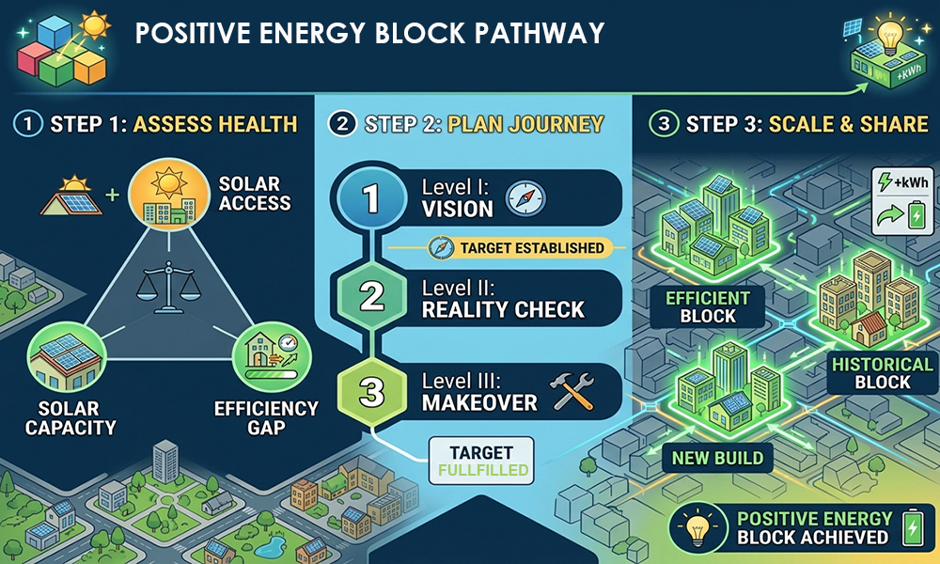
Positive Energy Block Pathway. The diagram illustrates a three-step process: assessing each building’s solar access, solar potential, and energy-efficiency gap; establishing and testing a shared energy target; and coordinating buildings aggregations to generate and share renewable energy as a positive energy block. (AI-generated image, adapted by M. Sibilla).
Acknowledgments
A special thanks to: Jack Allen (Building Energy Experts); Charles Bradshaw-Smith (Smart Klub); James Herincx (Bristol City Leap); Gerald Charles (Principal Net Zero Consultant at AtkinsRéalis); Isabella Bhoan (Landscape Lead – WW+P architects London); Phil Partridge (Value Optimised Retrofit Group); Jon Sankey (Vattenfall); Rich Green (West of England Combined Authority); Paul Kearsley (Emersons Green Town Council and director of ELCOE local not-for-profit helping the community transition to clean, green energy); Gordon Brown, GBSPM; Mark Letcher, southglos
Contact: Dr Maurizio Sibilla Maurizio.sibilla@uwe.ac.uk
Reading
Sibilla, M., & Karaki, G. (2025). A decision-making framework for early-stage design of positive energy blocks. Architectural Science Review, 1–16. https://doi.org/10.1080/00038628.2025.2502471
Sibilla, M., & Karaki, G. (2026). Exploring positive energy block potentials: A parametric analysis approach. In Net Zero Transition in Buildings (pp. 501–521). Elsevier. https://doi.org/10.1016/B978-0-443-34164-9.00014-9
Sibilla, M., & Arslan, M. (2026). Navigating policy challenges in peer-to-peer energy trading. In Net Zero Transition in Buildings (pp. 523–545). Elsevier. https://doi.org/10.1016/B978-0-443-34164-9.00007-1