Human-Robot Collaboration in Construction project presented in UWE research events

Posted on

Author: Eduardo Costa

Last week was an eventful one! UWE hosted two events focusing on future directions of research and innovation. The first one was UWE’s Festival of Research, which brought colleagues from across the University together for inspiring talks, dynamic lightning presentations, eye-catching showcases, and a vibrant expo filled with interactive displays. The second one was Digital Construction and Artificial Intelligence: Who’s in Control? Organised by the amazing staff in the MSc BIM, and proudly sponsored by CABER, it brought together industry and academia to explore the opportunities, challenges, and future direction of AI in the built environment.

In both events, I had the pleasure to talk about a project I have recently started developing called CENTHAUR, an acronym for “human-centred, industry-informed human-robot collaboration for assembly-based timber construction”.

The CENTHAUR project

The CENTHAUR project stems from the understanding that current automation, enabled by advances in robotics, artificial intelligence and immersive technologies, is transforming many industrial sectors and has been widely framed as the fourth industrial revolution. Construction is increasingly following this trajectory, with robotic systems demonstrating benefits in precision, quality and productivity across both academic research and industry (Parascho, 2023; M. Tehrani, BuHamdan and Alwisy, 2022).  In particular, mobile robots have shown strong potential in addressing the dynamic and unpredictable environments typical of construction settings (Dörfler et al., 2016).

Despite these advantages, adoption of automation in construction has raised concerns regarding workforce displacement, unemployment and wage inequality (García de Soto et al., 2022). Moreover, approaches centred on full automation risk overlooking the complementary strengths of humans and machines. While robots excel at repetitive, hazardous or highly precise tasks, they often lack the contextual judgement, adaptability and holistic understanding that skilled workers routinely deploy on site (Parascho, 2023).

Human-Robot Collaboration (HRC) offers an alternative paradigm in which robotic accuracy is combined with human cognitive, embodied and experiential knowledge. Such approaches help preserve the cultural and social richness of construction labour, including tacit knowledge, craft traditions and the situated interplay between humans, tools and materials (Mitterberger and Dörfler, 2024). Assembly-based construction processes such as bricklaying, masonry, metallic frame structures and timber structures provide a relevant testbed for this paradigm, aligning with circular construction through its potential for disassembly and reuse (Yang et al., 2024). Timber is particularly relevant for being lightweight and sustainable, but also inherently variable: elements that share identical geometry can differ significantly in internal properties, introducing uncertainty that remains difficult to fully capture through digital models alone.

While existing HRC research in timber construction has predominantly focused on bespoke prototypes and experimental demonstrations, there remains a need to investigate scalable and industry‑relevant applications, particularly in offsite contexts. Offsite timber construction combines high levels of prefabrication with tight production tolerances, making it an ideal domain for exploring how robotic systems and human expertise can be productively integrated.

The project addresses this gap by developing and evaluating an integrated HRC framework specifically tailored to offsite, assembly‑based timber construction. The proposed solution centres on three components. First, it establishes a technological framework that integrates parametric design workflows, mobile robotics, extended reality (XR) interfaces and motion capture systems. Second, the framework is grounded in an empirical understanding of industrial practice. Through engagement with industry partners, resulting insights inform the configuration of collaborative robotic tasks and interaction protocols, ensuring that the proposed system responds to real operational conditions rather than idealised laboratory assumptions. Third, the research adopts an observational and iterative approach to evaluating collaboration itself. Human-robot interactions are analysed to assess engagement, spatial accuracy and task coordination.

Technological framework

At the current stage of the CENTHAUR project, we’re exploring the potential of the technological framework, experimenting with how to connect various hardware and software components into an integrated prototype that enables HRC within a lab environment.

To this point, we have been focusing in two main tasks: the first is connecting a robotic arm to a Computational Design system, in which timber structures can be virtually designed and planned, thus ensuring that the robot supports the construction of the designed structure, as well as adapt to events during the construction process.  The second task of the framework has been focusing on connecting the Design System with an Immersive Environment, currently composed of a Motion Capture system which enhances the precision of the whole system by mapping the physical and virtual models of the timber structure. Next steps include the integration of an Augmented Reality headset, which will enable human collaborators to better engage in the construction process, and a mobility solution comprising a linear rail, extending the reach of the robotic arm in the construction site.

This is the very first stage towards the exploration of HRC workflows in a lab environment. However, the vision is to start enquiring such workflows as soon as possible with the help of industry partners working with timber. Their insights on the potential of such approaches will be crucial to keep the project relevant and impactful in keeping the AEC sector up to speed in terms of technology, while keeping humans in the loop.


If you want to know more about CENTHAUR, check out the project page in the CABER website, or get in touch via email via Eduardo.Costa@uwe.ac.uk. The CENTHAUR project is being developed with the generous financial support from the Centre for Advanced Build Environment Research, and in collaboration with The Bridge Studios, namely with technical support from the amazing Technical Specialists James Knight (for robotics) and Michelle Wu (for immersive). Thank you all!

References

Dörfler, K., Sandy, T., Giftthaler, M., Gramazio, F., Kohler, M. and Buchli, J. (2016) Mobile Robotic Brickwork. Robotic Fabrication in Architecture, Art and Design 2016 [online]. pp. 204–217. Available from: https://link.springer.com/chapter/10.1007/978-3-319-26378-6_15 [Accessed 14 January 2025].

García de Soto, B., Agustí-Juan, I., Joss, S. and Hunhevicz, J. (2022) Implications of Construction 4.0 to the workforce and organizational structures. International Journal of Construction Management [online]. 22 (2), pp. 205–217. Available from: https://www.tandfonline.com/doi/abs/10.1080/15623599.2019.1616414 [Accessed 13 January 2025].

M. Tehrani, B., BuHamdan, S. and Alwisy, A. (2022) Robotics in assembly-based industrialized construction: a narrative review and a look forward. International Journal of Intelligent Robotics and Applications 2022 7:3 [online]. 7 (3), pp. 556–574. Available from: https://link.springer.com/article/10.1007/s41315-022-00257-9 [Accessed 14 October 2024].

Mitterberger, D. and Dörfler, K. (2024) Rethinking Digital Construction: A Collaborative Future of Humans, Machines and Craft. Architectural Design [online]. 94 (5), pp. 108–117. Available from: https://onlinelibrary.wiley.com/doi/abs/10.1002/ad.3103 [Accessed 2 July 2025].

Parascho, S. (2023) Construction Robotics: From Automation to Collaboration. Annual Review of Control, Robotics, and Autonomous Systems [online]. 6 (Volume 6, 2023), pp. 183–204. Available from: https://www.annualreviews.org/content/journals/10.1146/annurev-control-080122-090049 [Accessed 14 October 2024].

Yang, X., Amtsberg, F., Sedlmair, M. and Menges, A. (2024) Challenges and potential for human–robot collaboration in timber prefabrication. Automation in Construction [online]. 160, p. 105333. Available from: https://linkinghub.elsevier.com/retrieve/pii/S0926580524000694 [Accessed 11 October 2024].

Tripartite Stakeholder Engagement for Advancing Design for Occupational Safety and Health in Malaysia

Posted on

By: Patrick Manu [Professor at UWE] and Che Khairil Izam Che Ibrahim [Professor at UiTM]

In many countries, construction is one of the most dangerous sectors [1]. In Malaysia, the sector accounts for about one-third of worker deaths and many occupational injuries [2]. Studies have established that design is one of the key underlying causal factors in construction accidents and worker fatalities [3]. This has led to the prominence of the practice of Design for occupational safety and health (DfOSH) which entails designers ‘designing out’ occupational safety and health (OSH) risks at the early design stages of construction projects to protect workers.

In the UK, the Construction (Design and Management) Regulations (CDM) have been introduced since 1995 to mandate DfOSH implementation. In Malaysia, the Occupational Safety and Health (Construction Work) (Design and Management) (CWDM) Regulations 2024, which have been adapted from the UK CDM, have just recently been passed, as a measure to improve OSH performance of the construction sector. Currently, Malaysia is still at the initial stage of implementing DfOSH, while the UK has garnered many years of experience in DfOSH. The experience and lessons learnt in the UK with regards to challenges in DfOSH implementation and their solutions would serve as a useful resource for construction stakeholders (academia, industry, and government) in Malaysia in building strong DfOSH implementation capacity.

Against this backdrop, the University of the West of England (UWE) in collaboration with academic institutions in Malaysia and UK (Universiti Teknologi MARA (UiTM), The University of Manchester (UoM), and University College London (UCL)) are delivering an international project to advance DfOSH implementation in Malaysia via tripartite engagement of Academia-Industry-Government stakeholders to strengthen stakeholder capacity and co-create solutions to address DfOSH implementation challenges. The project entails a series of activities including stakeholder engagement and capacity strengthening workshops, knowledge exchange, and on-going dissemination. This blog offers excerpts of activities undertaken (in 2025), and preliminary outcomes.

Activities

Industry–government engagement and capacity strengthening

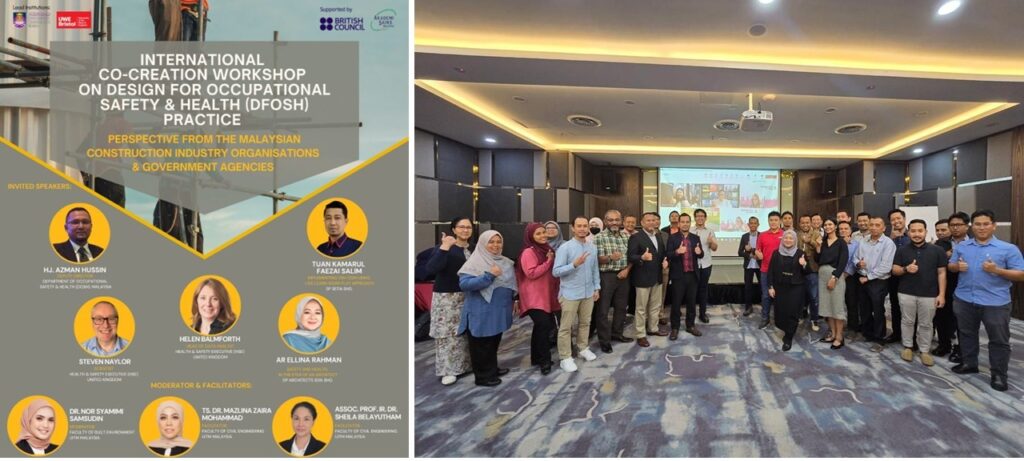
Two hybrid workshops were organised in Malaysia to bring together a wide range of stakeholders from the construction sector and government agencies. The first was held in Selangor in June 2025, followed by a second in Johor in July 2025. Together, these sessions engaged over 60 participants from industry (including contractors, consultants, architects, engineers, and safety and health professionals) and government agencies (including Department of Occupational Safety and Health (DOSH), Public Works Department, and Construction Industry Development Board). The workshops created valuable dialogue on challenges and practical solutions (from the perspective of industry and government) for improving the integration of occupational safety and health in construction design practices.

Figure 1: July 2025 Workshop

Knowledge exchange – UK visit

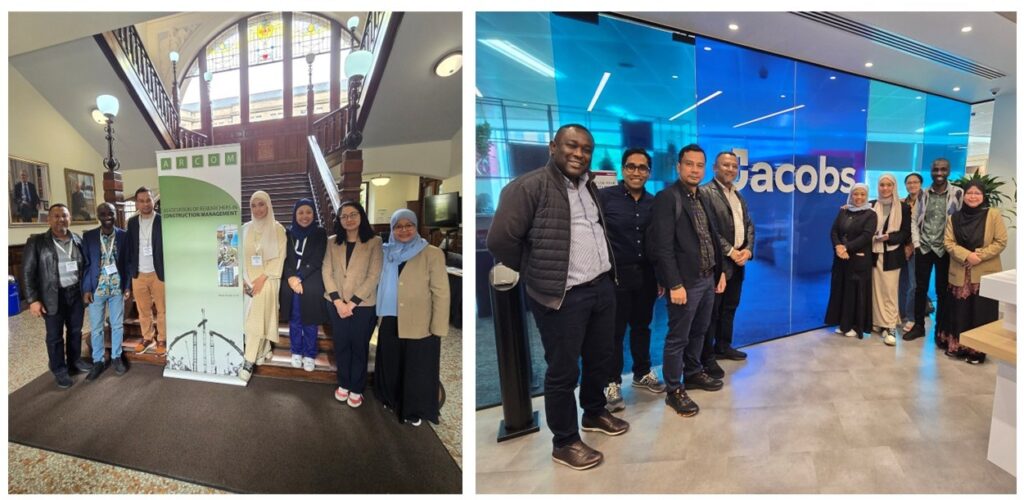
A Malaysian delegation (comprising members of the academic team and a representative of DOSH) visited the United Kingdom from August to September 2025 to strengthen international collaboration and exchange knowledge on DfOSH best practices. The delegation participated in the Association of Researchers in Construction Management (ARCOM) 2025 conference held in Dundee, where they shared the project’s initial findings with an international academic audience. The team visited Jacobs’ (a multinational engineering professional services (including design) firm) office in Manchester. During the visit, they learnt about Jacobs’ approach to DfOSH, which is encapsulated by their award-winning “de5ign” (pronounced ‘five in design’). To obtain DfOSH implementation insights from a regulator’s perspective, the team visited the Health and Safety Executive office in Buxton, where they received useful insights regarding UK’s DfOSH journey, challenges, and improvements over the years, as well as suggestions for Malaysia’s context. The delegation also visited academic partners at the UoM and the UWE. Overall, these activities provided significant opportunities for learning and for building lasting academic–industry–government linkages between Malaysia and the UK.

Figure 2: Members of the project team at ARCOM 2025 Conference (left) and during a visit to Jacobs (right)

Knowledge exchange – Guest lectures

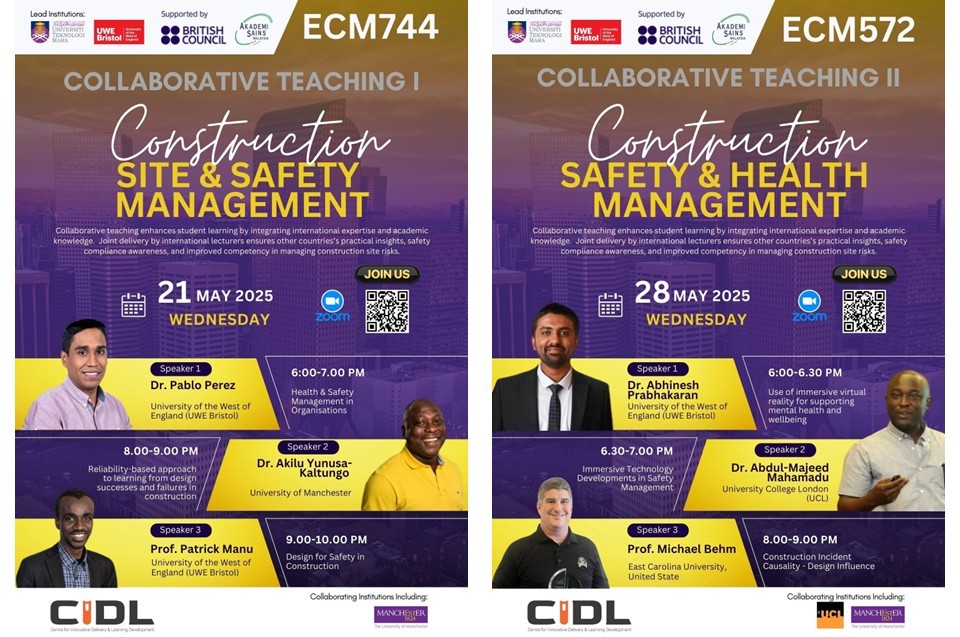
Guest lecture sessions on the Master of Construction Engineering course at UiTM (Construction Site & Safety Management) were delivered in May 2025. The sessions were delivered by project team members from UWE, UCL, UoM and a USA-based renowned academic in DfOSH. The lectures were attended by over 80 students who are also working professionals.

Figure 3: Line up of 2025 guest lecture series

Project Dissemination

To raise awareness of the project’s activities among stakeholders locally and beyond, several media posts have been made including use of social media and an article in a local news outlet.  Furthermore, academic outputs (comprising a conference article [4]) and a journal article [5]) disseminating preliminary insights from the project have been produced. Overall, the dissemination has ensured wide reach of among academic, industry and government stakeholders.

Preliminary Outcomes

The project has yielded a tripartite co-creation framework that aligns the roles of academia, industry, and government to institutionalise DfOSH as a key mechanism for improving occupational safety and health in Malaysia. The framework is guiding stakeholder dialogue to identify and prioritise DfOSH implementation challenges and solutions. Additional outcomes include: 1) insights from the workshops are being used by DOSH to inform revision of a code of practice and training modules for trained persons under Malaysia’s CWDM 2024 regulations; 2) improved stakeholder awareness of CWDM 2024 regulations and early-stage design risk management; 3) enhanced practitioner and postgraduate competencies and shared understanding of DfOSH practices; and 4) a UK-Malaysia-Indonesia collaboration (funded by UK’s International Science Partnership Fund) which seeks to drive OSH improvement in construction beyond the implementation of DfOSH.

Acknowledgement

  • Members of UK team: Patrick Manu, Abhinesh Prabhakaran, and Pablo Perez (of UWE), Abdul-Majeed Mahamadu (of UCL), Clara Cheung and Akilu Yunusa-Kaltungo (of UoM), and representatives of partner organisation.
  • Members of Malaysia team: Che Khairil Izam Che Ibrahim, Sheila Belayutham, Mazlina Zaira Mohammad, Shafienaz Ismail, and Nor Syamimi Samsudin (of UiTM), Azman Hussain (of DOSH), and representatives of partner organisations.

References

1. Eurostat (2025) Accidents at work statistics. Available online at https://ec.europa.eu/eurostat/statistics-xplained/index.php?title=Accidents_at_work_statistics

2. Department for Occupational Safety and Health (2021) Occupational Accidents Statistics by Sector January to December 2021 (investigated). Available online at https://intranet.dosh.gov.my/statistic-v/occupational-accident-statistics/occupational-accident-statistic-2021

3. Manu, P., Poghosyan, A., Mahamadu, A.-M., Mahdjoubi, L., Gibb, A., Behm, M. and and Akinade, O. (2019) Design for Occupational Safety and Health: Key Attributes for Organisational Capability. Engineering, Construction and Architectural Management, 26 (11), pp. 2614–2636.

4. Che Ibrahim, C. K. I., Manu, P., Belayutham, S., Cheung, C.M., Mohamad, M.Z., Yunusa-Kaltungo, A., Ismail, S., Samsudin, N. S., Prabhakaran, A., Perez, P., Mahamadu, A.-M. and Hussain, A. (2025a) Building a Safer Tomorrow: Tripartite Engagement and Co-Creation for Enhanced Design for Occupational Safety and Health in Malaysia. In: Thomson, C (Ed.) and Neilson, C J (Ed.), Proceedings 41st Annual ARCOM Conference, 1-3 September 2025, Abertay University, Dundee, UK. Association of Researchers in Construction Management, pp. 409-418.

5. Che Ibrahim, C. K. I., Manu, P., Belayutham, S., Cheung, C.M., Mohamad, M.Z., Yunusa-Kaltungo, A., Ismail, S., Samsudin, N. S., Prabhakaran, A., Perez, P., Mahamadu, A.-M. and Hussain, A. (2025b) Tripartite collaboration for design for safety in construction: A co-creation framework integrating academia, industry, and government. Safety Science, Article 107040.

Digital Construction and AI: Who’s in Control? UWE Bristol Conference 2026

Posted on

by Ahmed Hagras Ahmed.Hagras@uwe.ac.uk

On Friday, the 19th of  June 2026, UWE Bristol will host Digital Construction and AI: Who’s in Control? The third edition of a growing annual conference series that has become an increasingly valuable platform for dialogue across the built environment. Taking place at Bristol Business School, UWE Bristol, Frenchay Campus, the event will bring together voices from industry, academia, research, and the next generation of built environment professionals for a timely conversation about the future of digital construction.

The conference is organised through the MSc Building Information Modelling (BIM) programme at UWE Bristol, with support from CABER – the Centre for Advanced Built Environment Research. CABER’s work spans interdisciplinary built environment research, with a strong commitment to sustainability, innovation, and the digital transformation of the built environment. That makes it a particularly fitting home for a conference focused on the opportunities, risks, and implications of AI in construction.

Over the last two years, this conference series has evolved into much more than a one-day event. It has provided a space for researchers, practitioners, professional bodies, students, and industry leaders to come together to challenge assumptions, share practical insights, and examine the sector’s changing direction. Last year’s conference, Digital Construction Climate Nexus 2025, focused attention on the relationship between digital construction and climate action. The CABER blog described a programme that combined research, knowledge transfer, industry contribution, and doctoral engagement, reinforcing the value of connecting academic thinking with practice-based innovation.

This year’s theme shifts the focus to a different, but equally urgent, issue: control. As AI becomes more embedded in digital workflows, design support, information management, compliance checking, and decision-making, it is beginning to reshape how choices are made across the built environment. The question is no longer only what AI can do, but also what it means for human judgment, accountability, responsibility, governance, and professional practice. The conference is designed to explore those questions critically, and to do so across both industry and academia.

The programme will include opening contributions from UWE, CABER, and key professional networks, followed by a live debate between industry and academia on the conference theme. In the afternoon, a series of breakout rooms will allow for deeper discussion around research, standards, interoperability, inclusion, innovation, and applied case studies from practice. The event is not intended as a passive listening exercise; rather, it is designed as a forum for discussion, challenge, exchange, and the development of new connections.

Find out more on LinkedIn.

Event on the sustainability of natural materials for construction to mark COP30

Posted on

By Freya Wise, Alice Moncaster, Hector Archila and Tavs Jorgensen

On the 3rd of December Caber ran an action-packed hybrid event to mark COP30. After a short introduction reflecting on the COP30 outcomes we then had excellent presentations on three natural building materials which UWE researchers are involved with: bamboo, cob and timber. This blog reports the highlights of the session for a wider audience.

Reflection on COP30 by Dr Freya Wise

The reflection on COP30 by Freya highlighted that the overall outcomes were felt to be disappointing and lacked ambition but were not as bad as they could have been and that a range of useful things were achieved. It will be interesting to see if taking forward the fossil fuel and deforestation roadmaps outside the official COP process will actually allow them to be more ambitious and progress more quickly with willing countries.

Concerns were highlighted around a lack of acknowledgement of the latest climate science from the IPCC in the final document and the dropping of language on the need to fight misinformation. From a positive perspective however this was the first COP for several years in a countries where mass protests are possible and had strong civil society and cultural engagement around the city of Belem, including from high numbers of indigenous people.  

Specifically on the built environment, Freya identified a number of initiatives, guides and standards were launched at COP which have positive relevance. These included the Belém health action plan, United Nations Environment Programme (UNEP), ‘Beat the Heat’ initiative, and the Bélem ‘call for action for sustainable and affordable housing’ as well as initiatives on circularity and low carbon materials. If these are enacted, they will have positive implications for decarbonising the built environment and links to all can be seen at the end of the article.

Following on from some of the initiatives at COP around low carbon and biobased materials, we then had three engaging short talks on three different natural materials.

The benefits of Bamboo by Dr Hector Archila

Hector took inspiration for his talk from the ‘BambooBoost Initiative’ from the UN Framework Convention on Climate Change (UNFCC) and the International Network for Bamboo and Rattan (INBAR).

Hector explained that bamboo is a very sustainable material with rapid biomass production which translates to a high yield and excellent CO2 sequestration in both the biomass and the soil. Bamboo, which is actually a grass, is one of the fastest-growing ‘woody’ plants and thrives on degraded land. Over fifty years a tropical bamboo species produces between 5 and 8 times more biomass than Scots Pine and Oak, resulting in 5 to 8 times as much carbon sequestration as those trees over the same period.

Figure 1: Carbon yield for bamboo and selected wood

Hector highlighted that, according to UNFCC, if bamboo were cultivated on around 70-174 million hectares of degraded forestland it could sequester roughly 2 Gt of CO2 annually (for reference Spain and Portugal combined are cover about 68 million hectares). This would equate to 2% of current global greenhouse gas emissions and would also deliver significant net economic benefits. In terms of climate action, it therefore makes a lot of sense to plant bamboo forests which will produce carbon and fibre rich biomass in 4–6-year periods which can then be used in long-lived products to act as carbon stores.

In terms of biodiversity enhancements, Hector suggested that if more bamboo was planted less wood forest would need to be used thus reducing deforestation and providing ecosystem services. Bamboo forests themselves also have good biodiversity with a plethora of animal species. Bamboo can provide ecosystem and community resilience for the many people who rely on solid biomass for cooking such as charcoal or briquettes, with fast growing highly renewable biomass. Bamboo can also be converted to gas or pellets to provide a source of electricity and heating, thus reducing deforestation and use of fossil fuels

Finally, research at UWE by Hector on the project SmartBioC has shown how Biobased Building Systems for UK housing using engineered bamboo as the main structural component can provide better Natural, Human and Social benefits than traditional building systems used in the UK.

Figure 2: One of the biobased systems Hector has developed

Innovative earth building research at UWE by Dr Tavs Jorgensen

Tavs provided an introduction to cob or earth as a local, low carbon building material with a long history of use and increased research interest in recent decades. However, challenges were also highlighted with traditional cob construction around the thicknesses required to meet insulation levels in modern building regulations and the length of time that building traditional cob walls requires.

Tavs then discussed the research that he has been leading at UWE to investigate how to use 3D printing processes to make dies to extrude cob bricks in different shapes, which has the potential to substantially speed up the production process while allowing creativity in the creation of different brick shapes and forms.

Figure 3: Extrusion equipment and extruded cob bricks

Work has taken place to engage students in this research through competitions and a ‘Cob Club’ as well as a number of wider hands-on workshops exploring the qualities of different earth and the potential of the material. A ‘Cob Comp’ (cob competition) in 2024 enabled UWE students to explore extruded cob block technology and the winners’ ideas were used to successfully build a shelter on the University grounds.

Figure 4: The bricks and the shelter created by Cob-Comp in 2025

Tavs also took the opportunity to launch this year’s iteration of the competition, Cob Comp 2: Earthly Enquiries. This is an ideas competition to design a structure built from pressed earth brick units of students’ own ingenious designs and from materials found only within the boundaries of UWE’s Frenchay Campus. The competition aims to explore the structural capacities and concepts of making and building with compressed earth. There are plans to build the winning design in summer 2026.

Tavs therefore highlighted both the benefits of innovative methods for cob and the importance of engaging students in hands-on research and creativity.

Sustainable timber and biogenic carbon standards by Professor Alice Moncaster

Alice highlighted the new principles for Sustainable Timber Construction and which were officially launched at COP30 (see link below). Alice then went on to give a quick introduction to lifecycle assessment (LCA) which measures the carbon emissions associated with the whole life of a material including its extraction, manufacture, transport, installation, maintenance and end of life disposal.

Figure 5: Lifecycle stages

She then discussed how the biogenic carbon stored in natural materials (and then released back into the atmosphere at the end of the of the material’s lifespan), is treated in a range of national and international standards on whole life carbon reporting. Biogenic carbon storage is one of the key benefits of natural materials and is particularly valuable in buildings as they theoretically last a long time, thus storing carbon for many decades (but not permanently). For a full LCA, the biogenic storage in phases A1-A3 is then reemitted in phase C, while most standards currently require that if only upfront carbon is assessed, biogenic carbon is reported separately.

Alice discussed multiple standards and reported on discussions at a recent meeting of International Energy Agency (IEA) Energy in Buildings and Communities (EBC) Annex 89, ‘Ways to implement net-zero whole life carbon buildings’. Climate science says that biogenic carbon is not equivalent to fossil carbon and cannot be added together. The discussions therefore focussed on whether biogenic carbon should be reported separately throughout all LCAs. This does not mean that the biogenic storage of natural materials is not useful and positive but does highlight that it is not a simple silver bullet and cautions against some of the evangelical calls for over-building with timber as a form of carbon removal from the atmosphere.

Alice therefore opened the discussion and posed some questions on how we should be reporting sustainable timber use for everyone to consider. 

Summary

The session was well received the main concern seemed to be that we would all have enjoyed more time for discussion! During the questions Hector made a very good point that no natural material is ‘The Solution’ on its own and what is actually needed is a balanced diet or menu of the most appropriate materials for different scenarios and locations. We look forward to continuing the discussion.

Links to further information from all the presentations

COP30 reflections and initiatives

Bamboo

 Earth Buildings

Sustainable Timber and biogenic carbon

CABER members can view the recording of the event on Teams

Sustainable buildings in Trondheim

Posted on

Author: Alice Moncaster

Trondheim is just outside the Arctic Circle, and late November means limited daylight and plenty of snow and treacherous ice. Winters are not as cold as they used to be however according to our host. This is an increasingly common refrain. And while you might not mind milder winters, the excessively hot summers and increasing disasters around the world are making it absolutely crystal clear that we all need to do whatever we can to limit carbon emissions and climate change.

Nidaros Cathedral and Trondheim by night

I was in Trondheim at the Norwegian University of Science and Technology (NTNU) for two events trying to address the 40% or so of our carbon emissions which are from the construction and operation of our buildings. The first event was a conference, part of the long-established Sustainable Built Environment (SBE) series.  I first attended an SBE conference in Helsinki in 2011, and over the years they have led to the development of a shared community of practice around the world. I particularly enjoyed Trondheim’s SBE25 Cities and Climate Change. Organised by Rolf Andre Bohne and colleagues, and Scientific Committee led by Freja Rasmussen, it had a distinctively friendly and open atmosphere, which had a noticeable impact both for early career researchers (who were less nervous), and for more senior researchers (who were less combative!). Of the research shared, I’d pick out the ARV project presented by Niki Gaitani (NTNU) and others, and the INDICATE-LIFE project presented by Giovanna Cassavia (TU Graz) and others, for special interest.

I was also proud to present (CABER Visiting Prof) Morwenna Slade’s beautifully illustrated paper (Blenheim Palace! Medieval churches!) explaining how understanding the vulnerabilities of individual heritage buildings, combined with projected localised climate change, can help develop maintenance plans towards future resilience – and how this ‘conservation philosophy’ can also be applied to improve resilience across all buildings. On the second day I then presented my former student Jon Andrew’s paper based on his MSc dissertation, which explored the motivations and actions for the new student accommodation at UWE – why Passivhaus was supported, while aspirations for net zero whole life carbon were dropped.

Conference dinner at E.C.Dahls brewery with new colleagues and old

The conference illustrated again for me how important direct and personal communication is. We are bombarded with webpages and reports and social media notifications (yes, I see myself 🙂 ) every day, and yet nothing works as well as talking to each other.  This is a problem, as only a few have the opportunity; there is a very real financial limitation on who can attend conferences, and often, on top of that, personal limitations due to disability and caring responsibilities. So, while attending conferences is amazing, those of us lucky enough to be there need to remain conscious of the voices which aren’t heard. There were important lessons in all the papers presented, but how many will read them or even hear of them outside Trondheim, I wondered?

Alexander Passer, Operating Agent for Annex 89, presents to the group

The second half of the week was spent in a scientific meeting of the IEA EBC Annex 89, ‘Ways to implement net-zero whole life carbon buildings’. Colleagues from around the world came together to develop and discuss our emerging results and the variations in what is happening in the 30+ countries we represent.  As a subtask 4 co-lead, I am particularly interested in gathering case studies which help us understand how the transition to low carbon buildings happens in practice – in projects, through industry initiatives, and in policy. How do we make it happen more widely?

A tour of the plant room in the ZEB Lab at NTNU

It was super interesting to hold the meeting in the Zero Emission Building Laboratory at NTNU, and to have a tour of the plant room. In sub-zero temperatures it clearly worked – and the mass timber construction, including the stairwell, made an attractive and comfortable environment. As a living laboratory, the building is also used as a demonstrator, and the plant room is huge just so that visiting groups can enter and see everything working.

But is this the future of the built environment? I think not.  ‘Net zero’ means that the carbon is paid back over the years, but the construction still costs carbon upfront, even in timber. We don’t have the carbon budget remaining to rebuild our cities. In Europe we already have the building stock we need. Our dual focus now needs to be on retrofit and adaptation for future climates, and on social change to ensure everyone has a roof over their head.

Annex 89 participants braving the ice for a group photo

CoolScapes: Co-Learning across Cultures in a Warming City

Posted on

Author: Ghada Karaki

CoolScapes is an experiment in co-producing solutions to questions of thermal comfort by leveraging the social and vernacular knowledge of migrant communities.

Context

Climate projections for the UK show higher temperatures and changing precipitation patterns that will lead to hotter and drier summers (SWM, 2021). Increased temperatures are expected to cause thermal discomfort and contribute to health problems, depending on the communities and their cultural heritage. Bristol is an increasingly diverse city, with 28.4% of its residents from ethnic minority groups and speaking 90 languages (Bristol City Council, 2023), and is increasingly attracting migrants from warmer parts of the world. Many new migrant communities have the knowledge and practices needed to adapt to a warming climate, drawing on local traditional vernacular knowledge and practices. 

The current practice to retrofit in the UK is based on a step-by-step and incremental approach of increasing insulation, improving airtightness, and installing renewable energy technologies (Killip & Fawcett, 2022). While this approach effectively reduces winter heating demand, it can have unintended consequences, such as excessive heat in summer or inadequate ventilation (Godefroy & Baeli, 2024, Wingfield et al. 2011). In addition, there is little innovation in building retrofit design and a lack of understanding of buildings and their occupants as a socio-technical system. 

We will address in this pilot study the challenges of thermal comfort, working with migrant communities from warmer climatic zones (e.g. the Middle East and East Africa). By understanding their thermal comfort perceptions, cooling behavioural adaptations, and vernacular practices, we aim to co-develop culturally informed responses to the climate crisis.

Our Approach

We used a Social Practice Framework (SPF) to map how migrant communities adapt to heat and cooling. Alongside creative storytelling, we integrated live scribing, a visual note-taking process that captured participants’ words, examples, and sketches in real-time. Storytelling and live scribing encouraged participants to share knowledge, experiences, and needs. Because comfort is felt emotionally as well as physically, live scribing made discussions visible: participants could point, edit, and build on what was drawn, turning comments into co-developed output.

What’s been done so far

Building on the view that practices are continually reperformed (Shove & Southerton, 2000), we used storytelling and live scribing as inquiry tools.

  • We ran multiple workshops with first-generation migrants from warmer climatic zones, across different ages and genders.
  • Sessions centred on perceptions of thermal comfort and documented cooling practices (architectural forms, materials, window and door configurations, courtyard use, natural ventilation, communal routines, clothing, use of shade/space, hydration).
  • Live scribing captured narratives and examples in the moment; participants edited and extended the drawings to clarify meanings (e.g., how to make shared spaces work better and how to get cross-breezes flowing).
  • The resulting visuals act as shared artefacts that we can transform into digital posts and a finding brief.

CoolScape Workshop I – 23rd June 2025, live scribing by Jasmine Thompson. Funded by CABER-UWE​

Big thank you!

Thank you to all our wonderful participants, Stacey-Ann, Gofaone, Nijood, Nkoane, and Emmanuel-Ian, for your time and stories. We also appreciate the collaboration with ACH, especially Jah Caballero, for the great work in facilitating the workshops with the participants, and Watershed for their support. Many thanks to Jasemine Thompson for the great work live scribing the workshops.

We gratefully appreciate CABER-UWE for funding the pilot study.

What’s next

We are analysing scribed boards, notes and recordings. A summary and next steps will follow in the coming months.

Contact us: Ghada Karaki (email: ghada.karaki@uwe.ac.uk)

Glyn Evertt (email: glyn.evertt@uwe.ac.uk)

References

Bristol City Council. (2023). Bristol Key Facts 2023. https://www.bristol.gov.uk/files/documents/1840-bristol-key-facts-2023/file

Godefroy, J. and Baeli, M. (2024) Retrofit Revisit: 10 Case Studies. London: Chartered Institution of Building Services Engineers (CIBSE). ISBN 978-914543-92-0. https://www.cibse.org/knowledge-research/knowledge-portal/retrofit-revisit-2024

Killip, G., Fawcett, T. (2022). Expert views of building retrofit in the UK: Residential, non-residential, and heritage building renovations. In ECEEE Summer Study Proceedings – Efficiency and beyond: innovative energy demand policies. European Council for an Energy-Efficient Economy.

Shove, E., Southerton, D. (2000). Defrosting the Freezer: From Novelty to Convenience: A Narrative of Normalisation. Journal of Material Culture. 5(3): 301-319. https://doi.org/10.1177/135918350000500303

Sustainability West Midlands (2021). Third UK Climate Change Risk Assessment (CCRA3) Technical Report: Summary for England. Climate Change Committee. https://www.ukclimaterisk.org/wp-content/uploads/2021/06/CCRA-Evidence-Report-England-Summary-Final.pdf

Wingfield, J., Bell, M., Miles-Shenton, D., South, T., and Lowe, R.J. (2011). Evaluating the impact of an enhanced energy performance standard on load-bearing masonry domestic construction: Understanding the gap between designed and real performance: lessons from Stamford Brook. Project Report. London: Department for Communities and Local Government. ISBN 978-1-4098-2891-4.

Gaining inspiration at EU Sustainable Energy Week (EUSEW) 2025

Posted on

By Freya Wise, Research Fellow

The annual EUSEW is the biggest conference dedicated to renewable and energy efficiency in Europe with over 60 parallel policy sessions over three days and more than 2,000 online and in person attendees each day including local and national policy makers, industry experts, researchers and academics.

This year it was held on the 10-12 of June and was probably the 4th or 5th year that I had attended. Sometimes doing research on carbon reduction can feel a bit disheartening. For example reading latest update suggesting that urgent action is needed in the next three years to have any chance of limiting warming to 1.5ºC [1] and yet this urgency seems far from international and domestic political agendas.

I like EUSEW because its focus on policy means that you hear about real actions that are being taken on local, national and regional levels in locations around Europe and I always go away feeling a bit more positive because there are lots of good things happening out there locally and indeed, at an EU level.

This year’s theme was ‘powering a fair and competitive green transition’ so there was a lot of discussion about the cost of electricity in Europe being higher than in other parts of the world. There was also a lot of talk about disadvantaged communities, what that looks like in different parts of Europe and not leaving anyone behind.

In this blog post I wanted to touch on some highlights of the sessions that I attended at this year’s EUSEW.

Highlight 1: Retrofit advice actually works!

One of the first sessions I attended explored policy tools, local initiative and financing models to encourage decarbonised housing and reduce energy poverty in European Cities. There were speakers from Belgium, Greece, Spain and the EU commission amongst others.

Two of the speakers were from the city of Ghent and spoke about a project where they provided free retrofit advice and one stop shop services* to any citizen in Ghent as part of their ‘Ghent, Climate City’ initiative [2]. Through part of a Horizon Europe funded project they were able to evaluate the effect of this advice and found that every €1 invested in providing the advice service led to €7 of actual retrofit work carried out. And this €7 was of course invested in local businesses, led to carbon reductions and had the potential to reduce fuel poverty.

Having recently written a paper on informational barriers to retrofit in the UK [3], I thought that this was a great statistic on the effectiveness of providing tailored, contextual and free advice to encourage retrofit.

A further presentation on the Thursday emphasised the need to take information to citizens and go to them to get their opinions and involvement rather than waiting for them to come to you. This was also something that we advocated in our recent paper and another speaker from Spain showed this great example of a mobile ‘one stop retrofit advice shop’ which was used to encourage fuel poor households to take up government supported retrofit and provides a good example of ‘taking advice to people’.

Highlight 2: ‘Talking to Ginger’ and actions not words

On Tuesday evening was what proved to be my favourite session of the conference, a keynote by Dr Kris de Meyer, a neuroscientist and director of the Climate Action Unit [4] at UCL, discussing how we, the ‘experts’ communicate climate change.

He first introduced a comic of a man explaining something to reasonably to his dog, Ginger, but what Ginger heard was: Ginger, blah, blah, blah, blah… Ginger! Blah blah, blah…’ because Ginger didn’t understand the man’s ‘jargon’. He then went on to say that different people also mean different things with the same words and further that we as people are very reluctant to acknowledge this and deeply feel that our interpretation is the most widely held one even in the face of evidence that it is not.

There were lots of other interesting points and the presentation itself was apparently based on a recent TED talk, How to get unstuck on climate action. The other point that stuck with me however was that he explained that in sustainability research there is generally an assumption that if we educate people about the importance of climate action, they will act. However (and linking back to the insight 1!), people learn about climate change and then want to take action but don’t know how to overcome barriers. Instead, he was explaining that neuroscience has shown that it is action, not knowledge that inspires further action, and that action also leads to agency i.e. knowing how to act. 

So, instead of trying to change peoples’ beliefs and convincing them to care, then expecting them to act, we should instead help people to start taking action and this will:

  1. help to persuade them to care
  2. inspire them to take further actions
  3. help them develop their ability to act

I think that operationalising this concept in practice may be challenging but I can see the logic. When we want people to start a sport, we offer them the opportunity to try it, we don’t just talk about it. This feels harder to do with something like building retrofit but is still definitely worthy of consideration.

The only sad thing about this talk was that it wasn’t longer and that the questions weren’t online as the onsite organisers, speaker and participants went off for cocktails!

Highlight 3: Control is key and the solution is energy boxes

The third highlight came from two talks on the Thursday. The first was about balancing energy performance with indoor environmental quality and one of the speakers highlighted the importance of personal control in increasing indoor comfort and reducing energy use through three examples:

  1. Studies showed that offering options for individual control over lighting in office buildings paired with occupancy sensors reduced energy consumption compared with standard lighting practices and boosted visual comfort and productivity.
  2. The use of personal environmental control systems (PECS) such as heated chairs and foot warmers could maintain thermal comfort at ambient temperatures 3-4ºC higher or lower than those recommended by current standards, and reduce energy use by 15-60%
  3. Ceiling fans can create air movement which can make 28ºC temperatures feel like 25ºC while using <5% of the energy required by an air conditioning system used to achieve the same effect.

This was a nice summary of a range of literature that I’ve read in this field in the past and it was pleasing to know that simple solutions like this can have such positive effects.

Another presentation meanwhile talked about a living lab in Genk [5], Belgium, where they were experimenting with prefabricated façade retrofit of social housing to create positive energy districts. There were lots of interesting things about this project but I was particularly interested in the ‘plug and play’ energy boxes which contained a heat pump and hot water provision and other energy systems without having to alter internal systems in the house.

This is an interesting approach in itself as it is can help reduce some of the disruption barriers to heat pump uptake [6]. But what was particularly interesting was that because it was a living lab they were able to try having one combined technology box for 2-5 homes in a ‘microgrid’ and found that the price of the retrofit drops by 50% per dwelling at an optimum number of five dwellings in the grid. There are challenges with this approach around distributing the costs to the separate houses which still need more working through but it’s a very promising innovation.

Conclusion

Of course, not all of the sessions are about retrofit, there are also sessions on transport and industrial decarbonisation as well as policy developments, financing and grid infrastructure so there really is a lot of interest going on. EUSEW is over for this year now, although recordings of the presentations are still available on the platform if you’ve registered.

The next EUSEW will be in June 2026, registrations open around January and online attendance is free. I can heartily recommend attendance if you are interested in sustainability activities across Europe and would like to go away with a bit of positivity that good things are happening!

Author: Dr Freya Wise, ESRC Research Fellow (UWE Bristol)

* One stops shops offer retrofit information,  building specific plans for retrofit and offering support with sourcing finance and tradespeople, and often have a service to project manage the retrofit process for households and to conduct quality checks after the work has been completed. They are have been written into the recent recast of the EU’s Energy and Buildings Directive as something that all EU governments should implement

Reference list

 [1]        Forster PM, Smith C, Walsh T, Lamb WF, Lamboll R, Cassou C, et al. Indicators of Global Climate Change 2024: annual update of key indicators of the state of the climate system and human influence. Earth System Science Data 2025;17:2641–80. https://doi.org/10.5194/essd-17-2641-2025.

[2]         Ghent’s climate actions | Stad Gent 2025. https://stad.gent/en/city-governance-organisation/city-policy/ghents-climate-actions (accessed June 25, 2025).

[3]         Wise F, Gillich A, Palmer P. Retrofit information challenges and potential solutions: Perspectives of households, retrofit professionals and local policy makers in the United Kingdom. Energy Research & Social Science 2025;119:103866. https://doi.org/10.1016/j.erss.2024.103866 .

[4]         UCL. UCL Climate Action Unit. Climate Action Unit 2021. https://www.ucl.ac.uk/climate-action-unit (accessed June 25, 2025).

[5]         oPEN Lab – Leading the Transition to Positive Energy Neighbourhoods. EnergyVille n.d. https://energyville.be/en/project/open-lab-leading-the-transition-to-positive-energy-neighbourhoods/ (accessed June 25, 2025).

[6]         Wise F, Cooper A, Eckert C. A Transdisciplinary Engineering and Systems Approach for Decarbonizing UK Home Heating. Engineering For Social Change, vol. 60, Online: IOS Press; 2024, p. 359–68. https://doi.org/10.3233/ATDE240880.

Digital Construction Climate Nexus 2025: can digital construction become a genuine driver of climate action?

Posted on

by Ahmed Hagras, Senior Lecturer in Building Information Modelling, Co-programme leader MSc BIM

In 2024, we brought people together from across the built environment to ask a big question: “Are We There Yet?” It was a moment to pause and reflect on our collective progress in using digital technologies to meet the demands of the climate crisis. The conversation was open and honest.

What became clear was that while there has been real progress, we’re still a long way from fully connecting our digital capabilities with meaningful climate outcomes. So, for 2025, we’re not asking the question again. We’re taking the next step.

Digital Construction Climate Nexus 2025, hosted at UWE, is built around a new theme: From Asking to Acting. This year is all about moving the conversation forward, focusing less on where we stand and more on what we’re doing. The event brings together a rich mix of academics, industry professionals, researchers, and students to explore how digital construction can become a genuine driver of climate action. It’s not about repeating the same talking points. It’s about sharing what’s working, what’s scalable, and where the most significant challenges still lie.

One of the real strengths of this event is the diversity of its voices. You’ll hear from those working on the ground with retrofit projects, those pushing innovation in monitoring and data capture, and those developing strategies to embed carbon thinking into the earliest design stages. The breakout sessions, particularly the one led in partnership with buildingSMART UK & Ireland and nima, offer a space where technical experts, standards organisations, and academics can come together to explore real solutions.

Another exciting addition this year is the UWE & RBI Breakout Room, which will shine a spotlight on Knowledge Transfer Partnership (KTP) opportunities and success stories. This space focuses on building stronger bridges between academia and industry through collaboration and co-creation. Attendees can expect presentations of impactful KTPs, talks from CABER members on how their research aligns with digital construction and climate goals, and a dedicated poster session, especially encouraging PhD students to showcase their work. It’s an essential reminder that research doesn’t exist in a vacuum, and when paired with practical applications, it can drive real innovation in practice.

The event is supported by CABER (Centre for Advanced Built Environment Research) here at UWE, whose generous funding helps make it possible. Events like this work because of people. They succeed because individuals are willing to share, challenge, and collaborate. And they matter because they remind us that meaningful progress only happens when we connect knowledge with action.

As Professor Alice Moncaster, Co-Director of CABER, puts it:

In the construction sector, ‘digital innovation’ is often spoken of in the same breath as ‘climate action’. But exactly how do our rapidly growing digital tools and skills support the reduction of greenhouse gas emissions and the mitigation of climate change? The Digital Construction Climate Nexus on 20th June will provide much-needed clarity on this issue, by bringing together academic and industry experts to present, debate and discuss the hottest topics.

There’s something powerful about bringing together students, academics, software developers, and industry leaders in one space. It creates the kind of energy where ideas spark into something more tangible.

From Asking to Acting isn’t just a theme. It’s a reminder that every project, every piece of data, and every conversation can either move us closer to change or keep us where we are.

This year, we choose to move.

Back to top

Follow this blog

Get every new post delivered right to your inbox.