We’re very pleased that our latest paper has been published in Applied Energy and is now freely available at https://doi.org/10.1016/j.apenergy.2026.128895
Around the world, our existing buildings need retrofitting to reduce their energy and associated carbon emissions and make them fit for the future. Building retrofit is therefore a critical activity for both climate change mitigation and adaption. Almost three years ago, in November 2023, Alice Moncaster and I decided to conduct a systematic literature review of the global, quantitative, academic literature on retrofit. This was partly in response to a question during the creation of the UK Net Zero Carbon Building Standard1, something like: ‘what do we know about the embodied carbon impacts of retrofit?’
As we started by investigating previous reviews in this field, we realised that there would actually be significant value in going back a step and creating a comprehensive, systematic mapping review of the trends and gaps in the broader field of building retrofit for energy and carbon reduction.
What did we do?
Our initial search terms produced 9,334 across, Science Direct, Scopus and JSTOR, which we narrowed down to a mere 1,408 for further review, focussing on peer-reviewed journal articles published between 2017-2024 (this involved a second search stage in January 2025 to update the review to all papers in published in 2024).
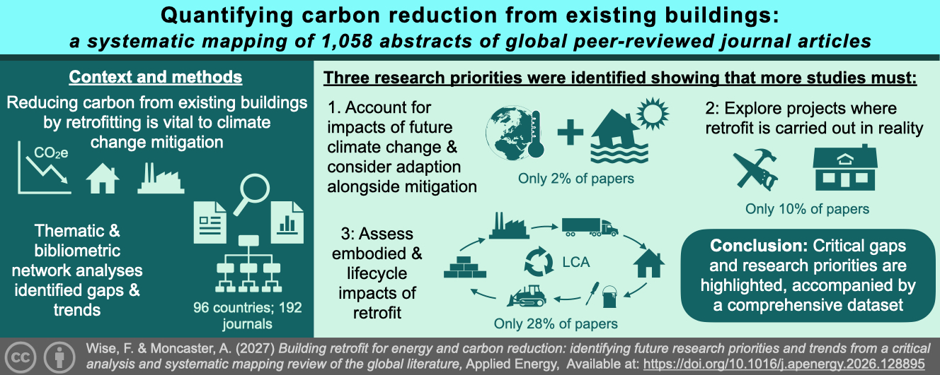
Our final dataset2 included 1,058 papers and we used detailed thematic analysis to assess the abstracts of these papers to identify topics, methods, types of retrofit and other aspects, and bibliometric network analysis to identify keyword and author clusters.
What did we find?
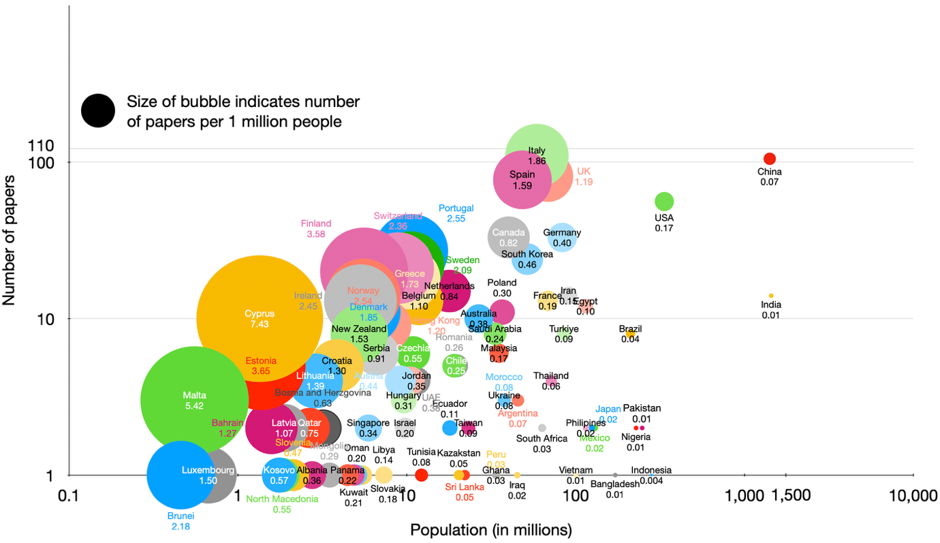
The research was published in 192 journals in multiple fields and covered 96 countries, although there was a strong research focus in Europe and China and a dearth of research in parts of Africa and in Oceania (Figure 1). Italy (110), China (105), the UK (81) and Spain (77) were the most researched countries. More research is therefore needed in under-examined areas and climates as the most suitable retrofits vary across regions.
Figure 1: Bubble graph plotting the number of papers per million of population per country.
Alongside the need for more research in certain regions, we found three key gaps where further research is needed.
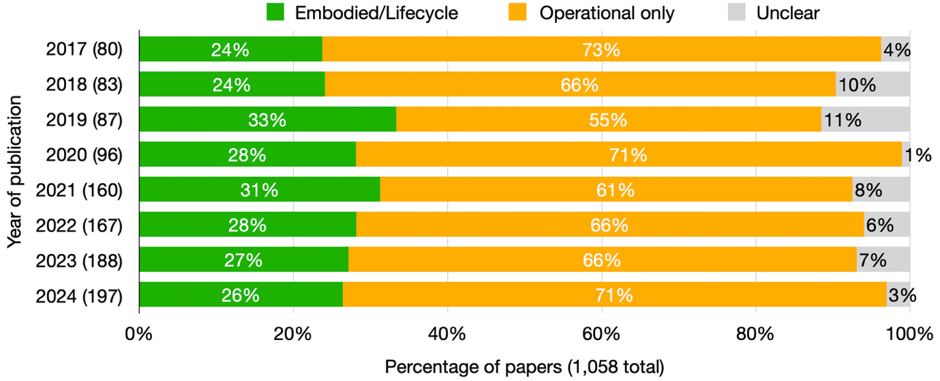
1. Just less than a third of papers considered embodied or lifecycle carbon, with the majority only focussing on the operational phase. Concerningly, this percentage didn’t meaningfully increase over the studied period (Figure 2). Neglecting embodied carbon means that the carbon cost is not considered and retrofits may actually be using more carbon than they save, or at least not making optimal savings. More retrofit studies should therefore include embodied carbon in a full lifecycle assessment.
2. Only around 10% of the papers examined the performance of retrofits in real life. The other 90% were based on modelling and simulation, which is concerning given the well-known performance gap between predicted and actual retrofit outcomes3. More studies of real world retrofit performance and comparison with and calibration of models is therefore critical to ensure that real savings are achieved.
3. Most importantly, after this summer of global heatwaves, 98% of studies examine retrofit using past climate data. Only 2% of papers considered the effects of future climate conditions on retrofit performance. These studies identified that considering future conditions affected the most suitable retrofits to create carbon savings and make buildings fit for purpose in a changing climate. It is therefore vital that studies stop relying on historic data and start designing retrofit in response to predicted future conditions.
To explore all these findings and all the details please enjoy the full paper from: https://doi.org/10.1016/j.apenergy.2026.128895
We hope that this paper and the accompanying dataset of papers will inform and inspire new, targeted research in these critical areas.
References
1. UK Net Zero Carbon Building Standard https://www.nzcbuildings.co.uk
2. Full dataset of the analysed papers available at: 10.5255/UKDA-SN-857925
3. Preprint of our paper on energy modelling for heritage buildings which discussed the performance gap http://dx.doi.org/10.2139/ssrn.7536546
By Ahmed Hagras Senior Lecturer in BIM; Programme Leader, MSc Building Information Modelling
On Friday 19 June 2026, UWE Bristol hosted Digital Construction and AI: Who’s in Control? at UWE Bristol Business School, Frenchay Campus. The event was organised through the MSc Building Information Modelling (BIM) in Design, Construction and Operations programme, and funded by the Centre for Advanced Built Environment Research (CABER).
This was the third edition of a growing annual conference series that brings together industry, academia, professional bodies, students and researchers to explore the future direction of the built environment. This year’s theme focused on one of the most important questions now facing digital construction: as artificial intelligence becomes more embedded in professional practice, who remains in control?
The event generated strong engagement and very positive feedback, with 110+ attendees taking part on the day. A surface-level analysis of the attendee demographics indicated that approximately 64% were from industry and external organisations, around 34% were from UWE Bristol, and approximately 2% were from other academic institutions. This shows the event’s strong industry focus and the breadth of engagement across professional practice and academia.
Moving beyond AI hype
A key message from the day was that industry is not looking for AI for its own sake. The discussion moved quickly beyond excitement about tools to more grounded questions about value, responsibility, implementation, and risk. The central message was clear: AI should not take control away from professionals. Instead, it should help project teams better manage complexity. This was strongly reflected in the Morgan Sindall Construction contribution, which framed AI around practical value, responsible deployment and human oversight. The presentation asked whether AI is being used to take control away from project teams, or whether it can give teams better control over complexity. It also stressed that construction decisions affect safety, quality, cost, carbon, and building users.
For BIM and digital construction education, this lesson is crucial. Students need to learn not only what AI tools can do. They need to understand when those tools are useful, how they should be governed, and where human judgement must remain central.
Human judgement remains central
Across the conference, a consistent message emerged: AI should support professional judgement, not replace it.
Industry contributors recognised AI’s value in summarising information, identifying patterns, improving access to project data, flagging risks, and reducing repetitive work. However, they also stressed that AI does not understand the full project context in the way experienced professionals do.
Design, construction and asset management decisions are not purely technical. They involve buildability, safety, commercial judgement, client priorities, regulatory requirements, carbon impact and long-term responsibility. This means that professional judgement remains essential.
The future graduate therefore needs to be more than a software user. They need to question outputs, understand uncertainty, communicate risk, and make informed decisions.
Data as the foundation of responsible AI
Another major theme was data. The conference highlighted that AI is only as useful as the data, assumptions and context behind it.
One of the strongest messages came from Isabella Bhoan’s presentation, Data as Tether, which reminded us that AI is only as good as the patterns it sees. But the more important question is: who decides which patterns matter?
This raised important issues around data bias, language, local context, governance and equity. Poor data quality and poor data governance were presented not simply as technical limitations, but as risks that can shape how AI interprets the world.
For BIM education, this matters greatly. Data is not neutral. People and organisations produce, select, structure, and interpret it. Future BIM graduates must therefore be data-critical, not simply digitally competent. They need to understand data quality, provenance, bias, interoperability and local context.
Information management before artificial intelligence
The event also reinforced a core BIM principle: good information management comes before effective AI.
The nima presentation on AI considerations for information managers made this point very clearly. Adding AI to a well-planned and well-implemented information management approach is likely to be beneficial. Adding AI to a chaotic, poorly defined or unstable process is unlikely to be beneficial.
This is an important message for the built environment. AI does not fix poor information management. In many cases, it exposes it.
For the BIM subject area, this means AI should not be treated as a separate or isolated topic. It needs to be embedded within information management, data quality, standards, governance, explainability, accountability and decision-making.
Accountability does not disappear
One of the most important questions raised during the event was accountability. If AI influences a decision, who is responsible for the outcome?
The industry message was direct: using AI tools does not remove accountability. People and organisations remain responsible for the decisions made, the outputs produced and the outcomes delivered.
This is a major issue for education. Future professionals need to understand that digital tools may support decision-making, but responsibility cannot simply be delegated to software. Graduates must be able to justify decisions, explain the basis of recommendations and understand the risks of relying uncritically on AI-generated outputs.
AI, BIM and whole-life carbon
The conference also connected AI and digital construction to one of the built environment’s most urgent challenges: carbon reduction.
Catherine Sinclair’s presentation on early-stage design decisions and whole-life carbon showed that many of the decisions that shape carbon outcomes are made very early in the design process. Life cycle assessment is often treated as a late-stage reporting task, but the real opportunity is to bring carbon thinking into earlier design decisions, when change is still possible.
This has direct relevance to BIM, AI and digital construction education. Digital tools should not only help students model, coordinate or automate. They should help future professionals understand consequences, compare options and make better decisions about carbon, resources and long-term performance.
Academia and industry: a productive tension
The live debate between academia and industry brought the event theme into sharp focus.
The academic side raised wider questions around ethics, responsibility, professional judgement, learning, automation bias and the role of universities in preparing students for an AI-enabled sector.
The industry side focused on implementation: what problem are we solving, what value does AI create, how do we scale responsibly, how do we manage risk, and how do project teams remain in control?
This was not a disagreement. It was a productive tension.
Academia asked what should be questioned, safeguarded and taught. Industry asked what can be implemented, governed and used effectively in real project environments. The future of BIM and digital construction education sits between these two positions.
Questions for BIM and digital construction education
The event raised several important questions for our subject area:
Are we teaching students to question AI outputs, not just use AI tools?
Are data quality, provenance and information management embedded deeply enough in the curriculum?
Do students understand accountability when digital tools influence professional decisions?
Are business case, rollout, ownership and proof of value part of digital construction education?
Are we connecting AI and BIM with early-stage design, whole-life carbon and sustainability?
Are we developing responsible digital decision-makers, not only software users?
These questions are no longer optional. They are becoming central to what it means to prepare graduates for the future of the built environment.
Looking ahead
The strongest message from the conference was that the question “Who is in control?” is not about resisting AI. It is about preparing people to use AI with evidence, judgement and responsibility.
For UWE Bristol, the event created a valuable space for industry and academia to learn from each other, challenge assumptions and reflect on what future professionals will need. It also reinforced the importance of employer engagement in shaping curriculum, assessment and student learning.
The future BIM and digital construction graduate will need data literacy, information management capability, ethical awareness, implementation skills, carbon awareness and confidence in professional judgement.
In that sense, the conference did more than ask who is in control. It reminded us that education plays a vital role in shaping how control, responsibility, and judgement develop for the future of digital construction.
We look forward to continuing the conversation and building on this momentum at next year’s event.
By: Patrick Manu [Professor at UWE] and Che Khairil Izam Che Ibrahim [Professor at UiTM]
In many countries, construction is one of the most dangerous sectors [1]. In Malaysia, the sector accounts for about one-third of worker deaths and many occupational injuries [2]. Studies have established that design is one of the key underlying causal factors in construction accidents and worker fatalities [3]. This has led to the prominence of the practice of Design for occupational safety and health (DfOSH) which entails designers ‘designing out’ occupational safety and health (OSH) risks at the early design stages of construction projects to protect workers.
In the UK, the Construction (Design and Management) Regulations (CDM) have been introduced since 1995 to mandate DfOSH implementation. In Malaysia, the Occupational Safety and Health (Construction Work) (Design and Management) (CWDM) Regulations 2024, which have been adapted from the UK CDM, have just recently been passed, as a measure to improve OSH performance of the construction sector. Currently, Malaysia is still at the initial stage of implementing DfOSH, while the UK has garnered many years of experience in DfOSH. The experience and lessons learnt in the UK with regards to challenges in DfOSH implementation and their solutions would serve as a useful resource for construction stakeholders (academia, industry, and government) in Malaysia in building strong DfOSH implementation capacity.
Against this backdrop, the University of the West of England (UWE) in collaboration with academic institutions in Malaysia and UK (Universiti Teknologi MARA (UiTM), The University of Manchester (UoM), and University College London (UCL)) are delivering an international project to advance DfOSH implementation in Malaysia via tripartite engagement of Academia-Industry-Government stakeholders to strengthen stakeholder capacity and co-create solutions to address DfOSH implementation challenges. The project entails a series of activities including stakeholder engagement and capacity strengthening workshops, knowledge exchange, and on-going dissemination. This blog offers excerpts of activities undertaken (in 2025), and preliminary outcomes.
Activities
Industry–government engagement and capacity strengthening
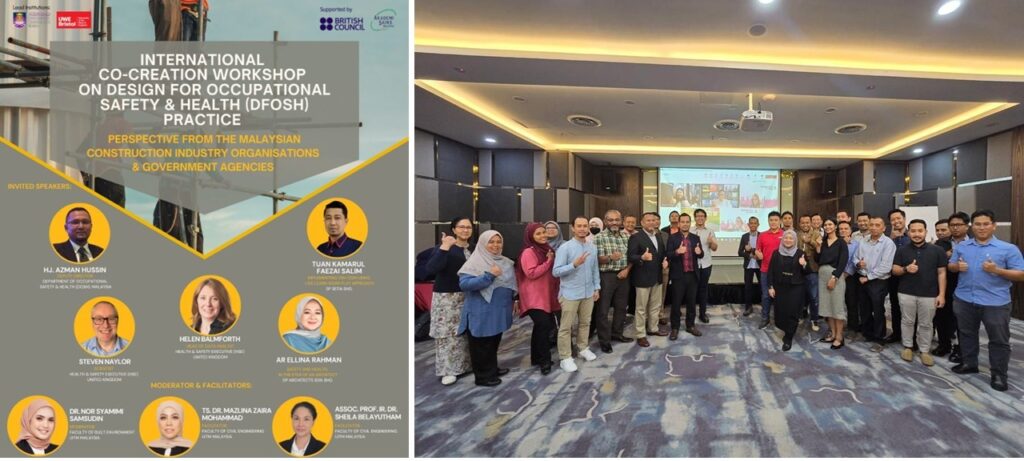
Two hybrid workshops were organised in Malaysia to bring together a wide range of stakeholders from the construction sector and government agencies. The first was held in Selangor in June 2025, followed by a second in Johor in July 2025. Together, these sessions engaged over 60 participants from industry (including contractors, consultants, architects, engineers, and safety and health professionals) and government agencies (including Department of Occupational Safety and Health (DOSH), Public Works Department, and Construction Industry Development Board). The workshops created valuable dialogue on challenges and practical solutions (from the perspective of industry and government) for improving the integration of occupational safety and health in construction design practices.
Figure 1: July 2025 Workshop
Knowledge exchange – UK visit
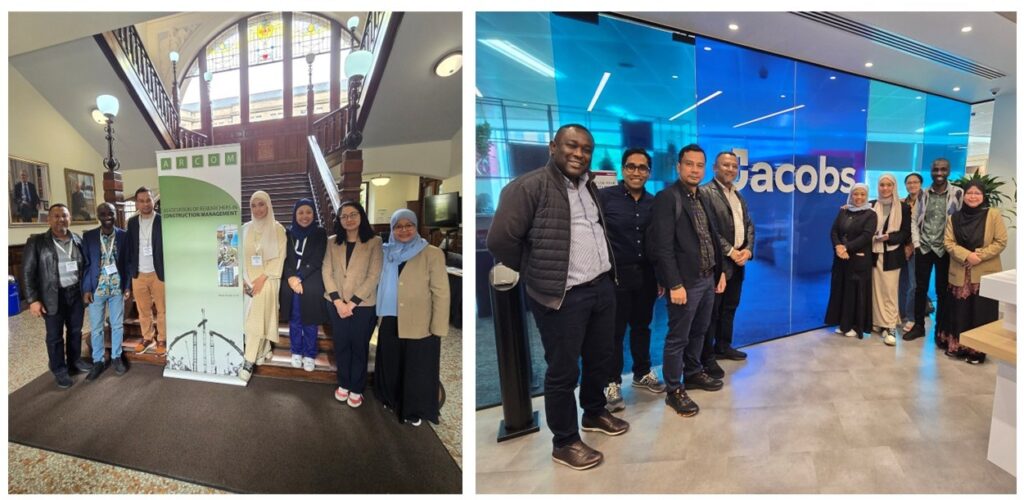
A Malaysian delegation (comprising members of the academic team and a representative of DOSH) visited the United Kingdom from August to September 2025 to strengthen international collaboration and exchange knowledge on DfOSH best practices. The delegation participated in the Association of Researchers in Construction Management (ARCOM) 2025 conference held in Dundee, where they shared the project’s initial findings with an international academic audience. The team visited Jacobs’ (a multinational engineering professional services (including design) firm) office in Manchester. During the visit, they learnt about Jacobs’ approach to DfOSH, which is encapsulated by their award-winning “de5ign” (pronounced ‘five in design’). To obtain DfOSH implementation insights from a regulator’s perspective, the team visited the Health and Safety Executive office in Buxton, where they received useful insights regarding UK’s DfOSH journey, challenges, and improvements over the years, as well as suggestions for Malaysia’s context. The delegation also visited academic partners at the UoM and the UWE. Overall, these activities provided significant opportunities for learning and for building lasting academic–industry–government linkages between Malaysia and the UK.
Figure 2: Members of the project team at ARCOM 2025 Conference (left) and during a visit to Jacobs (right)
Knowledge exchange – Guest lectures
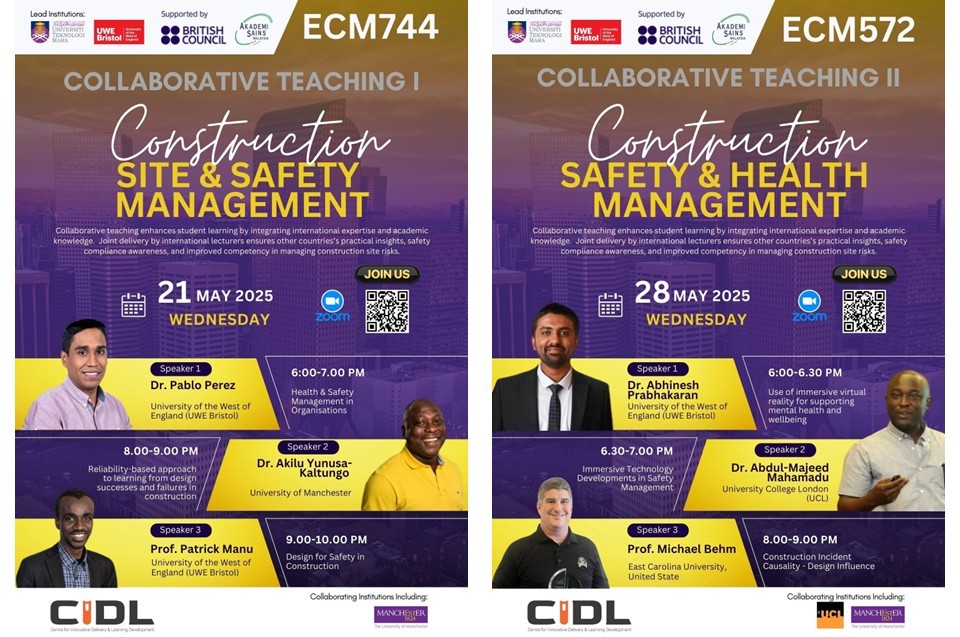
Guest lecture sessions on the Master of Construction Engineering course at UiTM (Construction Site & Safety Management) were delivered in May 2025. The sessions were delivered by project team members from UWE, UCL, UoM and a USA-based renowned academic in DfOSH. The lectures were attended by over 80 students who are also working professionals.
Figure 3: Line up of 2025 guest lecture series
Project Dissemination
To raise awareness of the project’s activities among stakeholders locally and beyond, several media posts have been made including use of social media and an article in a local news outlet. Furthermore, academic outputs (comprising a conference article [4]) and a journal article [5]) disseminating preliminary insights from the project have been produced. Overall, the dissemination has ensured wide reach of among academic, industry and government stakeholders.
Preliminary Outcomes
The project has yielded a tripartite co-creation framework that aligns the roles of academia, industry, and government to institutionalise DfOSH as a key mechanism for improving occupational safety and health in Malaysia. The framework is guiding stakeholder dialogue to identify and prioritise DfOSH implementation challenges and solutions. Additional outcomes include: 1) insights from the workshops are being used by DOSH to inform revision of a code of practice and training modules for trained persons under Malaysia’s CWDM 2024 regulations; 2) improved stakeholder awareness of CWDM 2024 regulations and early-stage design risk management; 3) enhanced practitioner and postgraduate competencies and shared understanding of DfOSH practices; and 4) a UK-Malaysia-Indonesia collaboration (funded by UK’s International Science Partnership Fund) which seeks to drive OSH improvement in construction beyond the implementation of DfOSH.
Acknowledgement
Members of UK team: Patrick Manu, Abhinesh Prabhakaran, and Pablo Perez (of UWE), Abdul-Majeed Mahamadu (of UCL), Clara Cheung and Akilu Yunusa-Kaltungo (of UoM), and representatives of partner organisation.
Members of Malaysia team: Che Khairil Izam Che Ibrahim, Sheila Belayutham, Mazlina Zaira Mohammad, Shafienaz Ismail, and Nor Syamimi Samsudin (of UiTM), Azman Hussain (of DOSH), and representatives of partner organisations.
4. Che Ibrahim, C. K. I., Manu, P., Belayutham, S., Cheung, C.M., Mohamad, M.Z., Yunusa-Kaltungo, A., Ismail, S., Samsudin, N. S., Prabhakaran, A., Perez, P., Mahamadu, A.-M. and Hussain, A. (2025a) Building a Safer Tomorrow: Tripartite Engagement and Co-Creation for Enhanced Design for Occupational Safety and Health in Malaysia. In: Thomson, C (Ed.) and Neilson, C J (Ed.), Proceedings 41st Annual ARCOM Conference, 1-3 September 2025, Abertay University, Dundee, UK. Association of Researchers in Construction Management, pp. 409-418.
On Friday, the 19th of June 2026, UWE Bristol will host Digital Construction and AI: Who’s in Control? The third edition of a growing annual conference series that has become an increasingly valuable platform for dialogue across the built environment. Taking place at Bristol Business School, UWE Bristol, Frenchay Campus, the event will bring together voices from industry, academia, research, and the next generation of built environment professionals for a timely conversation about the future of digital construction.
The conference is organised through the MSc Building Information Modelling (BIM) programme at UWE Bristol, with support from CABER – the Centre for Advanced Built Environment Research. CABER’s work spans interdisciplinary built environment research, with a strong commitment to sustainability, innovation, and the digital transformation of the built environment. That makes it a particularly fitting home for a conference focused on the opportunities, risks, and implications of AI in construction.
Over the last two years, this conference series has evolved into much more than a one-day event. It has provided a space for researchers, practitioners, professional bodies, students, and industry leaders to come together to challenge assumptions, share practical insights, and examine the sector’s changing direction. Last year’s conference, Digital Construction Climate Nexus 2025, focused attention on the relationship between digital construction and climate action. The CABER blog described a programme that combined research, knowledge transfer, industry contribution, and doctoral engagement, reinforcing the value of connecting academic thinking with practice-based innovation.
This year’s theme shifts the focus to a different, but equally urgent, issue: control. As AI becomes more embedded in digital workflows, design support, information management, compliance checking, and decision-making, it is beginning to reshape how choices are made across the built environment. The question is no longer only what AI can do, but also what it means for human judgment, accountability, responsibility, governance, and professional practice. The conference is designed to explore those questions critically, and to do so across both industry and academia.
The programme will include opening contributions from UWE, CABER, and key professional networks, followed by a live debate between industry and academia on the conference theme. In the afternoon, a series of breakout rooms will allow for deeper discussion around research, standards, interoperability, inclusion, innovation, and applied case studies from practice. The event is not intended as a passive listening exercise; rather, it is designed as a forum for discussion, challenge, exchange, and the development of new connections.
By Freya Wise, Alice Moncaster, Hector Archila and Tavs Jorgensen
On the 3rd of December Caber ran an action-packed hybrid event to mark COP30. After a short introduction reflecting on the COP30 outcomes we then had excellent presentations on three natural building materials which UWE researchers are involved with: bamboo, cob and timber. This blog reports the highlights of the session for a wider audience.
Reflection on COP30 by Dr Freya Wise
The reflection on COP30 by Freya highlighted that the overall outcomes were felt to be disappointing and lacked ambition but were not as bad as they could have been and that a range of useful things were achieved. It will be interesting to see if taking forward the fossil fuel and deforestation roadmaps outside the official COP process will actually allow them to be more ambitious and progress more quickly with willing countries.
Concerns were highlighted around a lack of acknowledgement of the latest climate science from the IPCC in the final document and the dropping of language on the need to fight misinformation. From a positive perspective however this was the first COP for several years in a countries where mass protests are possible and had strong civil society and cultural engagement around the city of Belem, including from high numbers of indigenous people.
Specifically on the built environment, Freya identified a number of initiatives, guides and standards were launched at COP which have positive relevance. These included the Belém health action plan, United Nations Environment Programme (UNEP), ‘Beat the Heat’ initiative, and the Bélem ‘call for action for sustainable and affordable housing’ as well as initiatives on circularity and low carbon materials. If these are enacted, they will have positive implications for decarbonising the built environment and links to all can be seen at the end of the article.
Following on from some of the initiatives at COP around low carbon and biobased materials, we then had three engaging short talks on three different natural materials.
The benefits of Bamboo by Dr Hector Archila
Hector took inspiration for his talk from the ‘BambooBoost Initiative’ from the UN Framework Convention on Climate Change (UNFCC) and the International Network for Bamboo and Rattan (INBAR).
Hector explained that bamboo is a very sustainable material with rapid biomass production which translates to a high yield and excellent CO2 sequestration in both the biomass and the soil. Bamboo, which is actually a grass, is one of the fastest-growing ‘woody’ plants and thrives on degraded land. Over fifty years a tropical bamboo species produces between 5 and 8 times more biomass than Scots Pine and Oak, resulting in 5 to 8 times as much carbon sequestration as those trees over the same period.
Figure 1: Carbon yield for bamboo and selected wood
Hector highlighted that, according to UNFCC, if bamboo were cultivated on around 70-174 million hectares of degraded forestland it could sequester roughly 2 Gt of CO2 annually (for reference Spain and Portugal combined are cover about 68 million hectares). This would equate to 2% of current global greenhouse gas emissions and would also deliver significant net economic benefits. In terms of climate action, it therefore makes a lot of sense to plant bamboo forests which will produce carbon and fibre rich biomass in 4–6-year periods which can then be used in long-lived products to act as carbon stores.
In terms of biodiversity enhancements, Hector suggested that if more bamboo was planted less wood forest would need to be used thus reducing deforestation and providing ecosystem services. Bamboo forests themselves also have good biodiversity with a plethora of animal species. Bamboo can provide ecosystem and community resilience for the many people who rely on solid biomass for cooking such as charcoal or briquettes, with fast growing highly renewable biomass. Bamboo can also be converted to gas or pellets to provide a source of electricity and heating, thus reducing deforestation and use of fossil fuels
Finally, research at UWE by Hector on the project SmartBioC has shown how Biobased Building Systems for UK housing using engineered bamboo as the main structural component can provide better Natural, Human and Social benefits than traditional building systems used in the UK.
Figure 2: One of the biobased systems Hector has developed
Innovative earth building research at UWE by Dr Tavs Jorgensen
Tavs provided an introduction to cob or earth as a local, low carbon building material with a long history of use and increased research interest in recent decades. However, challenges were also highlighted with traditional cob construction around the thicknesses required to meet insulation levels in modern building regulations and the length of time that building traditional cob walls requires.
Tavs then discussed the research that he has been leading at UWE to investigate how to use 3D printing processes to make dies to extrude cob bricks in different shapes, which has the potential to substantially speed up the production process while allowing creativity in the creation of different brick shapes and forms.
Figure 3: Extrusion equipment and extruded cob bricks
Work has taken place to engage students in this research through competitions and a ‘Cob Club’ as well as a number of wider hands-on workshops exploring the qualities of different earth and the potential of the material. A ‘Cob Comp’ (cob competition) in 2024 enabled UWE students to explore extruded cob block technology and the winners’ ideas were used to successfully build a shelter on the University grounds.
Figure 4: The bricks and the shelter created by Cob-Comp in 2025
Tavs also took the opportunity to launch this year’s iteration of the competition, Cob Comp 2: Earthly Enquiries. This is an ideas competition to design a structure built from pressed earth brick units of students’ own ingenious designs and from materials found only within the boundaries of UWE’s Frenchay Campus. The competition aims to explore the structural capacities and concepts of making and building with compressed earth. There are plans to build the winning design in summer 2026.
Tavs therefore highlighted both the benefits of innovative methods for cob and the importance of engaging students in hands-on research and creativity.
Sustainable timber and biogenic carbon standards by Professor Alice Moncaster
Alice highlighted the new principles for Sustainable Timber Construction and which were officially launched at COP30 (see link below). Alice then went on to give a quick introduction to lifecycle assessment (LCA) which measures the carbon emissions associated with the whole life of a material including its extraction, manufacture, transport, installation, maintenance and end of life disposal.
Figure 5: Lifecycle stages
She then discussed how the biogenic carbon stored in natural materials (and then released back into the atmosphere at the end of the of the material’s lifespan), is treated in a range of national and international standards on whole life carbon reporting. Biogenic carbon storage is one of the key benefits of natural materials and is particularly valuable in buildings as they theoretically last a long time, thus storing carbon for many decades (but not permanently). For a full LCA, the biogenic storage in phases A1-A3 is then reemitted in phase C, while most standards currently require that if only upfront carbon is assessed, biogenic carbon is reported separately.
Alice discussed multiple standards and reported on discussions at a recent meeting of International Energy Agency (IEA) Energy in Buildings and Communities (EBC) Annex 89, ‘Ways to implement net-zero whole life carbon buildings’. Climate science says that biogenic carbon is not equivalent to fossil carbon and cannot be added together. The discussions therefore focussed on whether biogenic carbon should be reported separately throughout all LCAs. This does not mean that the biogenic storage of natural materials is not useful and positive but does highlight that it is not a simple silver bullet and cautions against some of the evangelical calls for over-building with timber as a form of carbon removal from the atmosphere.
Alice therefore opened the discussion and posed some questions on how we should be reporting sustainable timber use for everyone to consider.
Summary
The session was well received the main concern seemed to be that we would all have enjoyed more time for discussion! During the questions Hector made a very good point that no natural material is ‘The Solution’ on its own and what is actually needed is a balanced diet or menu of the most appropriate materials for different scenarios and locations. We look forward to continuing the discussion.
Links to further information from all the presentations
Trondheim is just outside the Arctic Circle, and late November means limited daylight and plenty of snow and treacherous ice. Winters are not as cold as they used to be however according to our host. This is an increasingly common refrain. And while you might not mind milder winters, the excessively hot summers and increasing disasters around the world are making it absolutely crystal clear that we all need to do whatever we can to limit carbon emissions and climate change.
Nidaros Cathedral and Trondheim by night
I was in Trondheim at the Norwegian University of Science and Technology (NTNU) for two events trying to address the 40% or so of our carbon emissions which are from the construction and operation of our buildings. The first event was a conference, part of the long-established Sustainable Built Environment (SBE) series. I first attended an SBE conference in Helsinki in 2011, and over the years they have led to the development of a shared community of practice around the world. I particularly enjoyed Trondheim’s SBE25 Cities and Climate Change. Organised by Rolf Andre Bohne and colleagues, and Scientific Committee led by Freja Rasmussen, it had a distinctively friendly and open atmosphere, which had a noticeable impact both for early career researchers (who were less nervous), and for more senior researchers (who were less combative!). Of the research shared, I’d pick out the ARV project presented by Niki Gaitani (NTNU) and others, and the INDICATE-LIFE project presented by Giovanna Cassavia (TU Graz) and others, for special interest.
I was also proud to present (CABER Visiting Prof) Morwenna Slade’s beautifully illustrated paper (Blenheim Palace! Medieval churches!) explaining how understanding the vulnerabilities of individual heritage buildings, combined with projected localised climate change, can help develop maintenance plans towards future resilience – and how this ‘conservation philosophy’ can also be applied to improve resilience across all buildings. On the second day I then presented my former student Jon Andrew’s paper based on his MSc dissertation, which explored the motivations and actions for the new student accommodation at UWE – why Passivhaus was supported, while aspirations for net zero whole life carbon were dropped.
Conference dinner at E.C.Dahls brewery with new colleagues and old
The conference illustrated again for me how important direct and personal communication is. We are bombarded with webpages and reports and social media notifications (yes, I see myself 🙂 ) every day, and yet nothing works as well as talking to each other. This is a problem, as only a few have the opportunity; there is a very real financial limitation on who can attend conferences, and often, on top of that, personal limitations due to disability and caring responsibilities. So, while attending conferences is amazing, those of us lucky enough to be there need to remain conscious of the voices which aren’t heard. There were important lessons in all the papers presented, but how many will read them or even hear of them outside Trondheim, I wondered?
Alexander Passer, Operating Agent for Annex 89, presents to the group
The second half of the week was spent in a scientific meeting of the IEA EBC Annex 89, ‘Ways to implement net-zero whole life carbon buildings’. Colleagues from around the world came together to develop and discuss our emerging results and the variations in what is happening in the 30+ countries we represent. As a subtask 4 co-lead, I am particularly interested in gathering case studies which help us understand how the transition to low carbon buildings happens in practice – in projects, through industry initiatives, and in policy. How do we make it happen more widely?
A tour of the plant room in the ZEB Lab at NTNU
It was super interesting to hold the meeting in the Zero Emission Building Laboratory at NTNU, and to have a tour of the plant room. In sub-zero temperatures it clearly worked – and the mass timber construction, including the stairwell, made an attractive and comfortable environment. As a living laboratory, the building is also used as a demonstrator, and the plant room is huge just so that visiting groups can enter and see everything working.
But is this the future of the built environment? I think not. ‘Net zero’ means that the carbon is paid back over the years, but the construction still costs carbon upfront, even in timber. We don’t have the carbon budget remaining to rebuild our cities. In Europe we already have the building stock we need. Our dual focus now needs to be on retrofit and adaptation for future climates, and on social change to ensure everyone has a roof over their head.
Annex 89 participants braving the ice for a group photo
On September 2025, CABER hosted its first Industry Advisory Panel (IAP) meeting, marking a key milestone in our commitment to aligning academic research with the needs of industry, government, and society. The meeting brought together a diverse group of professionals to reflect on CABER’s research direction and explore opportunities for collaboration and impact, and on a longer term, to help ensure that our research is addressing the right issues, aligned with sector priorities, and delivering meaningful impact.
The discussion was framed around CABER’s three research themes: Digital Built Environment; Sustainable Design, Materials and Building Performance; and Property and Land in a Changing World. Here are some of the key takeaways generated within a very interesting couple of hours:
Addressing Practical Barriers to Innovation
The panel broadly agreed that while CABER’s research themes are well chosen, there’s a need to focus more explicitly on the real-world barriers that prevent innovation from being adopted in practice. These include time and budget constraints, particularly at the client level, which often limit the ability to experiment or implement change. Overcoming these barriers requires not just technical solutions, but also a cultural shift—one that highlights the tangible benefits of innovation, including financial, environmental, and operational gains.
Emphasizing the Human and Social Dimensions
Several contributions underscored the importance of incorporating social science and interdisciplinary approaches into CABER’s work. Innovation in the built environment is not just about new technologies or materials—it’s about people. Understanding how to influence mindsets, engage stakeholders, and shift behaviours is essential for sustainable transformation. This includes considering the client perspective, the role of end users, and the broader societal context in which construction and development take place.
Providing Evidence for Policy and Practice
There was strong support for CABER’s role in generating evidence-based insights that can inform policy and industry standards. Topics such as whole life and embodied carbon, maintenance strategies, and climate resilience were highlighted as areas where research can have direct impact. The panel encouraged CABER to continue producing data and analysis that can support decision-making at both strategic and operational levels, helping to bridge the gap between academic research and practical implementation.
Unlocking the Potential of Digital Innovation
Digital technologies, including AI and robotics, were discussed as promising tools to address challenges like the skills shortage and housing affordability. However, the panel cautioned that the success of these technologies depends on data quality, integrity, and accessibility. Effective information management, secure data storage, and open sharing practices are essential to ensure that digital innovation can be safely and meaningfully integrated into construction workflows.
Enhancing Research Impact
To increase the impact of CABER’s research, the panel proposed several strategies. These included developing short courses for industry professionals, integrating research with delivery mechanisms, and engaging with insurers and professional institutions to build the business case for innovation. Real-world case studies were also suggested as a way to ground research in practical contexts and demonstrate its relevance to current challenges.
Next Steps
Following this first meeting, CABER will continue to work closely with the IAP to ensure our research remains relevant, impactful, and responsive to the evolving challenges of the built environment.