


Authors: Freya Wise and Alice Moncaster
We’re very pleased that our latest paper has been published in Applied Energy and is now freely available at https://doi.org/10.1016/j.apenergy.2026.128895
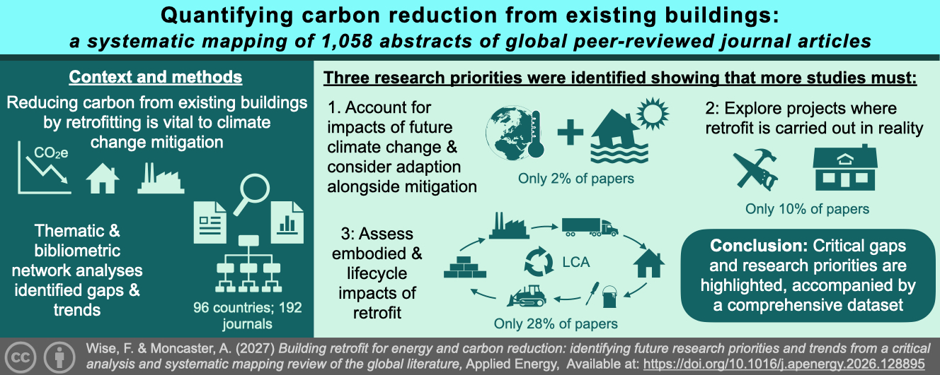
Around the world, our existing buildings need retrofitting to reduce their energy and associated carbon emissions and make them fit for the future. Building retrofit is therefore a critical activity for both climate change mitigation and adaption. Almost three years ago, in November 2023, Alice Moncaster and I decided to conduct a systematic literature review of the global, quantitative, academic literature on retrofit. This was partly in response to a question during the creation of the UK Net Zero Carbon Building Standard1, something like: ‘what do we know about the embodied carbon impacts of retrofit?’
As we started by investigating previous reviews in this field, we realised that there would actually be significant value in going back a step and creating a comprehensive, systematic mapping review of the trends and gaps in the broader field of building retrofit for energy and carbon reduction.
What did we do?
Our initial search terms produced 9,334 across, Science Direct, Scopus and JSTOR, which we narrowed down to a mere 1,408 for further review, focussing on peer-reviewed journal articles published between 2017-2024 (this involved a second search stage in January 2025 to update the review to all papers in published in 2024).
Our final dataset2 included 1,058 papers and we used detailed thematic analysis to assess the abstracts of these papers to identify topics, methods, types of retrofit and other aspects, and bibliometric network analysis to identify keyword and author clusters.
What did we find?
The research was published in 192 journals in multiple fields and covered 96 countries, although there was a strong research focus in Europe and China and a dearth of research in parts of Africa and in Oceania (Figure 1). Italy (110), China (105), the UK (81) and Spain (77) were the most researched countries. More research is therefore needed in under-examined areas and climates as the most suitable retrofits vary across regions.
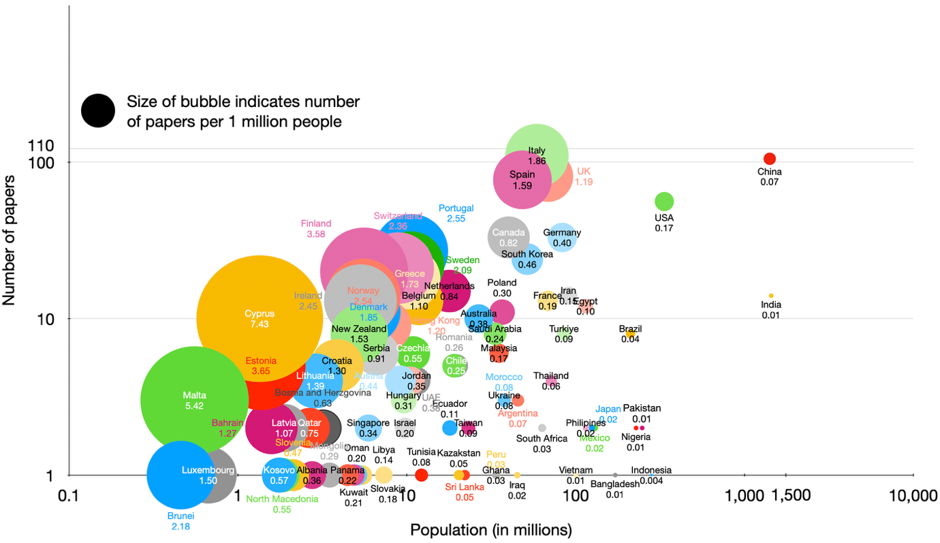
Figure 1: Bubble graph plotting the number of papers per million of population per country.
Alongside the need for more research in certain regions, we found three key gaps where further research is needed.
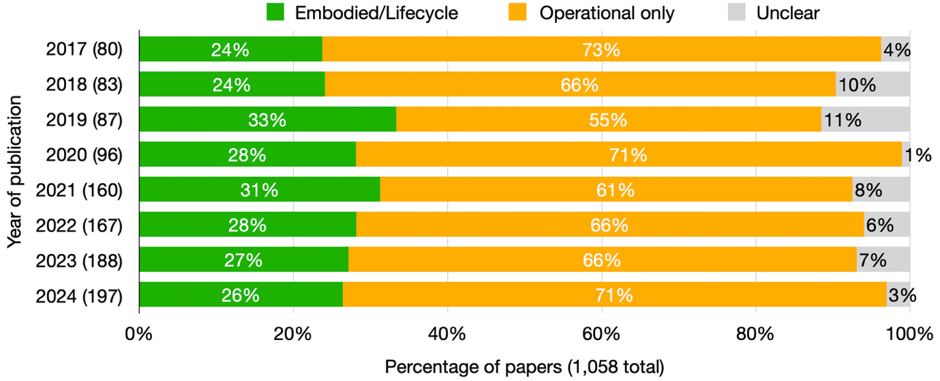
1. Just less than a third of papers considered embodied or lifecycle carbon, with the majority only focussing on the operational phase. Concerningly, this percentage didn’t meaningfully increase over the studied period (Figure 2). Neglecting embodied carbon means that the carbon cost is not considered and retrofits may actually be using more carbon than they save, or at least not making optimal savings. More retrofit studies should therefore include embodied carbon in a full lifecycle assessment.
2. Only around 10% of the papers examined the performance of retrofits in real life. The other 90% were based on modelling and simulation, which is concerning given the well-known performance gap between predicted and actual retrofit outcomes3. More studies of real world retrofit performance and comparison with and calibration of models is therefore critical to ensure that real savings are achieved.
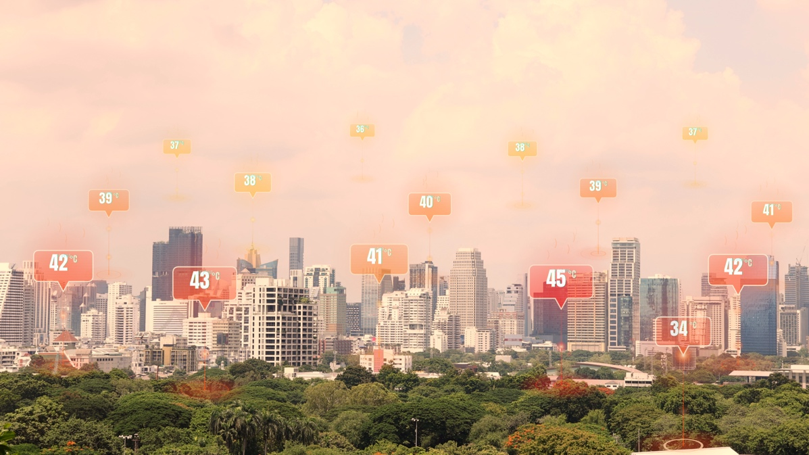
3. Most importantly, after this summer of global heatwaves, 98% of studies examine retrofit using past climate data. Only 2% of papers considered the effects of future climate conditions on retrofit performance. These studies identified that considering future conditions affected the most suitable retrofits to create carbon savings and make buildings fit for purpose in a changing climate. It is therefore vital that studies stop relying on historic data and start designing retrofit in response to predicted future conditions.
To explore all these findings and all the details please enjoy the full paper from: https://doi.org/10.1016/j.apenergy.2026.128895
We hope that this paper and the accompanying dataset of papers will inform and inspire new, targeted research in these critical areas.
References
1. UK Net Zero Carbon Building Standard https://www.nzcbuildings.co.uk
2. Full dataset of the analysed papers available at: 10.5255/UKDA-SN-857925
3. Preprint of our paper on energy modelling for heritage buildings which discussed the performance gap http://dx.doi.org/10.2139/ssrn.7536546


