
Human-Robot Collaboration in Construction project presented in UWE research events

Posted on

Author: Eduardo Costa

Last week was an eventful one! UWE hosted two events focusing on future directions of research and innovation. The first one was UWE’s Festival of Research, which brought colleagues from across the University together for inspiring talks, dynamic lightning presentations, eye-catching showcases, and a vibrant expo filled with interactive displays. The second one was Digital Construction and Artificial Intelligence: Who’s in Control? Organised by the amazing staff in the MSc BIM, and proudly sponsored by CABER, it brought together industry and academia to explore the opportunities, challenges, and future direction of AI in the built environment.

In both events, I had the pleasure to talk about a project I have recently started developing called CENTHAUR, an acronym for “human-centred, industry-informed human-robot collaboration for assembly-based timber construction”.

The CENTHAUR project

The CENTHAUR project stems from the understanding that current automation, enabled by advances in robotics, artificial intelligence and immersive technologies, is transforming many industrial sectors and has been widely framed as the fourth industrial revolution. Construction is increasingly following this trajectory, with robotic systems demonstrating benefits in precision, quality and productivity across both academic research and industry (Parascho, 2023; M. Tehrani, BuHamdan and Alwisy, 2022).  In particular, mobile robots have shown strong potential in addressing the dynamic and unpredictable environments typical of construction settings (Dörfler et al., 2016).

Despite these advantages, adoption of automation in construction has raised concerns regarding workforce displacement, unemployment and wage inequality (García de Soto et al., 2022). Moreover, approaches centred on full automation risk overlooking the complementary strengths of humans and machines. While robots excel at repetitive, hazardous or highly precise tasks, they often lack the contextual judgement, adaptability and holistic understanding that skilled workers routinely deploy on site (Parascho, 2023).

Human-Robot Collaboration (HRC) offers an alternative paradigm in which robotic accuracy is combined with human cognitive, embodied and experiential knowledge. Such approaches help preserve the cultural and social richness of construction labour, including tacit knowledge, craft traditions and the situated interplay between humans, tools and materials (Mitterberger and Dörfler, 2024). Assembly-based construction processes such as bricklaying, masonry, metallic frame structures and timber structures provide a relevant testbed for this paradigm, aligning with circular construction through its potential for disassembly and reuse (Yang et al., 2024). Timber is particularly relevant for being lightweight and sustainable, but also inherently variable: elements that share identical geometry can differ significantly in internal properties, introducing uncertainty that remains difficult to fully capture through digital models alone.

While existing HRC research in timber construction has predominantly focused on bespoke prototypes and experimental demonstrations, there remains a need to investigate scalable and industry‑relevant applications, particularly in offsite contexts. Offsite timber construction combines high levels of prefabrication with tight production tolerances, making it an ideal domain for exploring how robotic systems and human expertise can be productively integrated.

The project addresses this gap by developing and evaluating an integrated HRC framework specifically tailored to offsite, assembly‑based timber construction. The proposed solution centres on three components. First, it establishes a technological framework that integrates parametric design workflows, mobile robotics, extended reality (XR) interfaces and motion capture systems. Second, the framework is grounded in an empirical understanding of industrial practice. Through engagement with industry partners, resulting insights inform the configuration of collaborative robotic tasks and interaction protocols, ensuring that the proposed system responds to real operational conditions rather than idealised laboratory assumptions. Third, the research adopts an observational and iterative approach to evaluating collaboration itself. Human-robot interactions are analysed to assess engagement, spatial accuracy and task coordination.

Technological framework

At the current stage of the CENTHAUR project, we’re exploring the potential of the technological framework, experimenting with how to connect various hardware and software components into an integrated prototype that enables HRC within a lab environment.

To this point, we have been focusing in two main tasks: the first is connecting a robotic arm to a Computational Design system, in which timber structures can be virtually designed and planned, thus ensuring that the robot supports the construction of the designed structure, as well as adapt to events during the construction process.  The second task of the framework has been focusing on connecting the Design System with an Immersive Environment, currently composed of a Motion Capture system which enhances the precision of the whole system by mapping the physical and virtual models of the timber structure. Next steps include the integration of an Augmented Reality headset, which will enable human collaborators to better engage in the construction process, and a mobility solution comprising a linear rail, extending the reach of the robotic arm in the construction site.

This is the very first stage towards the exploration of HRC workflows in a lab environment. However, the vision is to start enquiring such workflows as soon as possible with the help of industry partners working with timber. Their insights on the potential of such approaches will be crucial to keep the project relevant and impactful in keeping the AEC sector up to speed in terms of technology, while keeping humans in the loop.


If you want to know more about CENTHAUR, check out the project page in the CABER website, or get in touch via email via Eduardo.Costa@uwe.ac.uk. The CENTHAUR project is being developed with the generous financial support from the Centre for Advanced Build Environment Research, and in collaboration with The Bridge Studios, namely with technical support from the amazing Technical Specialists James Knight (for robotics) and Michelle Wu (for immersive). Thank you all!

References

Dörfler, K., Sandy, T., Giftthaler, M., Gramazio, F., Kohler, M. and Buchli, J. (2016) Mobile Robotic Brickwork. Robotic Fabrication in Architecture, Art and Design 2016 [online]. pp. 204–217. Available from: https://link.springer.com/chapter/10.1007/978-3-319-26378-6_15 [Accessed 14 January 2025].

García de Soto, B., Agustí-Juan, I., Joss, S. and Hunhevicz, J. (2022) Implications of Construction 4.0 to the workforce and organizational structures. International Journal of Construction Management [online]. 22 (2), pp. 205–217. Available from: https://www.tandfonline.com/doi/abs/10.1080/15623599.2019.1616414 [Accessed 13 January 2025].

M. Tehrani, B., BuHamdan, S. and Alwisy, A. (2022) Robotics in assembly-based industrialized construction: a narrative review and a look forward. International Journal of Intelligent Robotics and Applications 2022 7:3 [online]. 7 (3), pp. 556–574. Available from: https://link.springer.com/article/10.1007/s41315-022-00257-9 [Accessed 14 October 2024].

Mitterberger, D. and Dörfler, K. (2024) Rethinking Digital Construction: A Collaborative Future of Humans, Machines and Craft. Architectural Design [online]. 94 (5), pp. 108–117. Available from: https://onlinelibrary.wiley.com/doi/abs/10.1002/ad.3103 [Accessed 2 July 2025].

Parascho, S. (2023) Construction Robotics: From Automation to Collaboration. Annual Review of Control, Robotics, and Autonomous Systems [online]. 6 (Volume 6, 2023), pp. 183–204. Available from: https://www.annualreviews.org/content/journals/10.1146/annurev-control-080122-090049 [Accessed 14 October 2024].

Yang, X., Amtsberg, F., Sedlmair, M. and Menges, A. (2024) Challenges and potential for human–robot collaboration in timber prefabrication. Automation in Construction [online]. 160, p. 105333. Available from: https://linkinghub.elsevier.com/retrieve/pii/S0926580524000694 [Accessed 11 October 2024].

Tripartite Stakeholder Engagement for Advancing Design for Occupational Safety and Health in Malaysia

Posted on

By: Patrick Manu [Professor at UWE] and Che Khairil Izam Che Ibrahim [Professor at UiTM]

In many countries, construction is one of the most dangerous sectors [1]. In Malaysia, the sector accounts for about one-third of worker deaths and many occupational injuries [2]. Studies have established that design is one of the key underlying causal factors in construction accidents and worker fatalities [3]. This has led to the prominence of the practice of Design for occupational safety and health (DfOSH) which entails designers ‘designing out’ occupational safety and health (OSH) risks at the early design stages of construction projects to protect workers.

In the UK, the Construction (Design and Management) Regulations (CDM) have been introduced since 1995 to mandate DfOSH implementation. In Malaysia, the Occupational Safety and Health (Construction Work) (Design and Management) (CWDM) Regulations 2024, which have been adapted from the UK CDM, have just recently been passed, as a measure to improve OSH performance of the construction sector. Currently, Malaysia is still at the initial stage of implementing DfOSH, while the UK has garnered many years of experience in DfOSH. The experience and lessons learnt in the UK with regards to challenges in DfOSH implementation and their solutions would serve as a useful resource for construction stakeholders (academia, industry, and government) in Malaysia in building strong DfOSH implementation capacity.

Against this backdrop, the University of the West of England (UWE) in collaboration with academic institutions in Malaysia and UK (Universiti Teknologi MARA (UiTM), The University of Manchester (UoM), and University College London (UCL)) are delivering an international project to advance DfOSH implementation in Malaysia via tripartite engagement of Academia-Industry-Government stakeholders to strengthen stakeholder capacity and co-create solutions to address DfOSH implementation challenges. The project entails a series of activities including stakeholder engagement and capacity strengthening workshops, knowledge exchange, and on-going dissemination. This blog offers excerpts of activities undertaken (in 2025), and preliminary outcomes.

Activities

Industry–government engagement and capacity strengthening

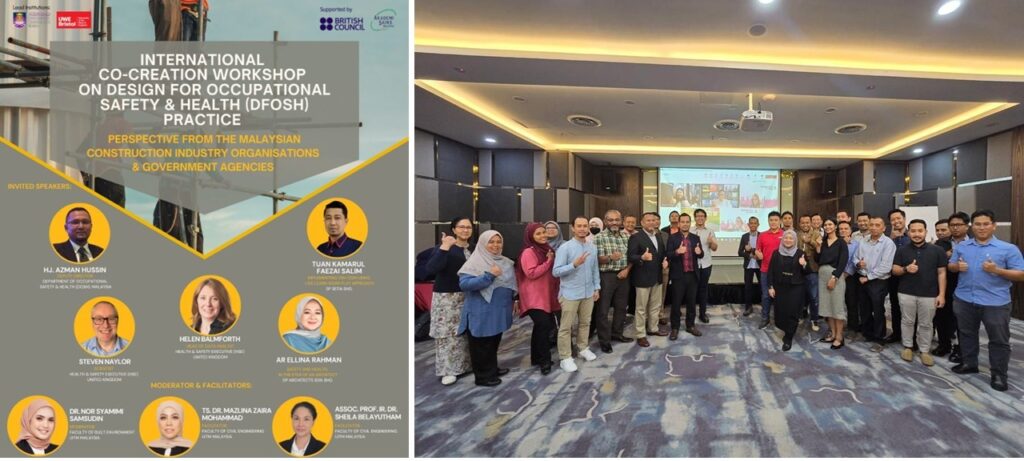
Two hybrid workshops were organised in Malaysia to bring together a wide range of stakeholders from the construction sector and government agencies. The first was held in Selangor in June 2025, followed by a second in Johor in July 2025. Together, these sessions engaged over 60 participants from industry (including contractors, consultants, architects, engineers, and safety and health professionals) and government agencies (including Department of Occupational Safety and Health (DOSH), Public Works Department, and Construction Industry Development Board). The workshops created valuable dialogue on challenges and practical solutions (from the perspective of industry and government) for improving the integration of occupational safety and health in construction design practices.

Figure 1: July 2025 Workshop

Knowledge exchange – UK visit

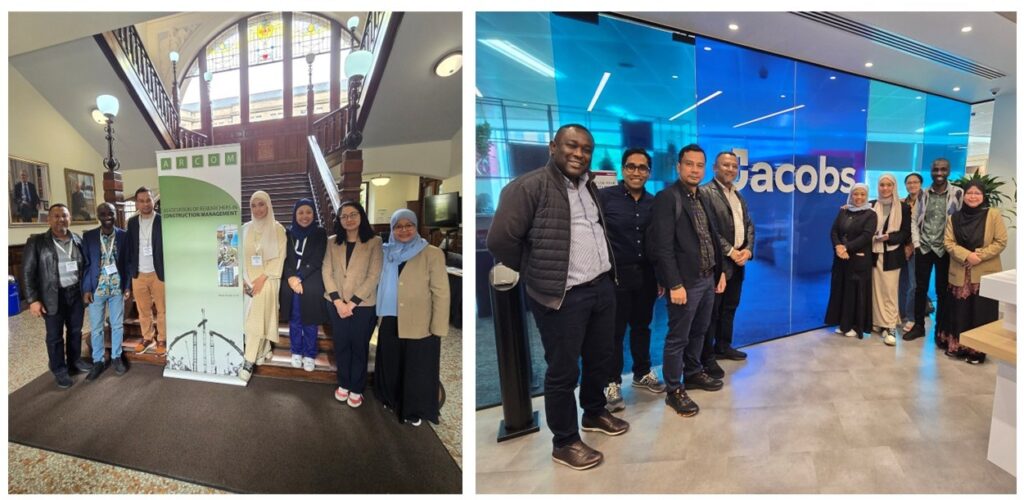
A Malaysian delegation (comprising members of the academic team and a representative of DOSH) visited the United Kingdom from August to September 2025 to strengthen international collaboration and exchange knowledge on DfOSH best practices. The delegation participated in the Association of Researchers in Construction Management (ARCOM) 2025 conference held in Dundee, where they shared the project’s initial findings with an international academic audience. The team visited Jacobs’ (a multinational engineering professional services (including design) firm) office in Manchester. During the visit, they learnt about Jacobs’ approach to DfOSH, which is encapsulated by their award-winning “de5ign” (pronounced ‘five in design’). To obtain DfOSH implementation insights from a regulator’s perspective, the team visited the Health and Safety Executive office in Buxton, where they received useful insights regarding UK’s DfOSH journey, challenges, and improvements over the years, as well as suggestions for Malaysia’s context. The delegation also visited academic partners at the UoM and the UWE. Overall, these activities provided significant opportunities for learning and for building lasting academic–industry–government linkages between Malaysia and the UK.

Figure 2: Members of the project team at ARCOM 2025 Conference (left) and during a visit to Jacobs (right)

Knowledge exchange – Guest lectures

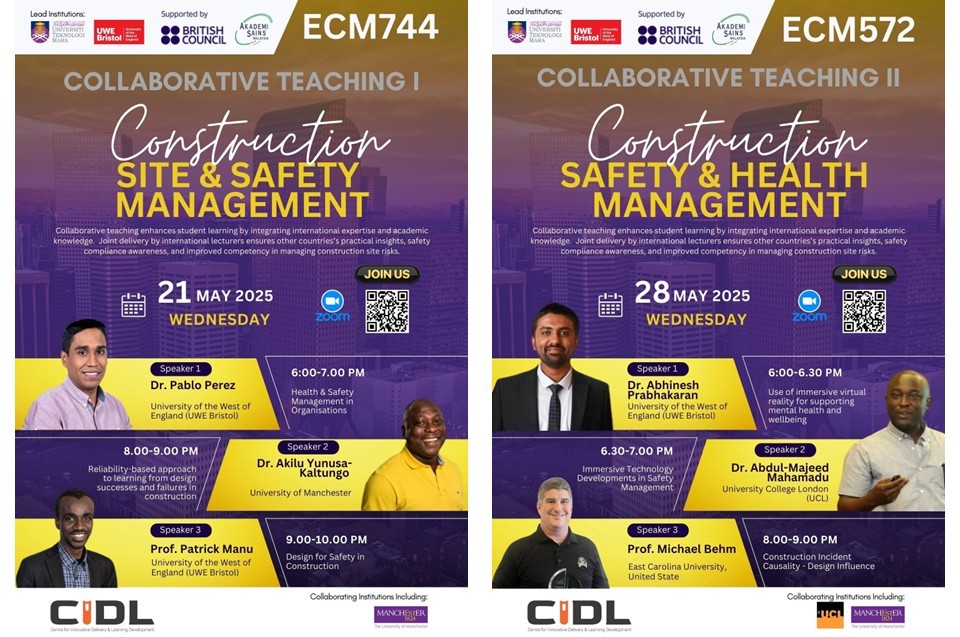
Guest lecture sessions on the Master of Construction Engineering course at UiTM (Construction Site & Safety Management) were delivered in May 2025. The sessions were delivered by project team members from UWE, UCL, UoM and a USA-based renowned academic in DfOSH. The lectures were attended by over 80 students who are also working professionals.

Figure 3: Line up of 2025 guest lecture series

Project Dissemination

To raise awareness of the project’s activities among stakeholders locally and beyond, several media posts have been made including use of social media and an article in a local news outlet.  Furthermore, academic outputs (comprising a conference article [4]) and a journal article [5]) disseminating preliminary insights from the project have been produced. Overall, the dissemination has ensured wide reach of among academic, industry and government stakeholders.

Preliminary Outcomes

The project has yielded a tripartite co-creation framework that aligns the roles of academia, industry, and government to institutionalise DfOSH as a key mechanism for improving occupational safety and health in Malaysia. The framework is guiding stakeholder dialogue to identify and prioritise DfOSH implementation challenges and solutions. Additional outcomes include: 1) insights from the workshops are being used by DOSH to inform revision of a code of practice and training modules for trained persons under Malaysia’s CWDM 2024 regulations; 2) improved stakeholder awareness of CWDM 2024 regulations and early-stage design risk management; 3) enhanced practitioner and postgraduate competencies and shared understanding of DfOSH practices; and 4) a UK-Malaysia-Indonesia collaboration (funded by UK’s International Science Partnership Fund) which seeks to drive OSH improvement in construction beyond the implementation of DfOSH.

Acknowledgement

  • Members of UK team: Patrick Manu, Abhinesh Prabhakaran, and Pablo Perez (of UWE), Abdul-Majeed Mahamadu (of UCL), Clara Cheung and Akilu Yunusa-Kaltungo (of UoM), and representatives of partner organisation.
  • Members of Malaysia team: Che Khairil Izam Che Ibrahim, Sheila Belayutham, Mazlina Zaira Mohammad, Shafienaz Ismail, and Nor Syamimi Samsudin (of UiTM), Azman Hussain (of DOSH), and representatives of partner organisations.

References

1. Eurostat (2025) Accidents at work statistics. Available online at https://ec.europa.eu/eurostat/statistics-xplained/index.php?title=Accidents_at_work_statistics

2. Department for Occupational Safety and Health (2021) Occupational Accidents Statistics by Sector January to December 2021 (investigated). Available online at https://intranet.dosh.gov.my/statistic-v/occupational-accident-statistics/occupational-accident-statistic-2021

3. Manu, P., Poghosyan, A., Mahamadu, A.-M., Mahdjoubi, L., Gibb, A., Behm, M. and and Akinade, O. (2019) Design for Occupational Safety and Health: Key Attributes for Organisational Capability. Engineering, Construction and Architectural Management, 26 (11), pp. 2614–2636.

4. Che Ibrahim, C. K. I., Manu, P., Belayutham, S., Cheung, C.M., Mohamad, M.Z., Yunusa-Kaltungo, A., Ismail, S., Samsudin, N. S., Prabhakaran, A., Perez, P., Mahamadu, A.-M. and Hussain, A. (2025a) Building a Safer Tomorrow: Tripartite Engagement and Co-Creation for Enhanced Design for Occupational Safety and Health in Malaysia. In: Thomson, C (Ed.) and Neilson, C J (Ed.), Proceedings 41st Annual ARCOM Conference, 1-3 September 2025, Abertay University, Dundee, UK. Association of Researchers in Construction Management, pp. 409-418.

5. Che Ibrahim, C. K. I., Manu, P., Belayutham, S., Cheung, C.M., Mohamad, M.Z., Yunusa-Kaltungo, A., Ismail, S., Samsudin, N. S., Prabhakaran, A., Perez, P., Mahamadu, A.-M. and Hussain, A. (2025b) Tripartite collaboration for design for safety in construction: A co-creation framework integrating academia, industry, and government. Safety Science, Article 107040.

Back to top

Follow this blog

Get every new post delivered right to your inbox.