

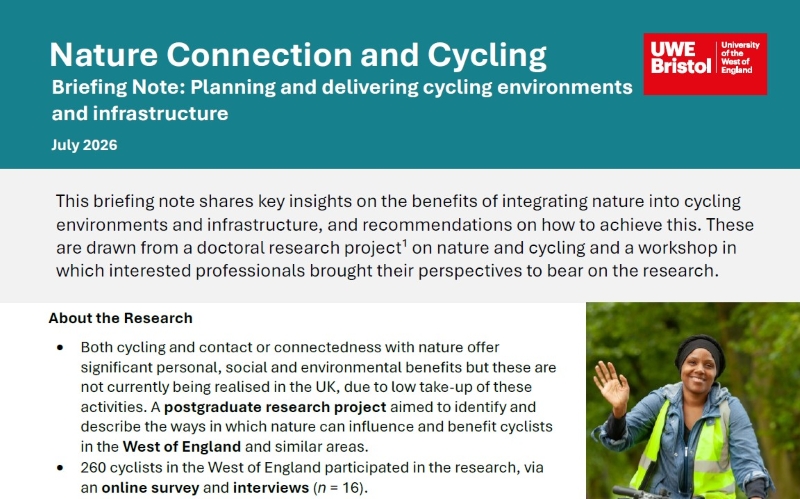
The top of the first page of one of the briefing notes.
By Mel Cairns, PGR Researcher
This blog post has been adapted from a recent post on UWE’s Centre for Public Health and Wellbeing blog.
A pair of Briefing Notes have recently been published on the UWE repository, outlining recommendations for integrating nature contact and connection into the planning, design and delivery of cycling environments, activities and promotion. The aim is to maximise the health and wellbeing benefits people can get from cycling, increase nature connection and improve cycling experiences.
The Briefing Notes were drafted based on my doctoral research about the role of nature for cyclists and a recent workshop with interested professionals, facilitated by myself, Professor Justin Spinney, and Dr. Asa Thomas from Centre for Transport and Society and Dr. Issy Bray, Director of UWE’s Centre for Public Health and Wellbeing. They are aimed at people who are working or volunteering in relevant roles, especially in the West of England and similar areas, and are available here:
Please share them with any colleagues and contacts who might be interested in using them in their work, such as urban and transport planners, designers and delivery teams, cycling campaigns, group ride leaders and anyone working in cycle promotion. A Nature Connection and Cycling LinkedIn group has been set up to facilitate the sharing of resources and case studies. Please contact me to request a link to join this group or if you have any questions about the group, Briefing Notes or the wider research.
About the research
My research formed the basis of the workshop content. The research used qualitatively-driven mixed methods to investigate and describe the role of nature in cycling experiences, outcomes and decision-making, through analysis of data generated with cyclists here in the West of England.
The research findings show that nature is a common and valued, yet underacknowledged, contributor to the wellbeing outcomes of cycling. The aesthetics, change and unpredictability of nature add interest to familiar routes and can draw attention in positive ways. When cyclists are able to notice and appreciate nature-rich environments that feel safe, they report positive experiences, ‘feeling better’ as a result. Even short sections of a route that enable these experiences can make a difference to cyclists. These positive experiences and outcomes can motivate some cycling, particularly for leisure, as well as being a factor in route choice across cycling activities. Links to conference presentations about the research can be found here: https://people.uwe.ac.uk/Person/melcairns
Workshop insights
My supervisor, Professor Justin Spinney, secured funding from UWE’s Public Engagement and Knowledge Exchange Fund, to collaborate with the West of England Combined Authority (WECA) on a Nature Connection and Cycling workshop. This involved participants from WECA, local councils, the Welsh government, the National Trust, NHS and independent consultants and ride leaders, for example. Research findings were shared with participants, who gave feedback and discussed how best to share them with relevant audiences who could apply the insights. These discussions informed the development of the briefing notes.
A key concern raised during the workshop was the importance of balancing differing needs and priorities, particularly in terms of considering groups that are more vulnerable or marginalised when it comes to cycling and/or nature access. Nature may be more of a barrier for these groups, so integrating nature and cycling (e.g., through rewilding along routes) risks further marginalising them, raising concerns about the equitable use of funds and resources. Human needs and preferences can also clash with optimal nature protection. There’s no simple, one-size-fits-all solution to these issues so these cautions have been included in the briefing notes as a case-by-case consideration.
Positive stories about cycling, including in relation to nature, and easier ways to find nature-rich routes that meet cyclists’ needs were also identified as enablers to encouraging cycling cultures and practices and improving cycling experiences. Participant comments, as noted and paraphrased by facilitators, included:
“Examples of good practice in highlighting nature are important to make the case.”
“Wayfinding on off-road routes needs to show what facilities are nearby. This needs to be well signed to ensure inclusion and encourage people to use such routes, showing that services might be closer to the routes than they might think.”
“Champions and storytellers within organisations can help normalise cycling and increase how it is valued by the organisational culture.”
Another issue raised by participants was about how guidance, regulations, appraisal processes, funding mechanisms and professional practices often prioritise transport, engineering or biodiversity outcomes in isolation, making it difficult to recognise and deliver the benefits of nature connection in active travel infrastructure schemes. Participants also noted limited awareness of nature connection principles and benefits among decisionmakers and delivery teams. It is hoped that these briefing notes will help to address this concern and make the case for greater integration.
Overall, the workshop was a really positive and enjoyable session. One of the facilitators commented:
“The interest and enthusiasm of workshop participants was energising and several expressed appreciation for the opportunity to come together and share learning about this under-explored topic.”
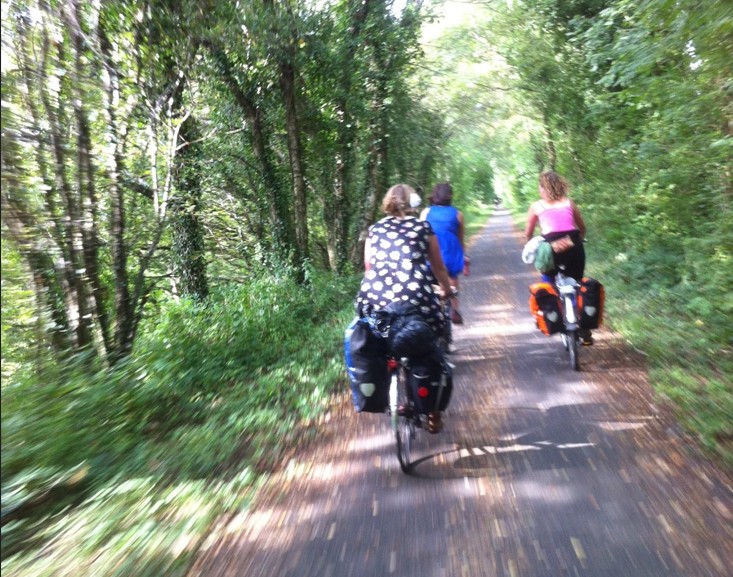
Three women cycling along a traffic-free path lined with trees. Photo credit: Lisa Muller, with thanks
Sharing these perspectives in the Briefing Notes
The draft recommendations from the research were amended drawing on the feedback from workshop participants, and themes from the workshop discussions, such as those mentioned above, were also included in the Briefing Notes.
Briefing Note 1 is aimed at people working or volunteering in planning and delivering cycling environments and infrastructure. Its recommendations focus on integrating nature contact and connection into cycle route planning and design.
Briefing Note 2 is aimed at people working or volunteering in planning and delivering cycling activities and cycle promotion. It focuses on how leaders of group rides and other cycling activities can incorporate nature contact and connection as well as how cycle promotion could lean into the positive experiences and outcomes of nature.
Both briefing notes aim to show how nature can be integrated into cycling environments and activities to maximise the benefits of cycling, improve cycling experiences and boost nature connectedness.
We are extremely grateful to WECA for their support and collaboration in planning and delivering the workshop, as well as to all the participants and the funder.
This blog was written by Mel Cairns, based on a project led by Professor Justin Spinney in collaboration with Associate Professor Issy Bray and Dr. Asa Thomas.
Mel Cairns is a Postgraduate Researcher at Centre for Transport and Society. Her current research explores the role of nature in cycling experiences and decision-making. She has previously worked on research and measurement relating to place-based wellbeing and sustainability.