

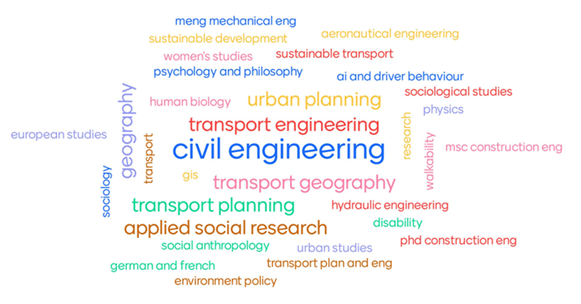
Figure 1: The interdisciplinary make-up of the Centre for Transport & Society
I see UWE’s interdisciplinary research Centre for Transport & Society has been around for 24 years now: why do we have a research centre specifically about ‘transport and society’?
CTS’s origins lie in the changing perspectives on the transport system and people’s travel, a shift that was underway by the 1990s. The ‘mobilities turn’ or ‘new realism’ questioned the domination of the transport sector by economic and engineering ways of thinking, arguing for an important role for the social sciences. CTS was one of a handful of new centres internationally which appeared at that time to focus on a more interdisciplinary, and particularly a more social science-oriented perspective. In our case, part of the ‘mission’ was to support the transport professions in the southwest as they engaged with the new approach.
Exactly how interdisciplinary is the Centre then?
It’s not something we track real-time, but a census of member qualifications a few years ago produced the word-cloud above. I think you’ll agree it’s diverse!
Yes, true, but however you dress it up, isn’t ‘transport’ mainly about moving people and things around the system efficiently and cheaply?
Yes, cost, journey times and reliability do matter, but the new approach emphasised that new transport technologies like the mass ownership of private cars had not just made existing travel faster but had changed both society and our way of planning space, with wide-ranging consequences.
Are you suggesting the car hasn’t played a socially progressive role?
Well, the car has brought new freedoms to some people and can generate strong and positive emotions. But it has also created social expectations around people’s ability to travel further, to a wider range of places. And that comes with cost and time burdens. What we have seen is entirely new travel patterns leading to a major increase in traffic and congestion. And, at the same time, these socioeconomic changes have excluded people without access to cars altogether. If that wasn’t enough, the ‘old regime’ failed to recognise the environmental and public health consequences of persistent congestion, rising vehicle emissions and falling physical activity levels which are largely due to the car.
I see. So, what is CTS doing to help address all these problems?
We have a wide-ranging research programme that addresses movement of people and goods across four themes: ‘Governance and equity’, ‘Transport planning and placemaking’, ‘Technological change’ and ‘Travel behaviour and the mobility experience’. There are currently around a dozen projects underway at the Centre of different scales and durations.
Sounds impressive, but is there any evidence you are making a difference to any of these many and big problems?
You’ll probably agree that ‘impact’ can be quite hard to pin back to specific research projects, but yes, we are currently working to understand our impact in a number of areas. The project ‘Triple Access Planning’ led to a debate around the need to ‘decide and provide’ for future demand, rather than simply predicting and providing. The approach has been adopted by public authorities around the world. The centre is also known for its evaluation studies, in helping to understand ‘what works’ in local transport planning, with recent work for the UK Government Department for Transport to understand the costs and benefits of initiatives such as providing flexible bus services and electric cycles in rural areas. The findings are helping to shape future policy and funding decisions. Other projects are changing the way local authorities think about freight; collecting design evidence to support the new highway code principle that pedestrians have priority at side-road crossings; understanding how women and people with caring responsibilities are influenced by the rise of ‘digital mobilities’; and assessing whether policy to support the electric car transition can be improved.
You mentioned that CTS emerged in response to past policy and practice problems: what about the future?
Well, as climate emissions increasingly becomes seen as a transport sector problem, due to its slow rate of change, we are redoubling our efforts to understand how ‘decoupling’ of society and the economy from fossil fuels can be achieved without social strife. One area we are turning our attention to is leisure travel and long-range travel and transport, for example the acceptability both of reduced air mobility and greener air mobility. Also, autonomous transport technologies were not something I mentioned earlier but have been a key area of industrial and academic collaborations in the last decade. And like all academics currently we are trying to ‘make sense’ of the digital and artificial intelligence revolution in our field. (AI was not knowingly used to produce this Q&A!)
I see you have a lot of collaborations beyond UWE, are you also looking to collaborate within the University?
We do a lot of work for the government in partnership with consultants and also collaborate with academics at other institutions, but yes, our virtual and physical doors are always open to discuss collaborations with UWE colleagues! As you might expect for an interdisciplinary research centre, we have full and associate members from all UWE three colleges and several departments. Past collaborations within UWE have been particularly strong with robotics and public health, but have also included economics, planning, environmental management, psychology, the visual arts, digital technologies and automotive engineering, plus any I forgot!
That’s quite a lot of information for a short Q&A session. What if I want to find out more about the work of the Centre or get involved?
Our website provides information about research themes, events, and members. You are welcome to reach out directly to specific members, or contact the Director, Graham Parkhurst. We also have an active blog and a LinkedIn page.
Lastly, what’s a good topic of conversation if I meet a CTS person in the corridor?
Don’t say: “Terrible traffic on the M32 this morning! I think I’m working from home tomorrow. Why don’t they build another lane?”
Do say: “Lovely run in on the ebike today! Great to have that nice wide cycle lane on the ring road. I feel fired up for my nine o’clock lecture!”