

by Sinead Ryan
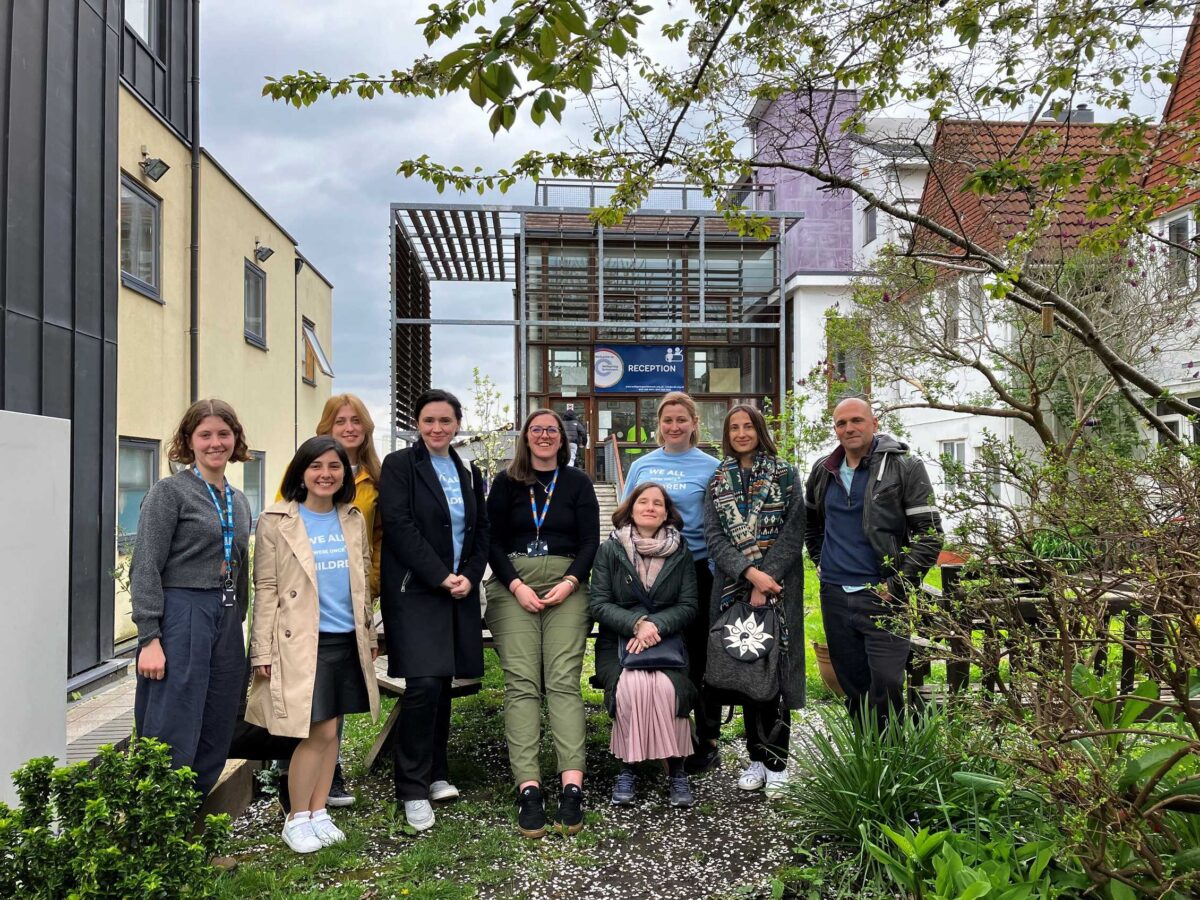
I am currently carrying out an internship with UWE Bristol’s World Health Organisation Collaborating Centre for Healthy Urban Environments. As part of my internship programme with UWE Bristol, I had the pleasure of attending a series of activities led by Dr Michael Buser in collaboration with the Voices of Children, a Ukrainian charity who were invited to UWE, where we attended events relating to creative art therapy over the course of a week.
On Monday, the founder of the Voices of Children, Olena Rozvadovska presented at UWE Bristol, joined with five of her colleagues, to showcase the work that they do. Ukraine has been in conflict since 2014 and Olena formally set up the charity in 2019. The Voices of Children are a charitable organisation who have worked to provide psychological and psychosocial support to children in Ukraine who are traumatised by war. The group recounted how after the invasion in February 2022, the lives of children in their country have become dominated by the war, with no child able to escape this reality. The VOC charity offers several support services which include online counselling, mobile teams of psychologists and facilitate camps for children and families affected by war. They also support rehabilitation services for children with special needs such as cerebral palsy and autism disorder. They discussed how children with autism can be highly affected by the disruption of war and the noise of bomb shelling’s can impact them to a greater extent. The group also offer training for psychologists, on how to specifically help children with PTSD, as many professionals had not dealt with such high-stakes counselling before.
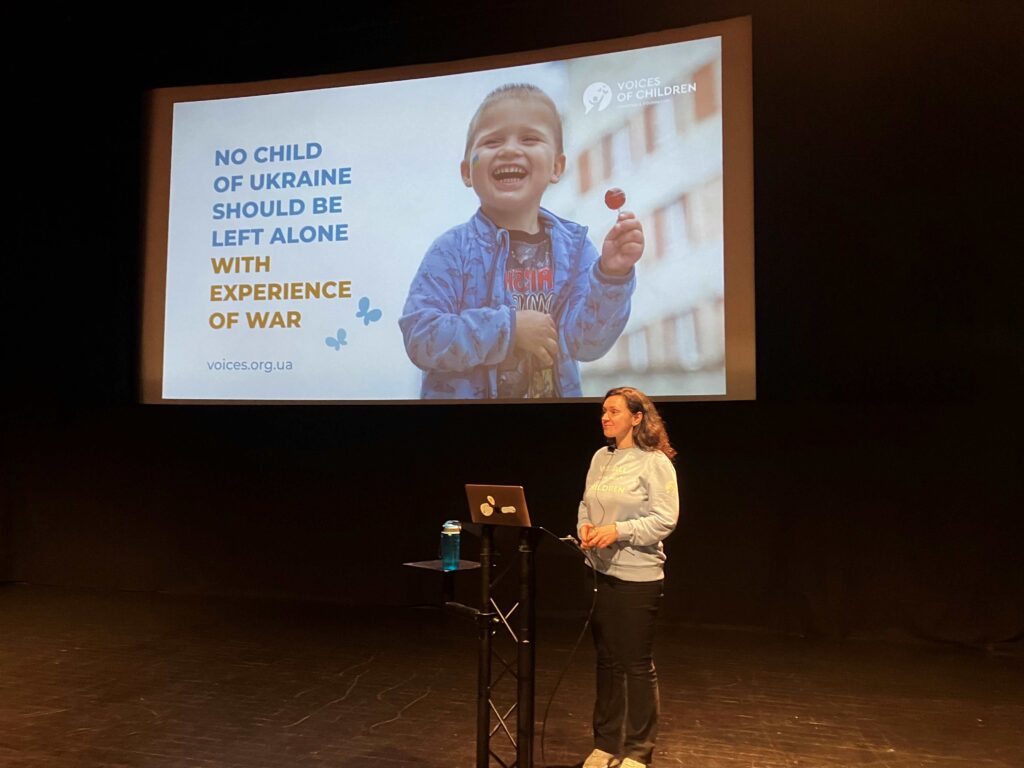
Olena Rozvadovska (Voices of Children) presenting at the Arnolfini on Friday 28th April 2022.
Olena described how they strive to deliver a potential option for children to attend 10 sessions of therapy. Therapy is not a one-stop shop, that can cure trauma in one dose. It is a gradual and ongoing process that requires patience and commitment. Children who are victims of war trauma need several therapy sessions to heal from their wounds and to grow from their experiences. The VOC team highlighted how the hardest part of the job, is not having the financial means to pro-long treatment or services for those who need them longer. The VOC group works tirelessly to give a voice to those most vulnerable victims of war – children. The children of Ukraine have faced displacement, unimaginable loss, witnessed violence and had disruption to their routine. Olena advocates for the importance of these children maintaining socialisation while they are deprived of their ordinary school routine and extra-curriculars.
The VOC group use traditional psychotherapy but also contemporary therapy approaches, including art therapy and engaging with nature. They described how being in nature was one of the most healing experiences they see for children. For these children, their green spaces are corrupted or unsafe, and the freedom to roam in a safe natural environment is abundantly healing. The VOC services help thousands of young people across Ukraine to reclaim their childhood and their future. The group were keen to develop their art therapy approaches and learn from the activities currently available in Bristol and to bring ideas for interventions back to Ukraine.
On Wednesday, I accompanied the group to a workshop at UWE Bristol with Julia Matthews, an art therapist who leads art expression groups in Bristol. She demonstrated some of the art therapy techniques which she uses in her group art sessions. Her colleague Nicola Holt, a psychologist here at UWE, discussed how she has been helping Julie to evaluate these classes and analyse how they benefit participants mental health. While this is not explicitly ‘art therapy’, whereby participants divulge trauma in the groups, they instead allow the art to become a healing process itself. She discussed how they have noticed improvements in mood and wellbeing after the classes and can measure this using evaluation forms.
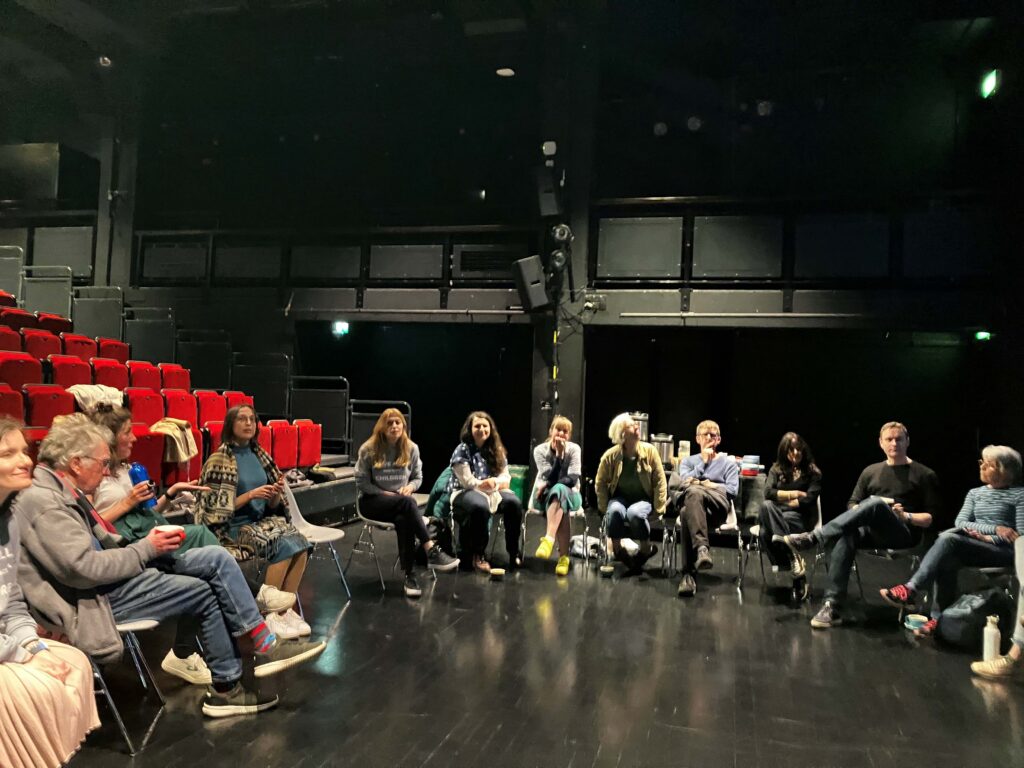
A group discussion at the Arnolfini in Bristol
Later that day, we took a trip to Barton Hill Settlement, in Bristol, to meet the Hope Asylum Seekers and Refugee Trauma Service, an NHS organisation who provide support for young refugees and asylum seekers, typically unaccompanied minors. Here, we met with two clinical psychologists, Juliet, and Anna, who discussed the approaches of therapy that they offer for those with severe trauma, including narrative exposure therapy, group therapy and creative therapy methods which they have found to be effective at dealing with PTSD. The therapy offered here is centred around grounding and creative a safe environment where one would be empowered to participate in psychotherapy. They discussed working with translators, widely varied cultures and working against the resistance to share vulnerability and how art can be a useful tool for this.
On Thursday, we attended Bath Spa University where we met with Agata Vitale, a psychologist who has adapted a narrative therapy method based on Ncube’s ‘Tree of Life,’ in settings of trauma. Agata ran through a how these therapy sessions would be conducted with this symbolic tree representing different aspect of one’s life. We participated in drawing and describing our own trees, and throughout the activity there was a sense of reflection, focusing on and realising the positives in our lives. It was useful to do in a group setting as we could all share our stories and celebrate the uniqueness and diversity in our lives, while still finding common ground to connect with. Agata described that this would naturally occur in her workshops, with participants often finding a sense of camaraderie or friendship between each other along the journey. At the end of the activity, we all agreed it felt healing and we could understand how Agata had used the therapy in previous settings to heal trauma and allow people to focus on the positives in their lives.
On Friday, the Voices of Children gave a final presentation at the Arnolfini in Bristol, where members of the public were invited to join. After a formal presentation by Olena, an informal discussion group encouraged attendees to ask questions about the organisation. Overall, the week showcased the ways that various forms of art therapy are being used in settings of trauma, to heal both adults and children and the potential for this form of psychological support. This demonstrated the real-life benefits of art therapy, and the promise of its cultural sensitivity, flexibility and how it is befitting in these environments of PTSD. Through all the workshops, which discussed different mechanisms of art therapy, similar themes emerged, suggesting it was a tool for building resilience, connecting with the human experience, and offering a platform to work through trauma. It was a privilege to hear the stories of the Voices of Children charity group, who are working in extensively difficult circumstances, yet still work with a message of hope and determination to keep fighting and a strong mission to provide opportunity for the next generation of Ukraine.