

by Yarden Woolf
A few weeks ago, I arrived in Stockholm for the International Federation of Landscape Architects (IFLA) World Congress. This was both my first time in Sweden and my first international conference, as well as the first time I would be presenting my research to professionals and academics from outside of the UK. One of the most unique aspects of this congress was that it was held simultaneously in Stockholm and Nairobi, Kenya. Throughout the three-day events, I got to listen to traditional live Swedish and African music, try some local dishes and hear from leading planners about projects in both countries, from conservation efforts aimed at saving the landscapes of the Masai Mara, to the challenges of the climate crisis and how they affect and transform contemporary Swedish landscape architecture.
One key-note lecture that left a particular impression on me, was delivered by Hitesh Mehta, an architect and landscape architect and President of HM Design. Hitesh spoke of the importance of AI, but not the one you are probably thinking of. You see, by AI he means Ancestral Intelligence – the knowledge of elders, of history, and how that can and should influence the way we plan and design for a sustainable future. As examples, Hitesh spoke of case studies he was involved in, such as the Masai master plan to protect local landscapes, Aitong Sustainability Centre (Masai Mara Centre for Sustainability – Olmanyara), and the first visitors’ centre to ever be designed in a national park in Kenya, at the base of Mt. Kilimanjaro. In all these examples, he emphasised the community engagement aspect of design, and particularly the importance of incorporating the knowledge of the elder members.
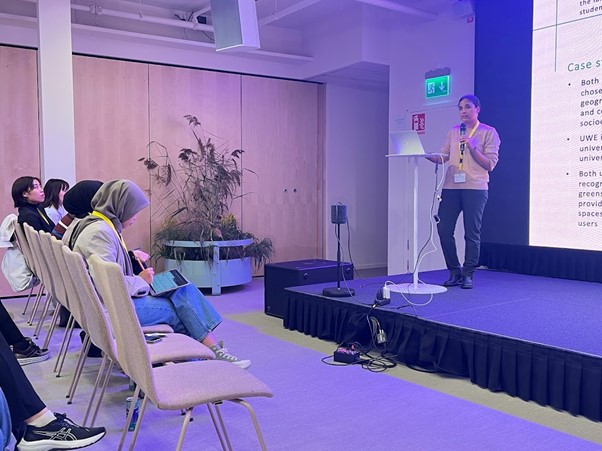
During the second day of the conference, I had the opportunity to present my research so far. I described my literature review, research aims and questions, and shared details of my upcoming methodology and plans for the next year at UWE Bristol. This was a great opportunity for me as I received feedback as well as answered questions and made new personal and professional connections with those who attended my lecture. As part of this session, I also had the privilege of hearing from other landscape architects about their research and projects across several countries, such as Sweden, Indonesia, and China.
On the last and final day, I joined a tour of the Stockholm seafront, guided by landscape architects and architects from Nivå Landskapsarkitektur and Sveriges Architecter. This tour focused on Djurgården Royal Park and the surrounding developments and canal. To me, the most fascinating landmark was Gravitational Ripples, the Swedish 2004 Indian Ocean Tsunami Memorial by Lea Porsegar. The design for the hidden memorial site was taken from the ‘gravitational waves’ phenomenon, first predicted by Albert Einstein. These waves occur when two celestial bodies orbit each other, spinning closer and unleashing energy which creates ripples in space-time itself. The memorial was built to represent this pulsating movement, and I found it to be both beautiful and emotional. As I walked in and around it, I felt serene and inspired, and this reminded me of how landscape design can shape experience and emotion. These are some of the topics my PhD research is focusing on.

As I left Stockholm, I reflected on my time in this wonderful city, the connections I have made and how I hope my thesis will encompass some of the fascinating lessons I learned here. I would like to take this opportunity to thank the SPE, and particularly my Director of Studies, Prof. Danni Sinnet, for making this trip possible.