Leadership, Language and Visualisation project

Posted on

This transformative research project is carried out in collaboration between three universities: London Metropolitan University, Oxford Brookes University and The University of the West of England (UWE Bristol) and a pioneering multinational company. The study is funded by two leading research institutions: British Academy of Management and The Society for the Advancement of Management Studies.

Although there has been substantial research into the experiences and practices of inclusivity and its links to leadership, much of what we know so far is based on traditional research carried out and published mainly in the English language.  This does not reflect linguistic and cultural diversity in contemporary global organisations and societies and its implications for everyday interactions at work. We argue that a much more nuanced, contextually and language sensitive perspective is needed to unpack what inclusivity looks like in contemporary organisations. We have therefore set to out to explore inclusion (and exclusion) in different languages and from the perspective of different cultures.

More specifically we seek to explore:

  • How is inclusion and exclusion experienced by staff in different roles and work contexts in a leading global contemporary organisation?
  • What do meaningful inclusion and exclusion practices look like in daily interactions between individuals and in teams?
  • What are the barriers and enables of inclusion for individuals, teams and the organisation as a whole?

We will then consider how meanings might change during the translation process to create new ways of thinking about inclusivity. This responds to calls for more reflexivity about language and translation in organisation, management and leadership studies.

Participation in the study involves taking part in a research interview with one of our researchers using photo elicitation. Participants bring photographs that capture their experiences of inclusion and exclusion within the organisation to the interview.  All interviews are run in a relaxed atmosphere where we then discuss the photographs and related questions. Our participants have praised the non-judgemental, safe space that we create which is an ideal setting to reflect differently on one’s experiences and organisational practices. Here are some excerpts from testimonials we have received:

“It was a very safe space in that I felt comfortable speaking out about my good (and bad!) experiences regarding inclusion (or lack thereof!)”

“The interview was great! I really enjoyed it.”

“The study has made me reflect and helped me stop excluding myself. Thank you! ”

Participants regularly comment that they appreciate the opportunity to discuss experiences in a ‘non-work’ setting and share their perspective so as to positively impact upon future workplace practices and policies.

The study is designed to make a positive contribution not only to academic debates but also to practice and the experiences of our research participants and their colleagues. Upon completion of the study, our findings and report will be shared and discussed with the partnering organisation. All participants will receive a summary of our findings. The opportunity for a positive impact is significant. As our participants have observed:

It will help shape [our] inclusion practices and help contribute to a more positive environment going forward.

“Inclusion needs to come from the inside out, so if we’re an inclusive employer then we can be inclusive for our customers too. But to be as inclusive as possible, we need to know what we are currently doing…This interview is your chance to help answer that and help [us] be as inclusive as possible.

The study ‘should help [understand] how we see each other, what makes us who we are. Having difficult conversations is all part of us moving forward.

Research is in progress, and we are currently actively recruiting participants. In particular we are looking for German, Irish, Austrian and Czech participants from our partnered international company so that we can best deliver on our goal of tapping into diverse language and cultural contexts.


Once we have completed an interview we begin analysis, this process has already started for interviews that have already been completed. The analysis involves examining the similarities and differences in representations of inclusion in the pictures, narratives in the original languages and scripts that have been translated by professional translators into English.  Translators fully engage the research team in the translation process, working closely with us to explain their decision-making rationales as texts are translated. This transparency enhances our ability to interpret and analyse the data more accurately.

This multi-layered approach allows us to explore how the concept of inclusion takes on meaning and is experienced both within and across different linguistic and cultural and socio-political contexts.

Why this matters:

We foresee that this research will improve knowledge in the area of leadership practices across cultural, socio-political and linguistic contexts; advance research methods by applying visual methodologies to the study of language translation and advance organisational practice by highlighting the linguistic intricacies of inclusivity agendas and their influence on the lives of employees.

If you’re working in our partnering organisation and would like to find out more or take part in our study please reach out to us as we’d really like to hear from you.

You can contact Gareth on gareth3.edwards@uwe.ac.uk who will put you in touch with one of our researchers responsible for data collection in your division’s respective language.

If you would like to follow our progress or find out more about the project in its entirety, look out for future blog articles and social media updates.


We are a seven-person strong multilingual and multi-disciplinary research team with expertise in leadership, critical management studies, sociology, anthropology, HRM, applied linguistics and visual methods. Our team includes: Professor Doris Schedlitzki (London Metropolitan University), Dr Sylwia Ciuk (Oxford Brookes University), Professor Gareth Edwards, Dr Harriet Shortt, Professor Hugo Gaggiotti, Dr Jana Patey and Dr Kay Galpin (UWE Bristol). We have partnered with an innovative organisation which has offices across several countries, including Germany, Italy, England, Ireland, Austria and Czech Republic.

Gareth Edwards – Principal Investigator

Director of Research and Enterprise and Professor of Leadership and Community Studies at the University of the West of England. Gareth’s research centres around the idea of distributed or dispersed leadership, but taking this approach to leadership from a community perspective. Access Gareth’s full profile here.

Email: Gareth3.Edwards@uwe.ac.uk

Gareth_edited.jpg

Screenshot 2024-06-26 at 16.16.37.png

Sylwia Ciuk Lead researcher

Reader in Organisation Studies and the Deputy Head of OBBS Doctoral Programmes at Oxford Brookes University. Sylwia often builds innovative research methods into her research designs. In the past she has developed a range of methodological innovations, such as narrative photo collages and experiential maps. Access Sylwia’s full academic profile here.

Email: s.ciuk@brookes.ac.uk


Doris Schedlitzki Lead researcher

Doris is Professor of Organisational Leadership and the Head of Research at Guildhall School of Business and Law, London Met. Doris’ main research focus is on leadership and explores the areas of cultural studies of leadership, discourse and leadership, leadership as identity, psychoanalytic approaches to leadership and the role of national language within cultural leadership studies. Access Doris’s access here

Email: d.schedlitzki@londonmet.ac.uk

Doris.jpg

Hugo.jpeg

Hugo Gaggiotti – Lead Researcher

Hugo is a Professor at the Faculty of Business and Law at the University of West of England. His research focus centers on the intersections between leadership, organizational narratives and professional mobility from an interdisciplinary organizational ethnographic approach. Access Hugo’s full Profile here. Email:Hugo.Gaggiotti@uwe.ac.uk


Harriet Shortt – Lead Researcher

Harriet is Associate Professor in Organisation Studies at the University of West of England (would you want to mention your secondment here?) Harriet’s research focuses on organisational space, artefacts, and the materiality of work. She has expertise in qualitative research methods including visual methodologies, specifically, participant-led photography.  Access Harriets full profile here. Email:Harriet.Shortt@uwe.ac.uk

Harriet.jpg

Jana Patey.jpeg

Jana Patey – Research Associate 

Jana is a Researcher at the University of West of England. She holds a PhD from the University of Essex and the University of Suffolk in the area of workplace relations, affect and psychoanalysis. She has expertise in applying qualitative methodologies and has worked as a Researcher on several research projects including a longitudinal work on workplace wellbeing and productivity. Access Jana’s full profile here. Email:Jana.Patey@uwe.ac.uk


Kay Galpin Research Associate

Kay is a Researcher at the University of the West of England. She holds a Phd from this university in the area of storytelling interventions and organisational change. She has an expertise in the application of qualitative research methods and is part of an a research and practice community called ‘The Unleadership Movement’ that is interested in creative enquiry exploring how leaderly practices can develop. Access Kays full profile here. Email:Kay.Galpin@uwe.ac.uk

Kay.jpg

Dr. Harriet Shortt: 2024 The Planner’s Woman of Influence 

Posted on

Bristol Leadership and Change Centre (BLCC) at Bristol Business School, University of the West of England, is incredibly proud to congratulate our very own Dr. Harriet Shortt on being named a 2024 Woman of Influence by The Planner.

Harriet has been named one of 54 Women of Influence in 2024 for her pioneering work in developing innovative methods for inclusive and participatory engagement within the urban planning and placemaking process. 

As an active member of BLCC, Harriet’s research has focused on bridging the gap between academia and industry practice. Her ground-breaking “Picturing Places” project, shortlisted for a 2023 Planning Award, exemplifies this approach. Using visual arts-based methods, Harriet engaged local communities and stakeholders, translating their values and experiences into a series of key performance indicators to embed within a masterplan from conception through to implementation. 

Harriet’s research has explored vital issues like the design of workplaces for hybrid environments and how the creation of inclusive spaces can foster cultural change within organizations. She has collaborated with organisations such as Stride Treglown, ISG, Argent LLP, Aster Housing Group, and the RFU on supporting this type of organizational transformation through authentic public engagement. 

At BLCC, we have greatly benefited from Harriet’s dual roles as an academic researcher and industry practitioner. As head of visual engagement at BiBO Studio and founder/director of SHORTt CONSULTING, she continually tests and implements her research findings within real-world planning and design projects. This integrated approach ensures her work generates tangible social impact. 

In response to receiving this award Harriet said:

“I’m delighted to have been listed as a Woman of Influence 2024 by those working in the placemaking industry. Not only is it great to be recognised for the work I’m doing, but I think this demonstrates how public engagement and knowledge exchange – where we as researchers working with industry and wider communities – can really add social value. It highlights the value of working at the nexus between academia and industry, and that impact beyond academia is fundamental to research success”. 

We are immensely proud to have Harriet as a core member of the BLCC team. Her passion, creativity, and commitment to inclusive placemaking embody the highest values of our research group. Congratulations, Harriet, on this well-deserved recognition! We look forward to your continued groundbreaking work and impact for years to come. 

Reclaiming Leadership in Higher Education

Posted on

This is a re-blog from Richard Bolden on the ILA blog in which he discusses the challenges facing higher education leadership and asks those of us working in HE to reflect on what we can do to reclaim our role(s) and responsibilities as leaders in our organizations.

I have spent the past two and a half decades working as a leadership researcher and educator in UK universities. Throughout much of this time I have studied leadership in higher education (HE) as well as experiencing it first-hand. I have taken on leadership roles — both formal and informal — and have witnessed the trials and tribulations of colleagues as they have endeavoured to navigate the complexities of this context. In this article I share reflections on what I have learnt, why it matters, and what we can (all) do to enhance the quality and inclusiveness of leadership in this important sector.

Why Higher Education Leadership Matters

To begin it’s worth considering why HE matters for leadership theory, practice, and development. My own interest in researching leadership in this context was sparked by early work on distributed leadership in schools (e.g., Gronn, 2003; Spillane et al., 2004). HE provided an obvious testbed for exploring how such ideas might apply to other educational settings — particularly those with more complex structures, cultures, identities, and performance outcomes. Although there is fairly widespread agreement that the key purpose of effective school leadership is to improve pupil outcomes (Leithwood et al., 2006), the same does not apply to universities. Whilst student outcomes are undoubtably important metrics — and if you are a student, parent, or potential employer, perhaps the ones that concerns you most — this is not the only criterion by which HE institutions (and their staff) are evaluated. Another essential area of activity for universities is research — typically assessed in terms of “high quality” publications as well as by the volume of funding secured. Alongside this are agendas for external engagement and impact, not to mention the very real concerns of keeping universities running as viable businesses. Together, the diversity of stakeholders and priorities in HE produces a complex and contested environment where people and organizations may feel pulled in different directions. Such issues are not unique to HE but do make it an interesting context in which to study leadership, with important insights for emerging areas of scholarship, including complexity leadership (Uhl Bien, 2021), paradoxical leadership (Smith, et al., 2016) and collective leadership (Ospina et al., 2020).

At the center of any analysis of leadership is the interconnection between purpose, values, and identity, yet the somewhat schizophrenic nature of academia disrupts these dynamics in ways that can produce a sense of disenchantment, disengagement, and alienation. The HE system (in the UK and elsewhere) is founded on competing values systems — emphasizing both normative aspects (such as public service, professional autonomy, collegial practice, and traditions) and utilitarian principles (such as profit-making, corporate management, customer service, and change), such that a university “considers itself (and others consider it), alternatively, or even simultaneously, to be different types of organisations” (Albert & Whetten, 1985, p. 270).

The hybrid nature of HE poses particular challenges for leaders trying to establish credibility and legitimacy in the eyes of those they seek to influence, as different stakeholders identify “more with members of their own subcultures rather than as members of the university” (Winter & O’Donohue, 2012, p. 566). This is particularly true of academics who, as knowledge workers, carry professional identities and affiliations that extend well beyond their immediate employer. Whilst these, and other factors, make HE a particularly rich and rewarding context in which to study leadership there remains surprisingly little robust empirical research in this area and the HE leadership literature tends to be fragmented according to the perspectives and ideologies of different groups (Macfalane, et al., 2024).

Crisis, What Crisis?

The conceptual complexities of leadership in HE may, in part, help explain some of the difficulties facing the sector. Universities were particularly hard hit by the COVID-19 pandemic (PWC, 2021) and whilst the immediate crisis may have passed, it has exposed deep-seated issues that have (by and large) remained below the surface for many years. In particular, accounts of “toxic” management are linked to widescale dissatisfaction, industrial action, and recruitment challenges in the sector (Watermeyer et al., 2021).

In a series of focus groups conducted as part of a project for Advance HE in Sept-Dec 2021 colleagues and I asked participants about the shifting context of global higher education (Watermeyer et al., 2022). Five key areas — policy, society, funding, students, and staff — were highlighted as impacting perceptions, experiences, and practices of leadership in contemporary HE. While the specifics of contextual issues varied between institutions and countries, there was strong agreement across the groups that current changes are producing tensions and challenges that are hard to resolve, as outlined in the following quote from a participant in Roundtable 1 with Heads of Departments and Deans.

“What we’ve seen… is this need [to]be agile and really responding to what is happening, straight now, but at the same time be someone who is looking ahead, at the same time as somebody who has that emotional intelligence to deal with not only their student population who is changing dramatically, but the needs of our staff and our whole pedagogy is changing? What do leaders need to do? How do they need to act? How do they need to be?” (p. 27).

In Britain, declining numbers of international students are putting huge pressures on a funding system dictated by government such that a third of universities are estimated to be trading at a deficit (Jenkins, 2023). In such circumstances it is hardly surprising that “bottom-line” financial performance metrics are of primary concern to senior institutional leaders, as are ranking schemes that determine the relative attractiveness of institutions to potential students.

Such measures, however, tend to be of far less significance to academics themselves in terms of what motivates and inspires them to work in HE. The growing divide between academics and managers is reported to be fueling extensive discontent within the sector, as indicated by unprecedented levels of industrial action across the UK (and elsewhere) throughout 2023 and reports of a “great resignation” (Ross, 2022).

Follower Perspectives on Leadership in Higher Education

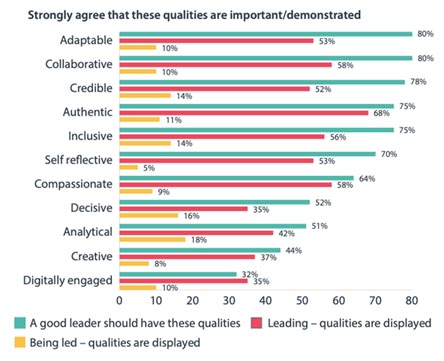
Within the Advance HE scoping study mentioned earlier, participants were asked to identify “what new or future leadership skills/competencies/behaviours are required within your organisation, professional area and/or wider sector?” Thematic coding identified 11 categories, which were incorporated into a subsequent survey completed by 553 respondents from around the World (Neves & Parkin, 2023). Figure 1 shows the proportion of respondents who strongly agreed that these qualities were important for good leaders within HE, as well as the extent to which they felt they demonstrated these qualities themselves (when leading) or observed these qualities within the people they were expected to follow (being led).

Chart for Richard Bolden Blog. Strongly Agree that these qualities are important/demonstrated. Green - A good leader should have these qualities Yellow - Being led - qualities are displayed Red - Leading - qualities are displayed. Adaptable. Green 80%; Red 53%; Yellow 10%. Collaborative. Green 80%, Red. 58%, Yellow 10% Credible: Green 78%. Red 52%. Yellow 14%. Authentic. Green 75%. Red. 68%. Yellow 11% Inclusive: Green 75%. Red 56%. Yellow 14% Self reflective. Green 70%. Red. 53%. Yellow 5%. Compassionate. Green 64%. Red 58%. Yellow 9%. Decisive. Green 52%. Red 35%. Yellow 18%. Creative. Green 44%. Red. 37%. Yellow 8%. Digitally engaged. Green 32%. Red. 35%. Yellow 10%.

Figure 1 – Chart based on those who “agree strongly” with each statement — the top point on a five-point agreement scale. Ranked in order of whether a good leader should have these qualities (Neves & Parkin, 2023: 9) [Reproduced with permission from Advance HE]

There is a clear pattern within the data, whereby good HE leaders are expected to be adaptable, collaborative, credible, authentic, inclusive, and self-reflective (with compassion also ranked highly). Participants rated their own capacity moderately highly on each of these qualities (albeit it consistently lower than the ideal). The most striking finding from this graph, however, is the huge gap between each of these rankings and perceptions of those people currently in leadership roles.

Follower perspectives (“being led”) suggest a gulf in expectations and experiences of leadership. Whilst it should be noted that there is no evidence to suggest that these negative assessments are reflective of the actual skills/qualities of senior leaders (indeed it is quite possible that many of these people are amongst those who rated their own capacity moderately highly) it highlights a significant issue to which senior leaders would be advised to pay attention.

Reclaiming Leadership in Higher Education

Follower-centric perspectives on leadership stress the importance of building strong relationships between leaders and followers that are founded on trust, respect, and a shared sense of purpose. The evidence outlined above suggests that this is not the experience of many people currently working in HE — a situation that has significant implications for the sector.

If we continue along the current trajectory the chances are that HE may slip into terminal decline (Fleming, 2021). A chasm between the values and priorities of those in formal leadership and management roles and those of academics involved in teaching, research, and/or external engagement will lead to further disillusionment with the academic profession and a corresponding deterioration in the quality and significance of academic work. This is a trend that has been well documented in critiques of neoliberalism and new public management in universities. So, what might we as academics (with or without management responsibilities) do to improve the situation?

First, we should acknowledge our rights and responsibilities as “citizens of the academic community” (Bolden et al., 2014) to play an active role in the governance of our HE institutions and the wider sector. Disengagement, whilst understandable, leaves space and opportunities for toxic management to thrive and may render us complicit in the process.

Second, as part of this we would do well to create and sustain spaces for critical and constructive debate around the nature and purpose(s) of HE in contemporary society. Whilst this should allude to and promote core values (such as academic freedom) it should also engage with the very real challenges facing many universities around financial sustainability and market position. Only through an honest and open dialogue can we hope to transcend the current fractures that characterize the sector.

Third, we need to ensure that a plurality of voices, perspectives, and lived experience infuse HE policy and practice. Genuine inclusion needs to be put at the heart of the educational mission of universities and used as a driver for continuity and/or change within the sector (see Bolden et al., 2019 for a similar argument about healthcare).

Fourth, we should rebuild our sense of community — to develop human relationships that have been fractured during the COVID pandemic, to mentor and support one another, and to celebrate collegiality and collective endeavour.

And fifth, we should find ways of (re)energizing and (re)inspiring current and future academics to embrace the privilege and opportunities of working in a sector that has such a huge impact on the lives of so many. Education and research are vehicles for individual and collective transformation and change and are the primary mechanisms through which we are likely to address global challenges such as climate change.

In relation to the last of these I was inspired by a recent LinkedIn post by colleague that reiterated his passion for the job (see below). As we reflect on the year that’s passed and consider the year ahead, I urge each of us to think on what WE can do and how, in our own (small) way, we can reclaim our role(s) and responsibilities as leaders in higher education.

Another term draws to a close 🌱

Each year, as September rolls around I always find myself thinking “I hope that I still love teaching and learning as much this year”. The sign that I finish off the term being simultaneously proud of students; grateful for the opportunity to be a small part of their journey; inspired by conversations; excited by the content; and sad for it to be over is a good one.

It’s no doubt that our world faces multiple crises, and that will continue, but being in this environment fills me with hope that generations want to understand what is happening in our landscape and want to put good into the world. Spending the time to delve into the human condition and understand new possibilities is what university is all about, and why I love this job.

So – here’s to accepting the feeling of sadness as a term draws to a close, but hope for what comes next 🌱

Dr Neil SutherlandLinkedIn – 13 December 2023 [Reproduced with author’s permission]

References

Albert, S., & Whetten, D.A. (1985). Organizational Identity. In L.L. Cummings & M.M. Staw (Eds), Research in Organizational Behavior, Vol. 7 (pp. 263‒295). JAI Press.

Bolden, R., Gosling, J., & O’Brien, A. (2014). Citizens of the Academic Community: A Societal Perspective on Leadership in UK Higher Education. Studies in Higher Education, 39(5), 754-770. https://doi.org/10.1080/03075079.2012.754855

Bolden, R., Adelaine, A., Warren, S., Gulati, A., Conley, H., & Jarvis, C. (2019) Inclusion: The DNA of Leadership and Change. UWE, Bristol on behalf of NHS Leadership Academy, Leeds. https://uwe-repository.worktribe.com/output/852067/inclusion-the-dna-of-leadership-and-change

Fleming, P. (2021) Dark Academia: How Universities Die. Pluto Press.

Gronn, P. (2003). Leadership: Who Needs It? School Leadership & Management, 23(3), 267-291. https://doi.org/10.1080/1363243032000112784

Jenkins, S. (2023, February 6). British Universities Can No Longer Financially Depend on Foreign Students. They Must Reform to Survive. The Guardianhttps://www.theguardian.com/commentisfree/2023/jun/02/british-universities-foreign-students-deficits-government-higher-education

Leithwood, K., Day, C., Sammons, P., Harris, A., & Hopkins. D. (2006). Successful School Leadership What It Is and How It Influences Pupil Learning. National College for School Leadership. https://dera.ioe.ac.uk/id/eprint/6617/2/media-3f6-2b-what-we-know-about-school-leadership-full-report.pdf

Macfalane, B., Bolden, R., & Watermeyer, R. (2024) [Forthcoming]. Three Perspectives on Leadership in Higher Education: Traditionalist, Reformist and Pragmatist. Higher Educationhttps://link.springer.com/journal/10734

Neves, J., & Parkin, D. (2023). Leadership Survey for Higher Education. Advance HE. https://www.advance-he.ac.uk/knowledge-hub/leadership-survey-higher-education

Ospina, S.M., Foldy, E.G., Fairhurst, G.T., & Jackson, B. (2020). Collective Dimensions of Leadership: Connecting Theory and Method. Human Relations, 73(4), 442-463. https://doi.org/10.1177/0018726719899714

PWC. (2021). Global Crisis Survey 2021: Building Resilience for the Future. PWC Research. https://www.pwc.com/gx/en/issues/crisis-solutions/global-crisis-survey-2021.html

Ross, J. (2022, July 8). ‘Do It All’ Culture ‘Driving Great Resignation’ in Academia. Times Higher Educationhttps://www.timeshighereducation.com/news/do-it-all-culture-driving-great-resignation-academia

Smith, W.K., Lewis, M.W., & Tushman, M.L. (2016). ‘Both/And’ Leadership. Harvard Business Review94(5), 66-70. https://hbr.org/2016/05/both-and-leadership

Spillane, J.P., Halverson, R., & Diamond, J.B. (2004). Towards a Theory of Leadership Practice: A Distributed Perspective. Journal of Curriculum Studies, 36(1), 3-34. https://doi.org/10.1080/0022027032000106726

Uhl-Bien, M. (2021). Complexity Leadership and Followership: Changed Leadership in a Changed World. Journal of Change Management, 21(2), 144-162. https://doi.org/10.1080/14697017.2021.1917490

Watermeyer, R., Bolden, R., Knight, C., & Holm, J. (2022). Leadership in Global Higher Education: Findings From a Scoping Study. Advance HE. https://www.advance-he.ac.uk/knowledge-hub/leadership-global-higher-education-findings-scoping-study

Watermeyer, R., Shankar, K., Crick, T., Knight, C., McGaughey, F., Hardman, J., Suri, V., Chung, R., & Phelan, D. (2021). ‘Pandemia’: A Reckoning of UK Universities’ Corporate Response to COVID-19 and Its Academic Fallout. British Journal of Sociology of Education, 42(5-6), 651-666. https://doi.org/10.1080/01425692.2021.1937058

Winter, R.P., & O’Donohue, W. (2012). Academic Identity Tensions in the Public University: Which Values Really Matter? Journal of Higher Education Policy and Management, 34(6), 565-573. https://doi.org/10.1080/1360080X.2012.716005

Doing books, careers, and book launches differently

Posted on

Dr Richard Longman

Richard Longman joined The Open University in 2023 after four years at UWE Bristol. His interests emerge from alternative theories and practices of organising, particularly those which enable more equitable, diverse, and inclusive organisations. He currently serves as Chair of the CMS Division of the Academy of Management. In this article he reviews the launch of Doing Academic Careers Differently: Portraits of Academic Life, edited by Sarah Robinson, Alexandra Bristow, and BLCC’s Olivier Ratle.

There are numerous reasons one might choose not to attend a book launch. It could be due to a lack of interest in books, indifference toward the authors, or even ambivalence regarding the topic. Yet, it’s difficult to associate any of these reasons with the launch event of Doing Academic Careers Differently: Portraits of Academic Life, edited by Sarah Robinson, Alexandra Bristow, and BLCC’s Olivier Ratle. The event, jointly hosted by CMS InTouch and the Critical Careers Network, went beyond the ordinary, unveiling the story behind this unique collaboration. Just as the book reimagines academic careers, the launch itself was a departure from the conventional.

“When UK academia and the academic profession is in crisis, the reflections and testimonies in this book are and should be an inspiration to many.”

Professor Cinzia Priola, The Open University

A book done differently.

The book, born out of a decade’s worth of research into contemporary academia, aimed to provide a platform for diverse visions of ‘an alternative, more nurturing, diverse, and inclusive academia’ (p.1). The editors were pleasantly overwhelmed by the response to their open call for contributions, receiving an abundance of submissions from academics around the world, spanning from those pursuing their PhDs to those well into their post-retirement years. The result is a collection of 46 individual and group self-portraits, offering glimpses into the careers of 82 academics. Departing from the traditional chapter structure, the book employs a captivating “gallery” metaphor, arranging the portraits like an art exhibit, where diverse narratives of meandering, transgressing, nurturing, and belonging find a space alongside stories of haunting, precarity, and inclusivity. Readers are guided through this journey with the aid of a beautiful gallery map by artist Joe Latham.

About academic careers done differently.

The portraits within the book are a rich source of insight for individuals exploring, initiating, or advancing in their academic careers. They boldly challenge the neoliberal expectations imposed on academia, advocating for a range of approaches: rejecting the pressure to focus solely on one major pursuit, emphasising the value of nurturing and care, transcending traditional disciplinary boundaries, reshaping daily routines, engaging with communities, and adopting academic roles that extend beyond formal academia. These portraits diverge from the polished public personas often presented, revealing the messy tensions and conflicts inherent in power dynamics, notions of virtue, beauty, wealth, and other qualities attributed to the subjects. As I reflect on the self-portrait I might have offered, I find resonance in the experiences shared by others: entering academia later in life, resisting abusive management, forging unconventional paths, managing hidden physical challenges, and maintaining hope for a brighter future.

Launched differently.

The launch event itself was a departure from the norm. In creating space for academics to candidly reveal their professional highs and lows, the launch moved away from the typical “heroic exegesis” model. The editors adopted a curatorial approach, inviting attendees to explore the gallery freely, replicating the experience of walking through an art exhibition. Like traditional curators, the editors provided context, interpretation, and critical insights into the exhibited works. This was not a moment for editorial self-promotion; many contributors were given a voice through written quotes or videos. The passion invested in the project was palpable, extending to the publisher, Terry Clague from Routledge. While many academics speak about deviating from the norm, this book launch turned those words into action, showcasing the transformational power of embracing new approaches.

 “I find each portrait pairs well with a double shot of espresso. We often misjudge a text’s potential to inform and inspire based on its length – yet I find many of the portraits to be precious jewels…”

In a departure from the norm for academic texts, Doing Academic Careers Differently: Portraits of Academic Life sits on my coffee table. I find each portrait pairs well with a double shot of espresso. We often misjudge a text’s potential to inform and inspire based on its length – yet I find many of the portraits to be precious jewels. Unsurprisingly, the book has received widespread acclaim, being described as “courageous” (Ghazal Zulfiqar, LUMS, Pakistan), “enthralling” (Alessia Contu, UMass Boston, USA), and “a must-read book for new and experienced academics” (Rafael Alcadipani, FGV-EAESP, Brazil).

This book has spurred a special issue in Management Learning, aiming for more critical, empowering, inclusive, and creative approaches to careers. The book showcases an alternative, demonstrating that despite attempts by managerial aspects of academia to dominate, we can resist the demands for conformity, functionalism, and individualism. Instead, we can engage in the meaningful practice of crafting academic careers in ways that resonate with our unique identities and aspirations.


Olivier Ratle is a dedicated academic known for advocating and promoting pluralism within the realm of management studies. His research focuses on the importance of nurturing and safeguarding diverse philosophical, methodological, and theoretical approaches in academia. He actively investigates the politics of methodology in management research, shedding light on the cultural authority of certain research methods and their impact on society. Olivier also explores the challenges faced by early-career academics in the current academic landscape, emphasizing their potential for positive change within organizations. Additionally, his work contributes to the emerging field of critical career studies, challenging traditional career paradigms. Olivier Ratle’s co-edited book, “Doing Academic Careers Differently: Portraits of Academic Life” is a significant milestone in this endeavour.

You can purchase a copy of Doing Academic Careers Differently: Portraits of Academic Life through the publishers site or get in touch with him directly for more information or potential collaboration queries

Academic Spotlight: Arthur Turner & Unleashing the Power of Creative Coaching.

Posted on

A member of BLCC with an impressive portfolio of experience Dr. Arthur Turner is well renowned both in research and industry circles. This wealth of experience and knowledge has lead him to writing The Theory and Practice of Creative Coaching; a book for practitioners and researchers alike.

In this blog Arthur sits down to discuss the inspiration behind his recent book, and, more generally, his coaching practices. In his book, he discusses how to break free from routine coaching, embrace creativity, connectivity, and the use of nature as a powerful tool for development.


What motivated you to write this book on creative coaching and to explore new approaches in coaching individuals in organizations and communities?

I would often get approached by colleagues to discuss the topic of coaching in a professional environment, and as researchers and academics, they would ask for books or sources that they could refer to, read and, ultimately reference. As things were, although there was some research available the information was sporadic and dispersed and not held together in one place. There wasn’t a source that collated this information. I was encouraged by colleagues to write something that could be used by researchers and practitioners alike, and so I decided that I should write a book that would meet that need. 

I could articulate many starting points began the development content of this book to a lot of different things, but I like to say that it all started with a finger puppet. My son had left a Dr. Che Guevara finger puppet (The Cuban revolutionary) the fridge at home. It had been gifted to him by a company he worked for at the time. I thought how novel this little puppet was and how something so simple can give a strong likeness to a historic figure and provoke so many disparate thoughts and ideas.

. . . I realized that there was immense value in allowing people to use such imaginative tools to rephrase their situations or circumstances in voices that aren’t their own . . .

I looked up the company that made the puppet and saw they made hundreds of these historical figure finger puppets. From that, I wondered what could be accomplished with objects such as this puppet ( I later started to call them mediating objects See Martha Brauer’s work in 2016) and began to explore the possibilities. This simple finger puppet sparked an idea about the power of creative techniques in coaching. I realized that there was immense value in allowing people to use such imaginative tools to rephrase their situations or circumstances in voices that aren’t their own. Allowing the mentee to use Frieda Kahlo, for example, to explain a concept to Barack Obama expanded their own understanding and opened them up to alternative thinking.

This approach taps into different perspectives, fostering a deeper understanding of topics and developing creative problem-solving skills that might not have been accessible otherwise. The finger puppet served as a catalyst for exploring innovative coaching methods that draw on creativity, imagination, and diverse viewpoints to enhance the coaching experience for both coaches and their clients.

You have mentioned that sources of inspiration you drew from, spanned from philosophy and the joys of nature, are you able to elaborate on these and how they influenced the development of the book’s content?

A lot of the book was written during pandemic and during lockdown, one of the few positive things that came out if the pandemic, for me, was the realisation on how much nature healed, being within and part of a natural environment was to enhance wellbeing.

In coaching, for example, I noticed how quickly someone would make connections between their environment and their situation.

I have found if you walk through an environment with somebody you begin to find that the environment around you leads the conversation, asks the questions – for example, a client and I walked along the river in Newport as the tide was coming out, we were walking past ancient castles, along an old Bridge, past a new housing estate and all the time the river was going in and out. Then the person I was coaching started talking about the ebb and flow of work; he began comparing it to the turbulence around pillars of the bridge which opened into a conversation reflecting on his situation using the nature as a tool to navigate his thoughts. Nature gave him a way to see beyond the turbulence of now and reframe his situation as an ebb to the flow to come.

This is an example of nature demonstrating the ways of how things are connected. When walking through nature you start to feel the connections around you, offering a tangible link leading to a true sense of the value of the connectiveness between each other. Knowing this value, feeling this connection can help you reframe an issue, challenge a status quo or develop a fuller opinion.

How does the book shed light on the use of creative techniques, and how do these techniques extend the possibilities for coaches and their clients?

The creative techniques I use on a day-to-day basis look at, how we can reflect on our surroundings and learn from what is around us, how we can use our all our senses to connect to an issue such as a lack of confidence, a challenge at work or a life challenge or event.

These creative techniques are in constant flow, of the ones discussed in this book I probably have 10 or so more that I use now. I have included them as a jumping-off point for coaches to build and develop their own toolkit of techniques that they can add to and archive as their own journey develops.

I believe, as in nature, we should be in positions of flex and flux, constantly in the position of bending or reflecting on what was before, what worked, what didn’t and why? We should be adaptive and listen to the needs of our client using the experience of our past techniques to build what is needed for the situation in front of us. So, the creative techniques are a reference point but not as a routine.

Lastly, what do you hope readers will take away from your book, and how do you envision it contributing to a stronger learning environment and increased diversity of coaching practices and understanding?

My vision for this book is to provide readers with the inspiration and tools they need to transform their coaching practice and approach their work differently. I want readers to build the courage and confidence to experiment with creative techniques and embrace their adaptive abilities within any given coaching situation. By making links to ways in which people engage with the world, such as art, poetry, music, and transformational objects, coaching practice can rapidly move away from rigid structures and rudimentary models.

By embracing our links with nature and the world around us through the power of creative coaching techniques this book aims to open doors for readers, empowering them to develop a diverse toolkit of techniques that can be adaptable and tailored to their clients’ unique needs. Through constant growth and reflection on past experiences, these coaching approaches will empower readers to break routine and tap into the flex and flux of the world around them. In addition, creative techniques help in group facilitation, leadership issues and team management.

As a result, I envision this book contributing to a stronger learning environment and fostering increased diversity in coaching practices. Coaches and their clients alike will benefit from this approach, enhancing their problem-solving skills, reframing issues, and ultimately achieving more meaningful and transformative coaching experiences.


More about Dr. Arthur Turner

Arthur was a Visiting Fellow at the University of South Wales (2014 – 2019) and is a Senior Lecturer at the University of the West of England. He has, in the past, been an Executive Board Member of the International Foundation for Action Research and a Recognized Teacher for the University of Ulster.

He completed his Doctorate in Business Administration in 2013, focusing on middle manager leadership development. He is an ILM Level 7 qualified coach and mentor since 2008. Since 2017 Arthur has been the programme manager for the ILM Coaching and Mentoring qualifications at Level 5 & 7.

His expertise lies in leadership development, with a focus on space, place, pace, the role of artefacts and mediating objects, and the use of the outdoors in adult learning. Dr. Turner has worked extensively with local councils and Health Boards in Wales and England, contributing to coaching, mentoring, and facilitative learning. His research interests have led to regular conference presentations and collaboration with practitioners from various fields. He co-directed the Professional Development Centre Limited between 2010 and 2021 and now works with the same company as a Senior Advisor, dedicated to improving leadership development through coaching and action learning approaches. As further development in his interests Arthur now works in voluntary basis with Newport City Council / Cyngor Dinas Casnewydd-ar-Wysg preparing a piece of City Centre land for Local Nature Reserve status.


You can contact Dr Arthur Turner about his research and practices through the contact details on his profile.

You can find more information about his book, The Theory and Practice of Creative Coaching on the publishers website.


Further reading

Turner A.F. & Seanor P. (2023) Walking in qualitative research  UWE Podcast https://uwe.cloud.panopto.eu/Panopto/Pages/Viewer.aspx?id=c906333f-5d8b-4322-97d3-afdc00eeee38

Turner A.F. & Norris L. (2023) Playfulness and humour in executive coaching. UWE Spotlight series. Can be accessed at: Podcast 05.01.23 Edited.mp3 

Turner A.F. (2023) Two contributions in:  Forbes L. & Thomas D. Professors at play playbook. Carnegie Mellon University: ETC Press 

Turner A.F. (2022) Space, Place and Time. Chapter in: Developing Leaders for Real – Proven approaches that deliver impact. Edited by Gray, Gilson and Cunningham (2022) Emerald Publishing Limited 

Turner A.F. & Mighall L. (2022) Serious play podcast. The University of the West of England. Can be accessed at: https://soundcloud.com/uwebristol/serious-leisure-podcast-ep-15-bees-bugs-and-growing-things?in=uwebristol/sets/serious-leisure

Turner A.F & Kempster S. (2022) Playfulness in Leadership Development Podcast. UWE’s Future Impact Podcast Series Published on the 7th April 2022 on: https://soundcloud.com/uwebristol/future-impact-podcast-12-playfulness-in-leadership-development

Turner, A.F.Edwards, G.Latham, C. and Shortt, H. (2021), “Reflections from the field (mountain, cityscape and park): walking for management development and links to being-in-the world, belonging and “Ba””, Journal of Management Development, Vol. 40 No. 5, pp. 313-323.

Turner A.F. (2020) Chapter 13. Silence in Coaching in The Coaching Handbook – The Complete Practitioner Guide for Professional Coaches. Editor Jonathan Passmore. Routledge, October 2020

Turner A.F (2018) Chapter 11 Use of multi-ethnic, contemporary and historical finger puppets. In: Field Guide to Leadership Development edited by Steve Kempster, Arthur F. Turner, and Gareth Edwards http://www.e-elgar.com/shop/field-guide-to-leadership-development

Turner A.F. & Norris L. (2022) Humour and playfulness and their potential use in the advancement of coaching psychology and practice. The Coaching Psychologist Vol 18 No 2 pages 30 – 41  

Turner A.F. (2020) All that jazz – a paper looking at the role of music in coaching practice. The Coaching psychologist Vol. 16 No 1 

Turner A.F. (2019): Silence and its role in coaching. The Coaching Psychologist Vol 15 No 1 

Heneberry, P., Turner, A.F. & Pardey D. (2019) A Practitioners’ Guide to Critical Leadership. Heneberry, Turner & Pardey

Academic Spotlight – Peter Case

Posted on

Academics from many backgrounds gravitate to Bristol Leadership and Change Centre. Today we spotlight Professor Peter Case, who amongst other achievements has most recently become Editor-in-Chief for a new journal, The Journal of Tropical Futures. Here he takes the opportunity to discuss his interests as well as the new journal, it’s importance and how you can get involved.

Q1.  Tell us a little about your background.

I’ve been a professional academic for over forty years and worked in various universities in the UK – for example, Bath, Oxford Brookes, Exeter and UWE – and overseas in Australia and Singapore with James Cook University (JCU). I’ve also held visiting positions at Helsinki School of Economics in Finland and the University of Humanistics at Utrecht, the Netherlands. I obtained my first chair at Oxford Brookes University by way of internal promotion and then moved to Exeter shortly after that. I joined UWE in 2005 and currently have part-time roles as Professor of Organization Studies at Bristol Business School and Professor of Management at James Cook University.

Q2 . How did you became interested in your research areas?

From a young age I’ve had eclectic intellectual tastes and my academic studies took me initially into the fields of economics, sociology and philosophy, whilst at the same time reading more widely in the humanities and social sciences. This eclecticism and broad curiosity are what brought me to disciplines of Organization Studies and Leadership Studies as they enable me to pull together the various fields I’ve studied over my lifetime as an academic. For the first twenty-five years or so of my career, I focussed on scholarly work and published mostly on topics related to organization theory and critical management studies. For the past several years, however, I’ve been turning my attention to more applied work in the areas of international development and global health. Again, I’ve discovered that these are fields in which I can draw on an eclectic intellectual background to work collaboratively with other colleagues on tackling the complex challenges that face societies, institutions and communities – particularly those in Low- and Middle-Income Countries.

Q3. Tell us more about your research and research projects, are there any projects you want to highlight? Any you would like to work on in the future? … Collaborations?

My research ranges across organization development, international development, rural development, global health, leadership studies and organization theory and philosophy. For more than a decade now I’ve been collaborating with colleagues at the University of California, San Francisco –one of the top medical colleges in the USA – who are based in the ‘Malaria Elimination Initiative’ (MEI) research centre. My move into the global health space came about as a consequence of work I’d been doing on rural development in Southeast Asia – particularly a set of projects in Laos – aimed at improving the way that the government supported smallholder farmers. It was in this context that I and some other colleagues, who were expert in the local farming systems, began experimenting with the use of something called ‘Participatory Action Research’  – which, as the title implies, involves bringing different stakeholders together to participate in a process of researching challenges and, through structured exchanges and facilitated processes, co-creating and implementing solutions to those challenges. The work I did in Laos, funded by the Australian Centre for International Agricultural Research over a period of about nine years, proved very successful in coming up with practical solutions and changing institutional governance structures.

The three projects l was responsible for, for example, led to the application of management tools co-designed with stakeholders and resulted in an increase in gross incomes for approximately 1,350 smallholder households, translating to an economic impact of more than £2m over a seven-year period (2012-19). One of the projects involved encouraging the formation of farmer organizations and resulted in the establishment of a whole new organic coffee growing region in Northern Laos. The impacts of the project led to more consistent central government support for the delivery of agricultural extension services, more autonomy for district-level offices and, in the longer-term, directly influenced the Government of Lao’s national strategy for commercialising smallholder farmer production. These successes also attracted further investment from the Swiss Agency for Development and Cooperation, the United Nations Development Programme and the World Bank.

My work in Laos caught the attention of the then Director of the Malaria Elimination Initiative and I was invited to join a small team of senior malariologists to assess the state of programme management of malaria, globally, and write a report for the Bill & Melinda Gates Foundation setting out findings and recommendations. As the management expert in the group, I was the person who ended up presenting the paper to a strategy committee at the Gates Foundation and this, in turn, led to many doors opening. I started out being asked to join a team of US medics working on malaria elimination in Vietnam and, amongst other things, as I’d done in Laos, began experimenting with the use of Participatory Action Research methods to tackle thorny issues relating to delivery of malaria healthcare services. This experimentation led to some promising outcomes and I was given my own funding to ‘prove the concept’ in another context – this time in southern Africa – initially in Zimbabwe and Eswatini but then extending the work to Namibia. The research culminated in the team developing a set of Organization Development and Quality Improvement tools that can be applied in tackling a range of health system-related challenges.

The composite toolkit is called Leadership and Engagement for Improved Accountability and Delivery of Services (LEAD) Framework and is now available as an open access resource. Our work in the malaria space led to significant improvements in elements of programme delivery, including data quality and communication, as well as fewer drug stockout events. These programme delivery improvements subsequently resulted in improved detection, testing and treatment facilities for more than 3 million people living in malaria zones in Zimbabwe alone. Additional benefits, such as capacity building of healthcare professionals and development of UWE accredited training of National Malaria Control Programme staff also resulted in sustainable impacts in these regions.

Most recently I co-led an organization development project funded by the Gates Foundation which applied the LEAD Framework to assist with restructuring and improving HIV prevention services at national and subnational level in Zimbabwe. This was a collaboration between the Zimbabwean Ministry of Health and Child Care, USCSF, UWE, the Women’s University in Africa and two international NGOS – the Clinton Health Access Initiative and Population Services International. We’re currently writing up the final report for this project and have plans to publish the findings in the coming year; but we already know that the programme of Participatory Action Research has had a significant and far-reaching impact on HIV-prevention service delivery in Zimbabwe.

Q4. You have recently become Editor-in-Chief for a new academic journal the Journal of Tropical Futures. What gaps does this journal fill and what is its importance?

Well, as you’ll have probably noticed, a great deal of my work in recent years has taken place in the tropical zones – and, of course, one of my academic posts is based in tropical North Queensland, Australia. I have a passion for working in the tropics and there are a great many challenges facing populations in the region. I’ve been working closely with colleagues based at James Cook University, Singapore, for several years who share my interests in the region and, together, we came up with the idea of creating an academic journal that could be a mouthpiece for research on sustainable business, development and governance in the tropics. It took us about two years to get to a point where SAGE Publications – who saw potential in our proposal – agreed to contract the journal. We were able formally to launch in January of this year (2023). There are very many journals that focus on tropical environmental science, marine science, human and cultural geography and so forth but, surprisingly, very few are concerned with sustainable business and development. In other words, these themes are conspicuously under-served by academic journals currently.

We should be paying close attention as scholarly and practitioner communities to the complex dynamics of the tropics, in my opinion. Here are few telling facts that are worth pondering: about 4 billion people are currently living between the Tropics of Cancer and Capricorn and by 2050 one in every two people and 55% of the world’s children under five, will reside in the tropics. 99% of the population of the tropics reside in Low- and Middle-Income Countries, while 80% of the planet’s terrestrial biodiversity and more than 95% of its mangrove and coral reef-based biodiversity is located in the tropics. Most GDP (about 65%) is generated by the Global North yet, the externalities of this economic productivity are having disproportionate impacts on the Global South and tropics.

We’re currently experiencing a collision of tectonic plates globally, in my view, as the conventional drives toward economic growth clash with the interests of indigenous populations and environments. The tropics are disproportionately disadvantaged by the deleterious impacts of climate change, pollution of lands and seas, monocultural agricultural production and deforestation; to name just a few of the more pressing issues. What are we to do to halt exploitative policies and practices? How can the multiple inequalities that characterize the North/South divide be mitigated or reversed? In short, what is to be the future of the tropics? The key mission of the journal is to help address challenges relevant to sustainable business and management, social and economic development, as well as to governance in the tropics.

Q5. How can someone get involved with the journal, is there anything you would like to see in the future? 

The journal is still in its infancy; so, as with any new journal, the immediate challenge we face is establishing a profile for JTF and attracting high quality manuscript submissions. Our plan in 2023 is to publish e-versions of articles using the SAGE OnlineFirst system and then release Volume 1 (Issues 1 & 2) in 2024. We plan on having two open issues per year initially and then expanding once the journal is more established.

We welcome contributions to the following themes: 

  • Sustainable Tropical Environments
  • Public Policy, Regional Development and Governance
  • Human and Workforce Development
  • International Business and Trade in Tropical Regions
  • Sustainable Business and Social Responsibility 
  • Sustainable Tourism, Hospitality and Marketing

Our plan is to publish rigorous empirical analyses (based on quantitative, qualitative, and mixed-method research), as well as case studies, theoretical articles and conceptual reviews. Please visit  Journal of Tropical Futures for more information.

I hope that anyone interested and enthused by the journal aims and scope will be encouraged to write for this exciting new publication. I’m happy to discuss ideas for articles or look at draft manuscripts so would encourage people to get in touch directly with me by email if they’re considering submitting something. If anyone would like to serve as a reviewer for manuscript submissions they should also get in touch. My email address: peter.case@uwe.ac.uk

For more information about Peter, his work or his publications please visit his staff profile.

Perspectives on Leadership in Global Higher Education

Posted on

Reposted with permission from the Advance HE blog, 16/12/2021


Over the past two months, as part of our scoping study for the Advance HE Leadership Survey, we have run 11 two-hour online roundtables on the nature and purpose(s) of leadership in contemporary higher education (HE). More than 100 individuals have contributed, representing the views of early career academics, established academics and professors, professional service directors and managers, senior executives, staff and organisational development practitioners, various representative associations, and HE support and funding bodies. While many contributors have been UK-based we have purposely engaged members of an international HE community and captured perspectives from multiple country settings including Australia, Bahamas, Bahrain, Egypt, Greece, Hong Kong, India, Jamaica, New Zealand, Saudi Arabia, Switzerland, Ukraine and the United Arab Emirates.

Together these conversations have provided rich and revealing insights into a turbulent and changing HE environment. It has been humbling to hear the scale of the challenges faced by HE staff at all levels and colleagues across the HE community, and equally inspiring to witness their commitment to the social value and societal benefit of higher education. The roundtables have been emotional, cathartic and energizing – a moment for reflection within ever more crowded diaries, and an opportunity to listen and to be heard by peers with compassion and empathy.

Unsurprisingly the COVID-19 pandemic has provided a backdrop to much of the conversation and has amplified many long-standing concerns. Issues of funding, workload, diversity and inclusion, sustainability, government policy, marketisation and the growth of hybrid and digital working are key priorities and concerns impacting global HE. Such concerns, however, are not easily resolved and their complex interdependencies highlight the difficulties of successfully navigating this shifting and uncertain terrain.

Within each roundtable we spent time exploring how values and purpose shape leadership in HE and, whilst participants articulated a strong set of ethical principles, they acknowledged that these are not always recognised and rewarded within an increasingly competitive and target-driven sector. Many of the discussions evoked a sense of existential crisis and the need for a much stronger sector-wide debate about the purpose and contribution of HE in a changing world. Torn between the demands and expectations of a range of powerful stakeholders there was a sense that some institutions, and their leaders, may potentially be losing sight of what really matters.

We concluded each roundtable by collating thoughts on the skills, competencies and behaviours required of HE leaders now and into the future. Common themes that emerged included courage, compassion, authenticity, agility, resilience, communication, decisiveness and the ability to build and sustain trust. Whilst many of the points referred to leaders in formal positions there was recognition of the need to develop and nurture collective or shared leadership at all levels.

As we work through the transcripts we are reminded of the pressing need for critical discussion about HE leadership during a time of global challenges and look forward to sharing emerging findings at the dissemination and engagement events in February 2022.

Authors: Richard Bolden, Professor of Leadership and Management, UWE, Bristol; Richard Watermeyer, Professor of Education, University of Bristol; Doug Parkin, Principal Adviser for Leadership and Management, Advance HE; and Katy Outhart, Membership Services Executive, Advance HE

The Rhetoric and Reality of Systems Leadership

Posted on

A talk by Professor Richard Bolden at The Future of Leadership conference hosted by Kings College, London.

Professor Richard Bolden was invited by the Defence Science and Technology Laboratory (an executive agency of the Ministry of Defence) to speak at a video conference on ‘The Future of Leadership’, hosted by Kings College London on 22nd May. His presentation, titled ‘The Rhetoric and Reality of Systems Leadership’ summarised insights from his recent research in the NHS and public health to highlight key insights for public service leadership over the coming decades.

What is Systems Leadership?

“Systems Leadership is about how you lead across boundaries departmental, organisational or sector. It’s how you lead when you’re not in charge, and you need to influence others rather than pull a management lever. It describes the way you need to work when you face large, complex, difficult and seemingly intractable problems; where you need to juggle multiple uncertainties; where no one person or organisation can find or organise the solution on their own…”
Sorkin, 2016

Watch the recorded conference HERE including Richard’s talk.

The Fall of Edward Colston and the Rise of Inclusive Place-Based Leadership

Posted on

by Professor Richard Bolden

The killing of George Floyd by a police officer in Minneapolis, USA on 25th May 2020 triggered a wave of protests about racial inequality that have spread around the world. In my home city of Bristol, UK the Black Lives Matter march on 7th June led to the toppling of the statue of Edward Colston, a 17th-century slave trader whose sculpture had stood in pride of place in the city centre for 125 years.  The ironic fact that the bronze cast was then dragged to the quayside and unceremoniously dumped into the water at almost precisely the same place as his ships had docked over three hundred years ago did not go unnoticed[1].

Colston, who was born in Bristol in 1636 and lived there for much of his life, made his fortune as a merchant – initially trading wine, fruits and cloth before becoming involved in the slave trade. From 1680-1692 he worked for the Royal Africa Company, which held a monopoly for trading along Africa’s west coast, serving as deputy governor from 1689 to 1690. During his time at the company around 84,000 Africans were transported into slavery, with an estimated 19,000 perishing in the process[2]. Despite his involvement in this abhorrent trade, Colston was widely celebrated for endowing significant sums of money to local schools, hospitals, alms-houses and churches. His statue was erected by the Victorians in 1895 to commemorate his philanthropy and his name still features on many city landmarks.

The actions of the protesters that day drew a range of reactions. Whilst the Home Secretary, Priti Patel, described it as ‘utterly disgraceful’ and the Prime Minister, Boris Johnson, called it a ‘criminal act’ others took a more nuanced approach.  Marvin Rees, the elected Mayor of Bristol, whilst not condoning the wilful damage of public property said the statue had been a ‘personal affront’ to him and many other people for years and that he ‘did not feel any sense of loss’[3].  As televised interviews for Channel 4 and BBC later that day pushed Rees to give a binary response to questions about the repercussions of the incident, he took the opportunity to lay-out the complexities of the context in which it had occurred. Rees outlined the sensitivities and challenges and the need for an open and honest debate about the history of race and inequality in the city. As the first elected Mayor of Afro-Caribbean descent in Europe, who took up his post in 2016 amidst the effects of the Brexit vote and sustained cuts to local government funding, he needed to mobilise the support of a diverse (and divided) population and a wide range of stakeholders. Whilst he actively supported campaigns to review Colston’s legacy, including a decision to rename the city’s Colston Hall music venue, attempts to remove Colston’s statue (or, at the very least, install a new plaque describing the atrocities that he had committed) had thus far been undermined[4]. With a finite amount of time, resource and political capital, Rees had many other priorities to attend to in order to address the challenges and divisions within the city[5].

Whilst some expressed outrage that the statue was pulled down David Olusoga, Professor of Public History at University of Manchester and a resident of Bristol, pointed out that the real question was why “21st-century Bristol still had a statue of a slave trader on public display” in the first place[6]. To those who suggested that removing Colston’s statue was an attempt to erase the city’s past, he responded “the toppling of Edward Colston’s statue is not an attack on history – it is history”. The legacy of Colston is writ large across the city and will not be forgotten simply because his image no longer gazes down upon those who walk the city’s streets. In an interview for the BBC on the day of the protests Olusoga argued “statues aren’t about history they are about adoration. This man was not great, he was a slave trader and a murderer”[7].

The speed with which other cities across the country have responded by reviewing and removing statues that fail to reflect the multi-cultural nature of contemporary Britain shows that these thoughts are finally being heard[8]. The history of colonisation and slavery that fuelled Britain’s economic, cultural and political influence for many centuries has become woven into the fabric of our institutions and society leaving many of us blind to the day-to-day racism and inequality it perpetuates.

Speaking at the funeral of George Floyd on 9th June Rev. Bill Lawson, who had campaigned alongside Rev. Martin Luther King Jr in the 1960’s, said “back in the days when I used to be part of marches, all the marchers were black, but now there are white people who know the story and there are Hispanics who know the story and there are Asians who know the story”[9].  He went on to say “Out of his [George Floyd’s] death has come a movement, a worldwide movement. But that movement is not going to stop after two weeks, three weeks, a month. That movement is going to change the world.”

The events of the past few weeks have a great deal to tell us about the nature and purpose of good leadership in contemporary society. Firstly, they demonstrate that in the second decade of the 21st Century we are still far from the ‘post-racial’ society that some may claim. The roots of racism go back many years and will no doubt take many more to rectify. The diversity of our workforce and communities is widely acknowledged as a significant source of creativity, innovation and competitive advantage yet the relatively superficial attempts to tackle unconscious bias within organisations barely scratches the surface of the discrimination experienced by black, Asian and minority ethnic (BAME) individuals on a daily basis. The role of leaders in a progressive, multi-cultural society is to actively foster and promote diversity in all its forms and to dismantle systems, structures and processes that “inhibit the full and equal engagement of all individuals”[10]. This is difficult and demanding work that requires significant time and emotional investment. It requires listening to and learning from the lived experience of others, and to actively champion and support marginalised individuals and groups. To quote Ruth Hunt, former CEO of the LGBT rights organisation Stonewall, “if you have any power whatsoever, think about how you can share it”[11].

Secondly it shows the need for a deep appreciation of context, informed by genuine respect for the plurality of perspectives on any particular issue. The Police Superintendent for Bristol, Andy Bennett, noted that whilst his officers were present when the statue of Colston was removed and pushed into the harbour, a decision was taken not to intervene as doing so was likely to lead to further disorder. In explaining this decision, he said “whilst I’m disappointed people would damage one of our statues, I do understand why it has happened, it is very symbolic” [12].  Bennett, like Rees, demonstrated a nuanced understanding of the issues and the potential for unintended consequences from his actions. Whilst, of course, attention would have been given to the immediate context of the situation it is highly likely that he also considered the wider context of policing and criminal justice within the city.  Bennett and his colleagues had invested considerable time and effort over many years building and strengthening relationships, trust and collaboration between diverse groups and communities and would, no doubt, be well aware of the long-term knock-on effect of heavy-handed policing in a situation such as this. For those protesting that day the statue of Colston was a vivid symbol of oppression and a reminder of the lack of progress that had been made in tackling systemic inequality[13].

And thirdly it demonstrates the importance of genuine, open discussion in mobilising and sustaining social change. Both Rees and Bennett’s response to the incidents in Bristol on 7th June show a real awareness of the importance of shifting the narrative from blame to reconciliation. The day after the protest Bristol City Council announced its intent to create a new exhibition at the city’s MShed Museum featuring placards and banners from the march, most likely alongside the despoiled statue of Edward Colston once retrieved from the harbour. A day later, Rees announced the launch of a new commission to document and share the ‘true history’ of Bristol[14].

Recognition of the disproportionate impact of the Coronavirus pandemic on BAME communities – both in health and economic terms – alongside a growing sense that not enough is being done at national level to address this is, of course, another key part of the backdrop to recent events[15]. At the time of the Black Lives Matter protests, the UK was still experiencing high numbers of infections and deaths from Covid-19 and laws were in place to enforce social distancing and prohibit gatherings of more than six people. The fact that so many people still took to the streets demonstrated the strength of emotion and level of concern about racial inequality.

Following the suffering and disruption caused by Covid-19 and the trauma of George Floyd’s death there is perhaps a glimmer of hope. Back in April Rees argued that the post-Covid recovery in Bristol should focus on building a “more sustainable, more inclusive, more fair and more just” economy and had begun rallying support for this across the city[16]. Indeed, the groundwork for such an approach had already been laid over the past few years through the development of the One City Approach[17] and the launch of the One City Plan in January 2019. This bold vision and action plan was inspired by a similar initiative in New York that set out a long-term strategy, co-produced with diverse communities and stakeholders, to build a thriving and inclusive city aligned with the UN Sustainable Development Goals[18]. The three aspects of inclusive place-based leadership outlined above – allyship, understanding and dialogue – will undoubtedly form the bedrock of Bristol’s recovery plan as it emerges from lockdown into a post-Covid world, hopefully building a stronger sense of shared purpose and commitment to learning from our past and moving forward in a caring and considered way.

Note

Whilst the opinions expressed in this article are my own, they are informed by my work with number of colleagues, including Anita Gulati, Dr. Addy Adelaine, Professor Carol Jarvis and Stella Warren, whose own ideas have greatly influenced my awareness and understanding of leadership and inclusion. My reflections on the leadership of Marvin Rees and Andy Bennett are informed not only by media reports but also through engaging directly with each of them on citywide initiatives, including the Bristol One City Approach, Bristol Leadership Challenge and Bristol Golden Key.


[1] https://www.theguardian.com/commentisfree/2020/jun/08/edward-colston-statue-history-slave-trader-bristol-protest

[2] https://en.wikipedia.org/wiki/Edward_Colston

[3] https://www.independent.co.uk/news/uk/politics/bristol-mayor-edward-colston-statue-black-lives-matter-protest-marvin-rees-a9554646.html

[4] https://www.bbc.co.uk/news/uk-england-bristol-47670756

[5] https://www.bristol247.com/news-and-features/news/bristol-tale-two-cities/

[6] https://www.theguardian.com/commentisfree/2020/jun/08/edward-colston-statue-history-slave-trader-bristol-protest

[7] https://www.independent.co.uk/news/uk/home-news/edward-colston-bristol-controversial-statues-uk-cecil-rhodes-a9554421.html

[8] https://www.theguardian.com/world/live/2020/jun/09/uk-protests-black-lives-matter-colston-statue-rhodes-live

[9] https://www.youtube.com/watch?v=kpOO7OzntN8

[10] https://uwe-repository.worktribe.com/output/852067

[11] https://uwe-repository.worktribe.com/output/5999310  

[12] https://www.bristolpost.co.uk/news/bristol-news/right-wing-people-came-down-4205570

[13] https://www.bristolpost.co.uk/news/bristol-news/how-city-failed-remove-edward-4211771

[14] https://news.bristol.gov.uk/news/bristols-real-story-must-be-told

[15] https://www.theguardian.com/politics/2020/jun/06/labour-accuses-government-of-cover-up-over-bame-covid-19-report

[16] https://www.bristol247.com/news-and-features/news/rees-lets-rebuild-a-fairer-inclusive-and-more-sustainable-economy/

[17] https://www.bristolonecity.com

[18] http://onenyc.cityofnewyork.us

Home-working during Coronavirus – using the corners of our home for work, rest and play

Posted on

Back in 2017 Dr Harriet Shortt, Associate Professor of Organisation Studies at UWE Bristol Business School, wrote a piece for Work Wise UK about how the commute – be it on a train, a bus or in a car – offers an important space for reflection and escape. She talked about how the commute can be a space ‘in-between’ in which we can momentarily break away from the multitude of identities we seek to maintain in contemporary society, and temporarily find a sense of sanctuary in a working world characterized by change and fluidity. The commute, therefore, offers a ‘liminal space’ in which to momentarily dwell – a liminal space being one that is on the ‘border’, a transitory space somewhere ‘in-between’ where we can suspend social expectations – and just press pause. She also reflected on the liminal spaces of the workplace – like corridors, stairwells, corridors and toilets. Places in which, as her research shows, are usually used to escape the visibility of the office or shared workspace and become important territories for private conversations, quiet reflection, and inspiration and creativity (Shortt, 2015).

In her guest blog post with Work Wise UK last week, she talks about the loss of these spaces and how we can find them again in our current conditions working from home, which for many of us also includes juggling home-schooling with work.

Since the Covid-19 crisis and the lockdown, for many workers these spaces have vanished. We aren’t commuting, which is great for the environment and for a whole host of other reasons, but I wonder if there are some of you who are missing the space the commute created between work and home – that liminal space for reflection, decompression or planning. And, of course, many of us are not in the office, so those corridor conversations, those watercooler moments, those snatched minutes in a toilet catching up with a colleague are gone. All these informal micro-interactions at work that are so vital in the everyday life of workers have, for the time being, disappeared.

Instead, many of us are working from home. We have set up workspaces almost overnight and our homes have become workplaces and meeting rooms, classrooms and gyms, places of worship and places to rest. These changes in our domestic environment have taken some adjusting. We have had to negotiate with partners and children about how our home spaces are used, for what purpose and when, we’ve had to compromise our sense of privacy and open up our homes as personal backdrops on Zoom calls, and as the earlier blog from Stefanie Reissner and Michal Izak shows, we have had to think carefully about how we establish, manage, and re-adjust our work/ home boundaries.

All this transposing of work life into the home and sudden, rather dramatic mass shift to working from home has made me think more about the organisation of space at home, and in particular, the liminal spaces of the home. In all my research projects in both public and private sector organisations over the past 15 years, the significance of liminal space has always emerged – whether it be the cupboards in which hairdressers find respite from the visible work they do, the toilets where open-plan office workers go to have private conversations or the stairwells that nurses use to catch up with each other away from the wards. But what are the liminal spaces in our homes, how are they being used in the current crisis, and do they have any value? As a researcher of organisational life, I’ve seen and heard various stories over the past 8 weeks from UK workers adjusting to working at home, and I’ve had my own experiences as a mother and knowledge worker juggling full time work and home schooling a 5-year-old, and the corners of our homes do seem to be significant in a number of ways…

Firstly – liminal spaces for new working practices. I have spent a number of years researching the work of hairdressers working in hair salons and over the past 8 weeks or so I have been struck by how innovative some in this industry have been at adapting to working life at home, using social media (mainly Instagram) to do so. What has been notable are the uses of liminal spaces in their homes, that are now appropriated as new workspaces. For example, one celebrity hair stylist in London is seen in a walk-in wardrobe demonstrating an easy up-do (wife as model). Another hair stylist in Wales is pictured in a hallway by the mirror demonstrating how to cut a little boy’s hair (son as model). And another stylist in London is filmed in a toilet demonstrating a guide to toning your hair at home (self as model). These new workspaces are allowing them to still work, still connect with clients, but perhaps help them avoid exposing parts of their homes to others and somehow this protects their privacy. As we’ve seen in recent weeks, the new Twitter account ‘Room Rater @ratemyskyperoom’ has been set up to comment on and rate the backdrops and private homes of the rich and famous as they Skype and Zoom in the media. As such, the privacy of our homes has been comprised by new working from home practices and so we might reflect on how the liminal spaces in our homes might offer an alternative to putting our more dominant spaces – kitchens, bedrooms and living rooms – on display for all to see.

Secondly – liminal spaces for privacy and rest. The privacy issue is one that we have not really talked about during this crisis. The big focus, naturally, during isolation has been countering the feelings of being alone or separated, and as Reissner and Izak advised in their blog earlier this week, we need to stay connected. But just as I would argue that overly open, collaborative workspaces sometimes forget the need for private, quiet space in their designs, for those of us as home in lockdown with partners or families, we might think about how important it is to find just a few moments alone for rest, reflection and respite. One Bristol-based entrepreneur I am working with on research project text me a photograph of her on the roof of her house and said:

This is the only place I can get some rest…some peace and quiet. This is where I can just breath for a minute. It’s a beautiful view and a lovely skyline, all the trees and rooftops. I love being up here, I might do this more often’

Another young mother in Bath, who works in the public sector and is working from home with 2 small children said:

‘I find myself just sitting on the stairs to get five minutes peace. If I’m in the kitchen, the kids want snacks. If I’m in the living room I’m working. I just sit on the steps for a few minutes and get a bit of down time’

So, it could be suggested that liminal spaces are helping us, just as they do in the office, to find private quiet moments of respite from family, technology and being on show. The corners of our homes, or, as above, the rooftops and stairs, are being used in the practice of self-care and wellbeing during Covid-19.

And finally – liminal spaces for play. I have seen how liminal spaces are being appropriated for play during our home-based lockdown. My 5-year-old daughter has been at home with my husband and I, like many other children, for the past 8 weeks, and the den-making has been rife! My daughter has made a den on the stairs, under the stairs, under the table in the dining room, in the hallway, on the landing, on the kitchen step. Dens have been built in every nook of our house over the past few weeks and having spoken to a few ‘working-from-home-mum-friends’, it seems I’m not alone in noticing this. One working mother in Oxford told me:

‘Yes, I’ve noticed my kids have been making dens all the time during lockdown! Behind the sofa, under a tree in the garden, all over the place – but never in the actual playroom that’s specifically designed for them and all their stuff!’

This has made me reflect on children’s needs for privacy and ownership over space. They compromise all the time in relation to space, with their bedrooms perhaps being the only haven they might have in a home, and even then for the most part parents place restrictions on these places – no food, no drink, tidy up, make your bed. It is no wonder that children, whilst in lockdown with their parents who are desperately seeking their own spaces and managing boundaries for work/home-life, are claiming snippets of space. This is perhaps a child’s response to seeking solace, rest and privacy, much like the entrepreneur on the roof or the working mother on the stairs discussed above. And of course, this only serves to highlight how liminal spaces, used for privacy and individual territory, are important to everyone, not just grown-ups in the workplace.  

So, working at home during Covid-19 has shed some light on the liminal spaces of our homes and how they are emerging as unexpectedly useful. As a response to the lockdown, we have seen how the territories on the margins of the dominant spaces in our homes (those we have defined uses for, like living rooms or kitchens), are now in regular use in new ways. Spaces like cupboards, hallways and stairways have always been there, in our peripheral vison, used mainly for transitioning through the home, but they now come into full view and full use – for work, for rest and for play. In our post Covid-19 world we might reflect on the potential for these spaces; how might they be used differently? What value do they have and for whom? And how might they feature when we’re working at home?

These are all reflections and food for thought on home-working during the Coronavirus crisis. I invite you to reflect on how you are using the corners of your home; what have you noticed about where you are working? Have the stairs and landings featured in your working day and if so, how? And what value do they have? As Bachelard (1958/1994, p.136) reflected, corners are symbols ‘of solitude for the imagination’ – what spaces in your home offer moments for imagination when you are home-working?

Back to top