

By Dr Kay Galpin in conversation with Dr Peter Stephenson
What if leadership isn’t primarily about charisma, vision, authority or the heroic leadership theories we read about in business schools?
What if it starts with something much more ordinary: the conversations and things we are doing every day; working and simply relating to other people?
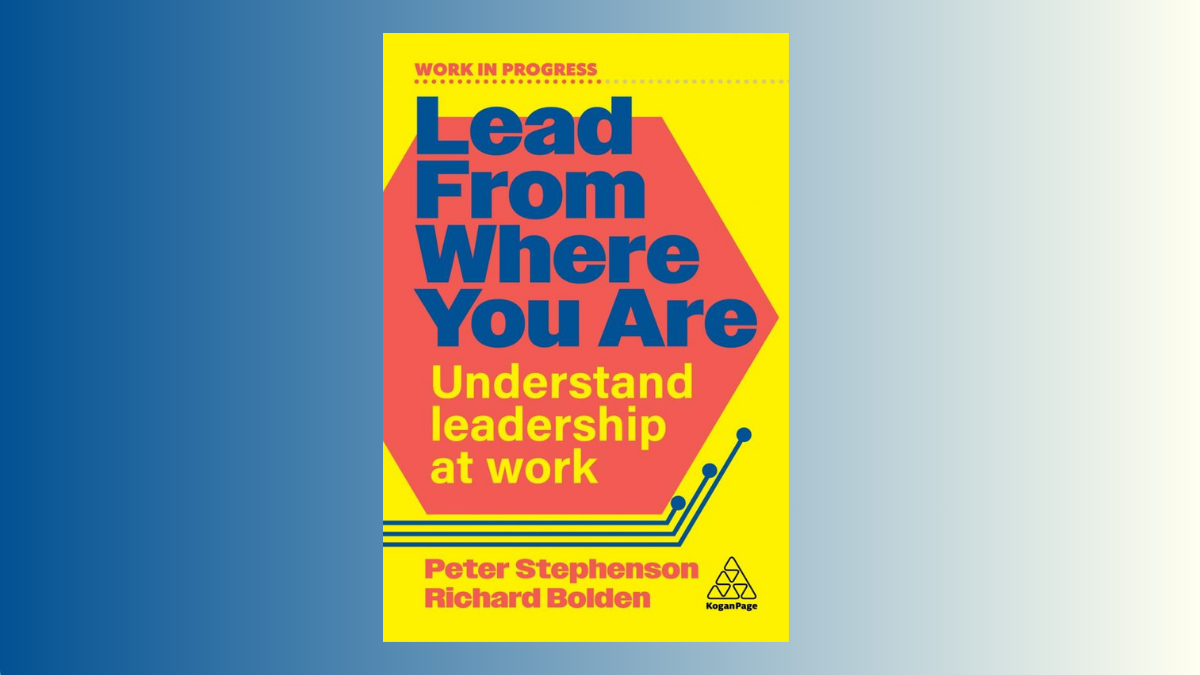
That idea sits at the heart of UWE alum Dr Peter Stephenson and Director of Bristol’s Leadership and Change Centre Professor Richard Bolden‘s new book on leadership Lead from where you are: Understand Leadership at Work published by Kogan Page as part of their Work in Progress series. It feels like such a relevant and practical read; that really gets to the heart of how, practically can we ‘do leadership’.

I asked Peter about his motivations for writing the book with Richard; as a successful entrepreneur prior to becoming an academic – why is he writing a book about leadership? He says it was born out of frustration!
“You go into work and you face a problem and you find that leadership literature, [or any business literature], doesn’t help you to start with thinking about why this person being so difficult and why can’t I get them to do what they’re supposed to do?“
The practical insights in the book are grounded in his doctoral research at UWE which involved studying a UK law firm over a twelve-month period during the transition to remote working. The timing proved unexpectedly valuable as Teams meetings could be recorded and transcribed, allowing him to observe leadership communication in real time. The result was a rich collection of conversations, interactions and leadership moments that continue to shape his research today. It also resulted in a book that feels less like a rulebook and more like a toolkit for navigating the realities of organisational life.
The centrality of language
One of the strongest themes running through the book is the importance of communication – whilst we of course use many other forms of influence – we use language the most when we are actively leading:
“Understanding our language, I feel like that’s a core place to start, that once we can start to get to grips with that, we can start looking further afield at some of the other influence processes and some of the other ways we communicate with people.“
And whilst the book was written for an audience of those perhaps at the beginning of their leadership careers; we both agreed that the book has much wider applicability as a reflective prompt for everyone who wants to increase their leadership influence. It encourages readers to consider development and refinement of these skills as a lifelong journey.
“It’s telling you to think about how you’re using the language and then trial and error and different things that you can think about to address your problems or your context or whatever it is specifically.“
This emphasis on self-reflection feels particularly valuable in an era where leadership advice is often presented as a set of universal rules. The book is written as a series of chapters you can dip in and out of; and use for the leadership purpose at hand. It really aims to challenge thinking and to encourage readers to consider how complex leadership really is – in relation to leadership roles, leadership impact, and how leaders are perceived by others.
Shifting our leadership paradigm
The book is trying to achieve a real paradigm shift in thinking – and to move beyond the binary of the heroes and villains of leadership to consider the broader systems, pressures and organisational contexts that influence behaviour. This moves the discussion away from individual personalities and towards a deeper understanding of how leadership operates in a much more nuanced way within complex environments. This goes beyond language; Peter and Richard drew inspiration from Foucault’s ‘dispositive’ considering much more holistic connections involved in social reality e.g. including morality, culture and social regulations. Writing this in a simple, practical book without diluting its brilliance Peter described as ‘difficult’ but I think they both do it justice! It’s a powerful reminder of just how sophisticated everyday communication really is.
What happens next?
Firstly, to say that Peter wanted to express his thanks again to his co-author Richard and also to Ryan Norman, the commissioning editor at Kogan Page who has endlessly supported the drafting and redrafting of this wonderful book!
The strongest impression I took away from our conversation was Peter’s enthusiasm – his curiosity is infectious. His work constantly encourages us to look beneath the surface, question assumptions and explore the hidden influences shaping our interactions. We can expect to see much more from Peter about leadership language and a more holistic understanding of the practice of leadership built upon some fascinating stories.
Buy the book and get a 25% discount with the code KOGANPAGE25
About the authors:
Dr Peter Stephenson is a Lecturer in Leadership and Management at the University of Exeter Business School. Before moving into academia, he founded and successfully exited two businesses. His research explores leadership, organisational culture, power dynamics and the role of language in shaping leadership in practice.
Professor Richard Bolden is Professor of Leadership and Management and Director of Bristol Leadership and Change Centre at the University of the West of England. His research explores the interface between individual and collective approaches to leadership and leadership development in contexts including healthcare, higher education and public services.
For more on the approach discussed in this article please see Beyond the Unethical Leader: A Dispositional Analysis of Unethical Leadership in the Case of Theranos.
Interested in conducting doctoral research at UWE Bristol? Find out about our doctoral programmes.