


By: Patrick Manu [Professor at UWE] and Che Khairil Izam Che Ibrahim [Professor at UiTM]
In many countries, construction is one of the most dangerous sectors [1]. In Malaysia, the sector accounts for about one-third of worker deaths and many occupational injuries [2]. Studies have established that design is one of the key underlying causal factors in construction accidents and worker fatalities [3]. This has led to the prominence of the practice of Design for occupational safety and health (DfOSH) which entails designers ‘designing out’ occupational safety and health (OSH) risks at the early design stages of construction projects to protect workers.
In the UK, the Construction (Design and Management) Regulations (CDM) have been introduced since 1995 to mandate DfOSH implementation. In Malaysia, the Occupational Safety and Health (Construction Work) (Design and Management) (CWDM) Regulations 2024, which have been adapted from the UK CDM, have just recently been passed, as a measure to improve OSH performance of the construction sector. Currently, Malaysia is still at the initial stage of implementing DfOSH, while the UK has garnered many years of experience in DfOSH. The experience and lessons learnt in the UK with regards to challenges in DfOSH implementation and their solutions would serve as a useful resource for construction stakeholders (academia, industry, and government) in Malaysia in building strong DfOSH implementation capacity.
Against this backdrop, the University of the West of England (UWE) in collaboration with academic institutions in Malaysia and UK (Universiti Teknologi MARA (UiTM), The University of Manchester (UoM), and University College London (UCL)) are delivering an international project to advance DfOSH implementation in Malaysia via tripartite engagement of Academia-Industry-Government stakeholders to strengthen stakeholder capacity and co-create solutions to address DfOSH implementation challenges. The project entails a series of activities including stakeholder engagement and capacity strengthening workshops, knowledge exchange, and on-going dissemination. This blog offers excerpts of activities undertaken (in 2025), and preliminary outcomes.
Activities
Industry–government engagement and capacity strengthening
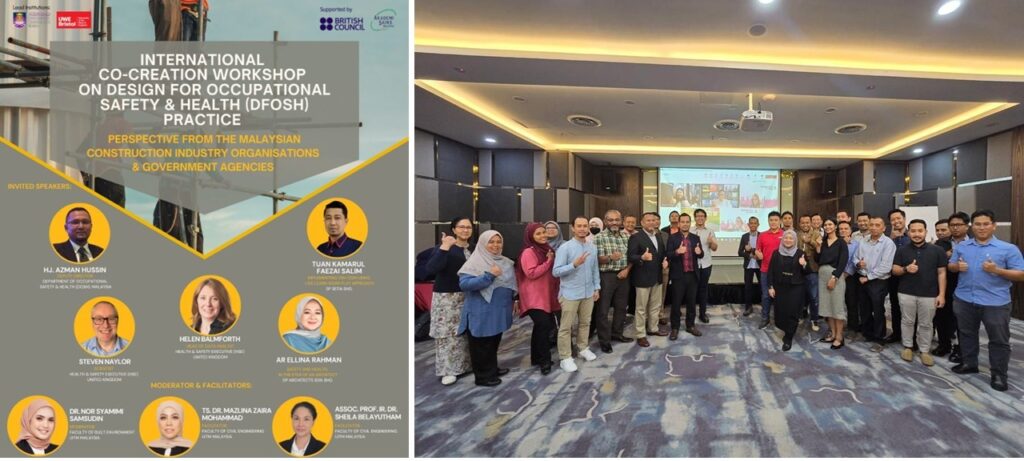
Two hybrid workshops were organised in Malaysia to bring together a wide range of stakeholders from the construction sector and government agencies. The first was held in Selangor in June 2025, followed by a second in Johor in July 2025. Together, these sessions engaged over 60 participants from industry (including contractors, consultants, architects, engineers, and safety and health professionals) and government agencies (including Department of Occupational Safety and Health (DOSH), Public Works Department, and Construction Industry Development Board). The workshops created valuable dialogue on challenges and practical solutions (from the perspective of industry and government) for improving the integration of occupational safety and health in construction design practices.
Knowledge exchange – UK visit
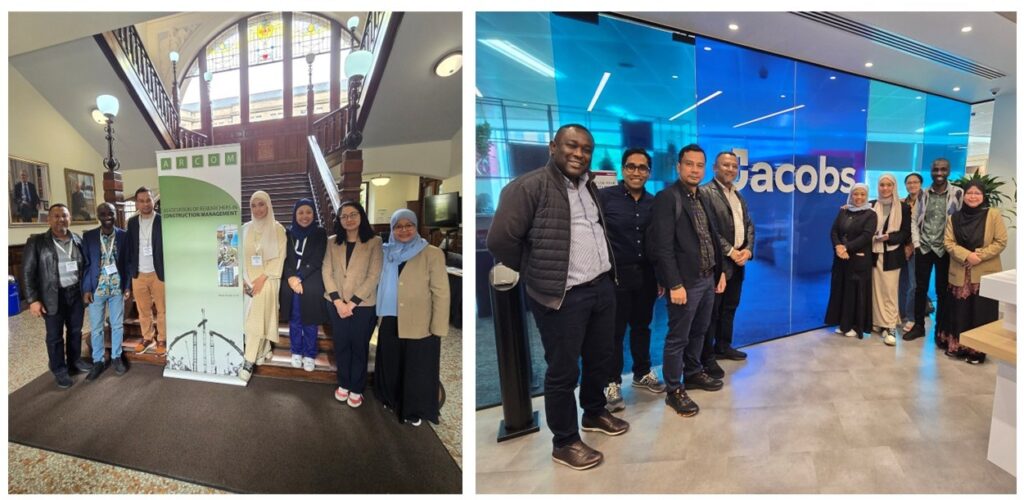
A Malaysian delegation (comprising members of the academic team and a representative of DOSH) visited the United Kingdom from August to September 2025 to strengthen international collaboration and exchange knowledge on DfOSH best practices. The delegation participated in the Association of Researchers in Construction Management (ARCOM) 2025 conference held in Dundee, where they shared the project’s initial findings with an international academic audience. The team visited Jacobs’ (a multinational engineering professional services (including design) firm) office in Manchester. During the visit, they learnt about Jacobs’ approach to DfOSH, which is encapsulated by their award-winning “de5ign” (pronounced ‘five in design’). To obtain DfOSH implementation insights from a regulator’s perspective, the team visited the Health and Safety Executive office in Buxton, where they received useful insights regarding UK’s DfOSH journey, challenges, and improvements over the years, as well as suggestions for Malaysia’s context. The delegation also visited academic partners at the UoM and the UWE. Overall, these activities provided significant opportunities for learning and for building lasting academic–industry–government linkages between Malaysia and the UK.
Knowledge exchange – Guest lectures
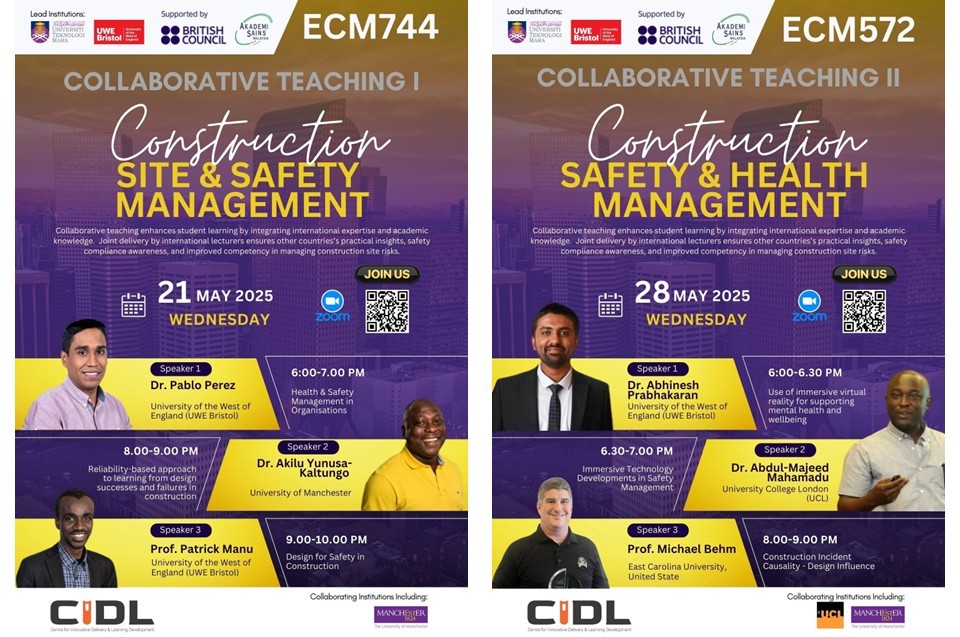
Guest lecture sessions on the Master of Construction Engineering course at UiTM (Construction Site & Safety Management) were delivered in May 2025. The sessions were delivered by project team members from UWE, UCL, UoM and a USA-based renowned academic in DfOSH. The lectures were attended by over 80 students who are also working professionals.
Project Dissemination
To raise awareness of the project’s activities among stakeholders locally and beyond, several media posts have been made including use of social media and an article in a local news outlet. Furthermore, academic outputs (comprising a conference article [4]) and a journal article [5]) disseminating preliminary insights from the project have been produced. Overall, the dissemination has ensured wide reach of among academic, industry and government stakeholders.
Preliminary Outcomes
The project has yielded a tripartite co-creation framework that aligns the roles of academia, industry, and government to institutionalise DfOSH as a key mechanism for improving occupational safety and health in Malaysia. The framework is guiding stakeholder dialogue to identify and prioritise DfOSH implementation challenges and solutions. Additional outcomes include: 1) insights from the workshops are being used by DOSH to inform revision of a code of practice and training modules for trained persons under Malaysia’s CWDM 2024 regulations; 2) improved stakeholder awareness of CWDM 2024 regulations and early-stage design risk management; 3) enhanced practitioner and postgraduate competencies and shared understanding of DfOSH practices; and 4) a UK-Malaysia-Indonesia collaboration (funded by UK’s International Science Partnership Fund) which seeks to drive OSH improvement in construction beyond the implementation of DfOSH.
Acknowledgement
- Members of UK team: Patrick Manu, Abhinesh Prabhakaran, and Pablo Perez (of UWE), Abdul-Majeed Mahamadu (of UCL), Clara Cheung and Akilu Yunusa-Kaltungo (of UoM), and representatives of partner organisation.
- Members of Malaysia team: Che Khairil Izam Che Ibrahim, Sheila Belayutham, Mazlina Zaira Mohammad, Shafienaz Ismail, and Nor Syamimi Samsudin (of UiTM), Azman Hussain (of DOSH), and representatives of partner organisations.
- This research was supported by British Council’s International Research and Empowerment Programme and Akademi Sains Malaysia, as part of the International Science Partnerships Fund (ISPF).
References
1. Eurostat (2025) Accidents at work statistics. Available online at https://ec.europa.eu/eurostat/statistics-xplained/index.php?title=Accidents_at_work_statistics
2. Department for Occupational Safety and Health (2021) Occupational Accidents Statistics by Sector January to December 2021 (investigated). Available online at https://intranet.dosh.gov.my/statistic-v/occupational-accident-statistics/occupational-accident-statistic-2021
3. Manu, P., Poghosyan, A., Mahamadu, A.-M., Mahdjoubi, L., Gibb, A., Behm, M. and and Akinade, O. (2019) Design for Occupational Safety and Health: Key Attributes for Organisational Capability. Engineering, Construction and Architectural Management, 26 (11), pp. 2614–2636.
4. Che Ibrahim, C. K. I., Manu, P., Belayutham, S., Cheung, C.M., Mohamad, M.Z., Yunusa-Kaltungo, A., Ismail, S., Samsudin, N. S., Prabhakaran, A., Perez, P., Mahamadu, A.-M. and Hussain, A. (2025a) Building a Safer Tomorrow: Tripartite Engagement and Co-Creation for Enhanced Design for Occupational Safety and Health in Malaysia. In: Thomson, C (Ed.) and Neilson, C J (Ed.), Proceedings 41st Annual ARCOM Conference, 1-3 September 2025, Abertay University, Dundee, UK. Association of Researchers in Construction Management, pp. 409-418.
5. Che Ibrahim, C. K. I., Manu, P., Belayutham, S., Cheung, C.M., Mohamad, M.Z., Yunusa-Kaltungo, A., Ismail, S., Samsudin, N. S., Prabhakaran, A., Perez, P., Mahamadu, A.-M. and Hussain, A. (2025b) Tripartite collaboration for design for safety in construction: A co-creation framework integrating academia, industry, and government. Safety Science, Article 107040.