


Photo credit: slgooding
The cognitive dissonance that haunts our profession
I recently found myself at an event listening to three presentations involving strategies to capture the potential of automated, driverless minicabs to improve three European cities by ridding the streets of private cars. I would characterise the audience reaction as politely sceptical of the technology, anxious about the regulation, but pretty much in tune with the idea that having fewer private cars around was, of itself, desirable.
It reminded me of another conference I attended some years ago where a chum was rhapsodizing about how delightful it would be to rid some nearby picture-postcard village or town centre of all the parked cars. My reaction was ‘why would you want to do that? There might be some really interesting ones in the mix.’ My chum was nonplussed by this, and reminded me that I had, not long since, suggested that the famously car-free cities of Siena and Venice were among my all-time favourite places (I’ve since found that it is possible to drive into parts of even central Venice, but you get my drift).
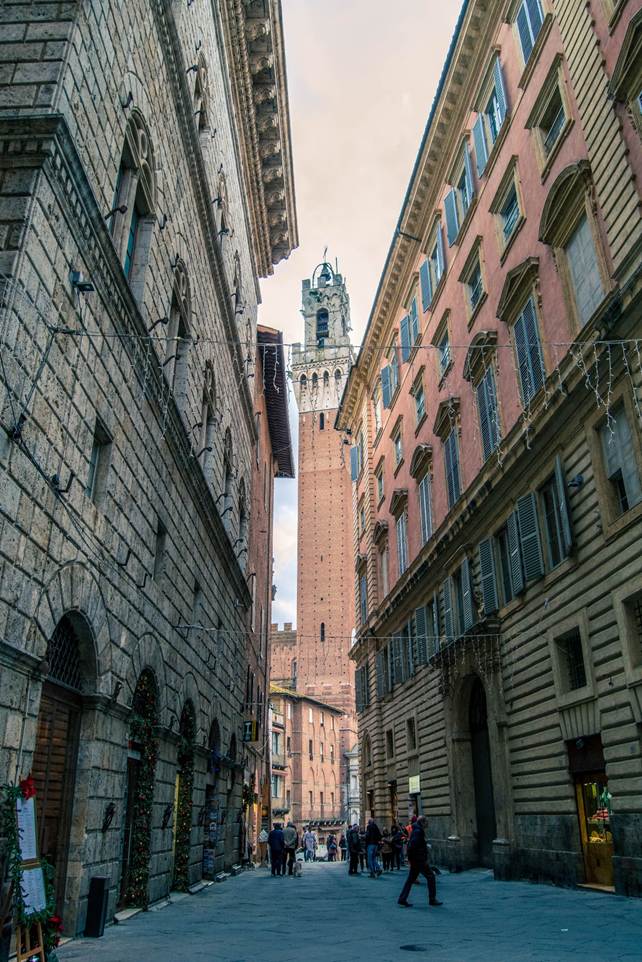
Siena streetscene. Credit: Mesut Alyakut, Pexels
The thing is that for as long as I can remember I’ve been ‘into’ cars – their design, aesthetics, performance. I couldn’t wait to get my licence to drive.
A couple of weeks ago I was helping with the RM Sotheby’s London to Brighton veteran car run – the world’s longest running motoring event. Not only did thousands of people turn out to watch hundreds of pre-1905 cars (and bicycles, it must be acknowledged) trundle past, many more squashed into Pall Mall the day before to look at a display comprising cars of all sorts – ancient and modern[1].
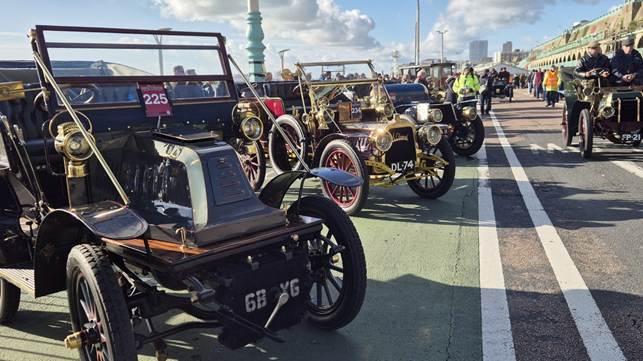
The London to Brighton veteran car run. Credit: slgooding
Earlier in the year I was one of the half a million people who made their way to the British Grand Prix at Silverstone (564,000 over the four days of the event, 175,000 on race day). Tickets for the two Goodwood festivals of motoring sell out in the blink of an eye.
I take from this that I am not alone in my affection for cars. Indeed, I would go so far as to say that a great many (no, not all, but lots) of us Brits love cars.
What we don’t like is traffic.
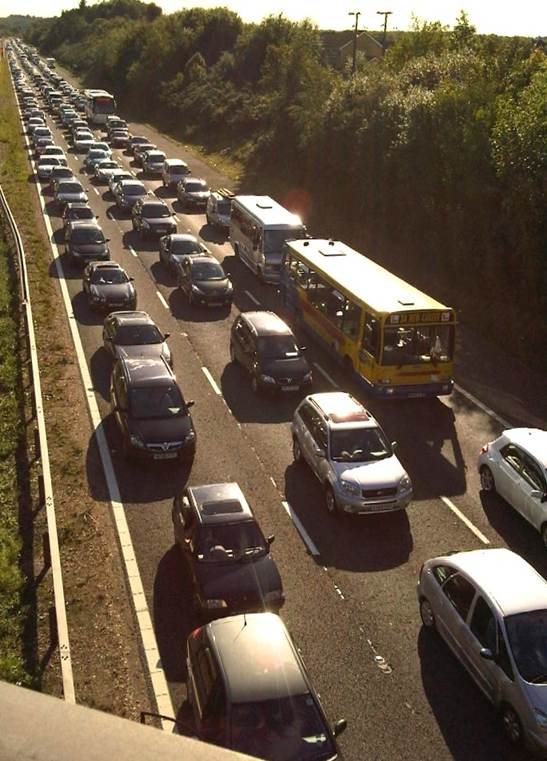
M23 Jam: the freedom of the open road? Credit: slgooding
Where a car shouts ‘opportunity’ and ‘freedom’, traffic means trouble – pollution, problem parking and traffic jams. Traffic, in the minds of many, is, of course, caused by other people. A concept mocked not that long ago in billboards advertising TomTom’s satellite navigation system stating: “YOU ARE NOT STUCK IN TRAFFIC. YOU ARE TRAFFIC.”
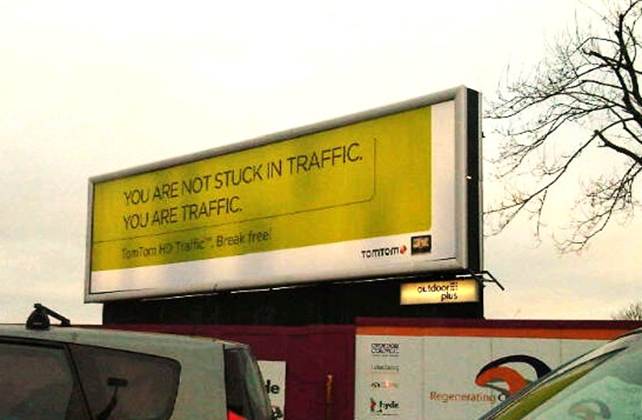
“…you are traffic”. Credit: slgooding
This creates a quandary for politicians. By and large those we elect to represent us buy-in to the objective of public policy being to strive for a happy, healthy population living securely in a country where you’d choose to live. But woe betide that policy being perceived as anti-motorist. As if ‘motorists’ were a breed apart, plumbed 24/7 into their cars. Which is clearly nonsense. And yet…
On the grounds that it makes sense to learn from past experience I feel compelled to share some experience from the 1990s, the heyday of a document some will remember called Planning Policy Guidance Note 13[2]. PPG13 sought to shape future land-use development in such a way as to reduce the need to travel. I found myself responsible, in the then Department of Transport, for co-sponsoring with my Department of the Environment oppo the production of a good practice guide to help practitioners comply with PPG13s requirements, and so getting into some feisty arguments with the author who persistently confused assertion with evidence – the truth was that it was too early to say what if anything in the application of PPG 13 was having the desired effect.
It is, to take a case I know well, possible to cause a large scale housing estate to be built cheek-by-jowl with a large office development such that residents could walk to work. It is salutary to observe that many of the residents then found employment somewhere else accessible by, you guessed it, car. Making limited provision for retail space is fine, but if that retail space gets occupied (as was often the case) by a betting shop, an off-licence and a corner-shop-grocery-cum-newsagent unable to compete with supermarket prices it shouldn’t surprise us if the residents choose to travel to an out-of-town superstore. Restricting parking provision in residential developments might attract those not wishing to be car owners, but can as easily result in cars littering the footways because there’s nowhere else convenient for their owners to leave them. I could go on.
Reducing the ‘need’ to travel is hard. Reducing the desire is really hard.
Thus it was that the ministers I worked for back in the 90s and noughties were very clear that while they were perfectly happy with car ownership, as an aspirational thing, it was car use that they wanted to discourage.
The trouble, as we all know, is that once we have a car and have covered the costs of ownership (including insurance) the marginal cost of using it can look very attractive compared to shelling out for public transport, and affordable compared to the alternative of not travelling.
I am open to being persuaded that the societal tide on all this is shifting. Maybe we have passed ‘peak car’. Maybe the place of the car as somewhere between a modern necessity and aspirational object of desire is fading.
A few months ago I strolled around the new and growing array of apartment blocks in really-very-central Manchester observing that occupancy rates are high despite provision for car parking being low. Back home barely a day goes by without my path as a pedestrian being blocked by a van stopped on the footway to enable home delivery of various households’ internet purchases that might otherwise have been the cause of a shopping trip. And we all know that those driverless vehicles are just around the corner.
But I would also observe that for everyone who has told me that young people aren’t interested in driving any more I can count at least as many bemoaning the time it is taking their children to get a driving test.
All of which strikes me as very fertile territory for exploration by the Centre for Transport and Society community. But in doing so may I make one plea – that we ensure our horizon extends beyond the urbanist, city-centric bubble I often encounter in debates about the future of travel to encompass the vast sprawling suburbs where most of us live and which, for reasons best known to themselves, successive generations of housing ministers seem intent on expanding.
Cars – love ‘em or hate ‘em we certainly have a lot of them, a shade under 35 million in the UK in 2026[3]. On which note, as a boss of mine was fond of saying, its all very well to have a good sense of how we wish things to be, but it’s important that we recognise that we have to start from where we are. And for many of us that’s in a suburb with a car parked out front.
[1] A review of the St James’s Motoring Spectacle can be read here: https://goanyway.uk/burns-and-mcrae-on-a-public-road-st-jamess-motoring-spectacle-2026/
[2] An interesting contemporary analysis of PPG 13 and what it was seeking to achieve by Tim Pharoah, at the time Reader in Transport and Urban Planning, South Bank University, can be accessed here: https://livingtransport.com/results.php?t=asset&search=46
[3] https://www.gov.uk/government/statistical-data-sets/vehicle-licensing-statistics-data-tables
Steve Gooding is a visiting professor at the Centre for Transport & Society with a long professional history in transport policy in the Department for Transport and, latterly, as Director of the RAC Foundation a charity whose mission is to research all aspects of motoring and road use – good and bad.