By Dio Kordopati and Professor Julie Mytton
Background
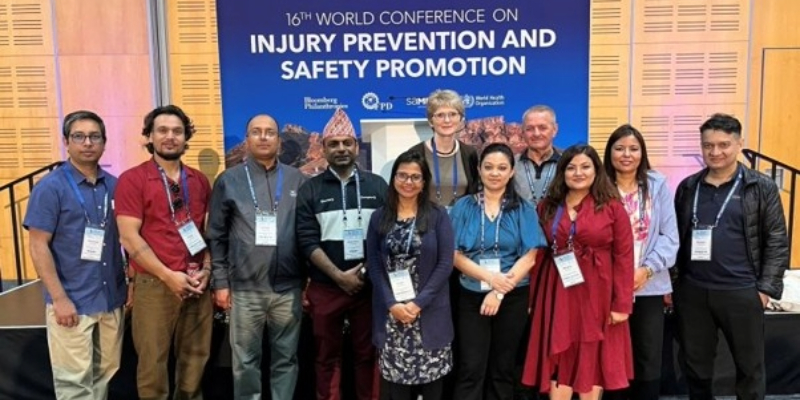
UWE researchers, led by Professor Julie Mytton, have been running a road safety research programme, SafeTrip Nepal, with colleagues at Kathmandu Medical College. In September, the programme team travelled to Cape Town for Safety 2026, the World Conference on Injury Prevention and Safety Promotion. Over three days the team presented 18 abstracts, 14 oral presentations and four posters, sharing findings from four years of research with an international audience.
For a programme now in its fourth year, this was a milestone. Earlier conference outings shared study designs and protocols. This time the team arrived with results: cohort data, policy analyses, qualitative findings and recommendations that are already shaping conversations with government and communities in Nepal.
Road safety policy
Nepal has no national road safety strategy, and the policy work package set out to understand what helps and hinders the effective delivery of road safety policy. The team presented a systematic review of facilitators and barriers to implementing road safety policies in low- and middle-income countries. Two posters presented findings from a study of the implementation of motorcycle helmet use policy, and a qualitative study of how stakeholders perceive the challenges of implementing road safety policy in federal Nepal.
Safer long-distance bus travel
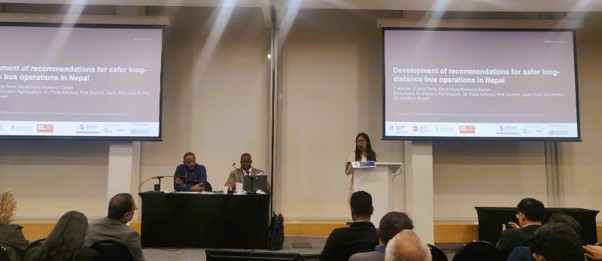
We were given the opportunity to deliver four oral presentations on long-distance bus safety. The team presented a systematic review of factors associated with crashes on long-distance public buses in low- and middle-income countries, followed by a secondary data analysis of four-years of Nepal police data on long-distance bus crashes. A qualitative study captured the perspectives of passengers, drivers, crash survivors and stakeholders. The final presentation set out the recommendations for safer long-distance bus operations that have grown out of that evidence.
Post-crash care
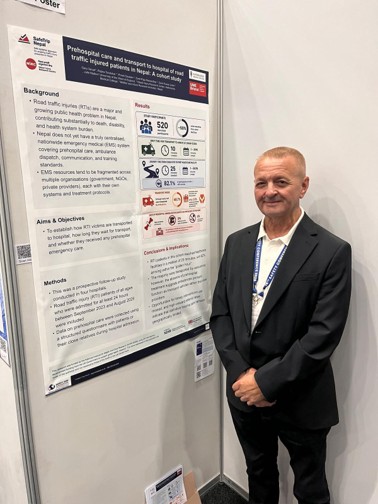
What happens to people after a crash was the focus of six presentations from our work package on post-crash care. Three presentations drew on a cohort of over 500 crash victims followed from their crash event for 12 months. Through this study we were able to describe who is being hurt on Nepal’s roads, what the injury costs families in lost income and out-of-pocket care, and what care patients actually receive before they arrive at hospital. The handover of injured patients from ambulance staff to the emergency department team was the focus of the other three presentations, with a systematic review of qualitative studies from low- and middle-income countries setting out what is already known. Further research then built on it: one presentation discussed observations of handovers taking place on the emergency department floor, and the other explored the barriers and facilitators to effective handover between the staff involved.
Communities taking action
The community engagement work package shared lessons from promoting community advocacy for safer roads with local governments. Two oral presentations covered how community advocacy has been used to shape local road safety practice, and the outcomes of that advocacy across eight municipalities in Nepal. A poster explored the challenges and opportunities of working with local governments on road safety.
Raising the Centre’s profile
With Nepal Injury Research Centre colleagues presenting in sessions across the programme, the conference significantly raised the Centre’s international profile.
It was a fantastic showcase of the UWE–Kathmandu Medical College collaboration funded by NIHR Global Health Research, and a busy few days for everyone involved. The team is now focusing on disseminating the research findings and working with partners in Nepal to turn evidence into action.