

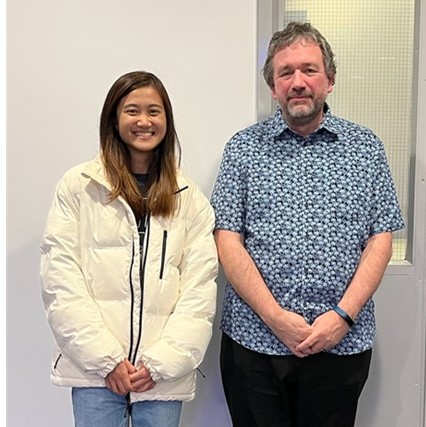
Picture: Tsz Yan Joyce Chan and Dr. Kevin Honeychurch
Dr. Kevin Honeychurch, Senior Lecturer in Forensic Chemistry and member of the Centre for Biomedical Research and his student Tsz Yan Joyce Chan have published a novel method for measuring Levimasole adulteration in cocaine
Levamisole is a drug that was previously approved for the treatment of parasitic infections such as worms, but was withdrawn from human use in 2000 due to side effects such as abdominal pain, vomiting, headache, and dizziness, and increased risk of infection. However, in recent years, Levimasole has been widely used as a ‘cutting agent’ in cocaine, where it is believed to enhance its effect. It also leads to a condition called Levamisole induced necrosis syndrome, which results in the destruction of skin tissue and can lead severe facial disfigurement.
As an adulterant of cocaine, Levimasole is difficult to identify, and there is increased interest in the development of new methods for its measurement. Common analytical approaches such as UV spectroscopy are hampered by its low absorbance maxima, while direct electrochemical detection suffers from interference from cocaine. However, the method developed by Dr. Honeychurch and his student, and recently published in the open-access journal Sci, employs a combination of solvent extraction, followed by chromatographic separation with electrochemical detection to effectively measure its concentration in urine. By developing an understanding of the electrochemical properties of Levimasole using Cyclic Voltammetry, as well as its chromatographic behaviour using High Performance Liquid Chromatography (HPLC), the researchers were able to achieve its selective and sensitive detection.
The method has the potential to assist medical professionals to identify and treat Levimasole exposure, and also assist law enforcement in identifying the presence and extent of cocaine adulteration. Dr. Honeychurch is now planning a similar approach to investigate other adulterants in a range of drugs including cocaine, cannabinoids and benzodiazepines.
Having completed her MSc in Forensic Science at UWE, Ms. Chan is now working as a Technical Specialist in the Centre for PanorOmic Sciences (CPOS), a genomics core laboratory, which is part of the University of Hong Kong’s Faculty of Medicine.