

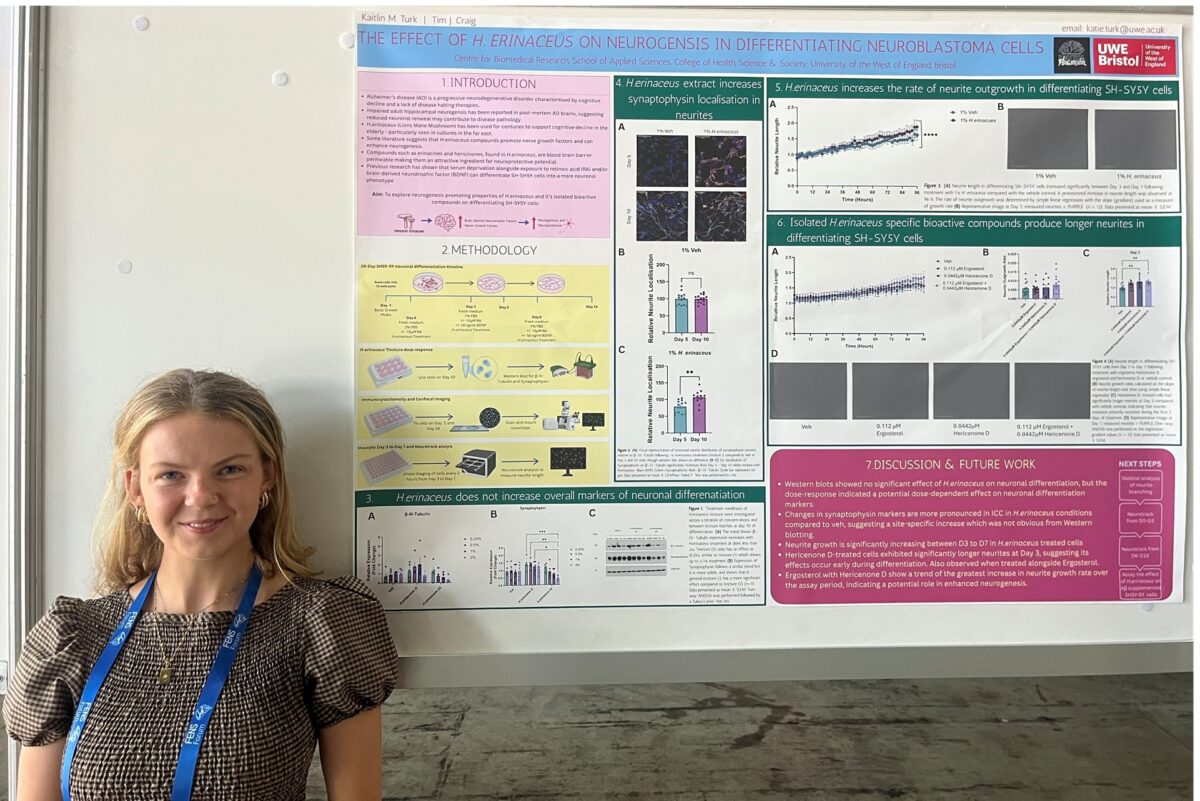
CBR researcher at European Neuroscience Forum

Posted on

Ms. Katie Turk recently presented her research at the FENS Forum 2026 in Barcelona. The FENS (Federation of European Neuroscience Societies) forum is the largest of its kind in Europe.

Katie’s research is investigating the impact that extracts from the fungus Hericium erinaceus (Lion’s Mane) have on neurogenesis using a neuroblastoma model. Lion’s Mane has been used for centuries to manage cognitive decline. With her supervisor Dr. Tim Craig, Katie is investigating what impacts, if any, this may have on neuronal differentiation and marker expression.

Here is what Katie had to say about her time at the conference:

Earlier this month, I had the opportunity to attend the Federation of European Neuroscience Societies (FENS) Forum 2026, held in Barcelona from the 6th till the10th July. As Europe’s largest neuroscience conference, the Forum only takes place every two years, and this year’s event was the biggest yet, bringing together more than 8,000 neuroscientists from over 80 countries.

The conference opened with a vibrant ceremony celebrating Spanish culture through traditional dance, alongside inspiring speeches from the FENS leadership – with the important reminder to “ask questions to encourage, not to intimidate” fostering supportive scientific discussion.

With neurodegenerative disease representing one of the greatest global health challenges, and as someone working in this field, it was inspiring to see the scale, diversity and momentum of research taking place across the world. The programme was packed with outstanding talks spanning every discipline of neuroscience. Highlights included plenary lectures from Guillermina López-Bendito, Yukiko Goda and Holly Ingraham, among many others.

The poster sessions were equally memorable there was such a positive atmosphere, with researchers at every career stage sharing ideas, asking thoughtful questions and offering constructive feedback. Some of the most valuable moments of the week came from these conversations, which gave me new perspectives on my own work.

Beyond the science, the Forum also celebrated neuroscience’s rich history and its connection with the arts, an exhibition honouring Nobel Prize-winning neuroscientist Santiago Ramόn y Cajal, created in collaboration with the design studio La Casa de Carlota, combined art and science through interactive installations, including a collaborative brain network drawing activity and a gallery inspired by Cajal’s iconic illustrations.

Congratulations to Katie on her presentation and for discovering the immense social and cultural value of conference participation.

Neuroscience research highlighted on BBC R4

Posted on

Dr. Tim Craig, Associate Professor of Neuroscience, talks to BBC Radio 4 Health and Science about the potential for Lion’s Mane extracts in the prevention or treatment of dementia

As part of an episode of Inside Health on BBC Radio 4, BBC Health and Science Correspondent James Gallagher interviewed Dr Tim Craig, Associate Professor of Neuroscience from the Centre for Biomedical Research (CBR), UWE, about his work looking at the potential neuroprotective effects of the Lion’s Mane mushroom. Dr Craig’s work on this project is funded by a Partnership PhD with the Bristol Fungarium, who specialise in functional mushroom extracts and tinctures. In the interview, Dr Craig discussed the purpose of the research project, which is to rigorously examine the potential of the extract of Lion’s Mane mushrooms to protect against neurotoxic damage in diseases such as Alzheimer’s Disease. Dr Craig’s PhD student, Kaitlyn Turk, is using cellular models of neuronal damage to look at neuroprotective effects of these extracts, with the ultimate aim of identifying specific therapeutic compounds produced by these mushrooms. This research is highly topical due to the massive increase in interest in the medicinal properties of a variety of edible mushrooms, some of which have been used in traditional medicine for hundreds of years.

The link to the interview can be found here.

Dr. Tim J. Craig

New book explores the impact of the COVID pandemic on animals

Posted on

Prof. John Hancock, Dr. Tim Craig and Ros Rouse discuss the impact that the pandemic has had on animals around the world

While the COVID pandemic has had a devastating impact on humanity across the globe, less consideration was given to its impact on animal populations. Prof. John Hancock (Professor of Cell Signalling), and Dr. Tim Craig (Associate Professor of Neuroscience), members of the Centre for Research in Biosciences and Ros Rouse, Research Governance Manager at UWE and wildlife artist have come together to discuss this important theme in their new book “Animal welfare in a pandemic: What does COVID-19 tell us about the future?“, published in April 2024 by CRC Press.

The book gathers together multiple aspects of COVID on animal welfare. It sets out which animals were infected by the virus. It draws upon the authors’ particular expertise in establishing whether molecular biology can be used as an approach to predicting species susceptibility to the virus. It also examines the relevance of vaccination as it pertains to animals. The book goes on to discuss the challenges encountered by zoos and animal conservationists during this period and finishes with a consideration of what can be learned and how we can respond more effectively to future pandemics.

The book is based on original research that Hancock, Rouse, and later Craig undertook together during the pandemic, as well as a review of the scientific literature. Rouse also brought her unique talents to the book, which includes several works of art and photographs by her, including the front cover. The book is a part of the CRC One Health One Welfare series which ‘recognises the interconnections between human wellbeing, animal health and welfare, and the environment’. The three authors are already planning further projects in this space.

Back to top