

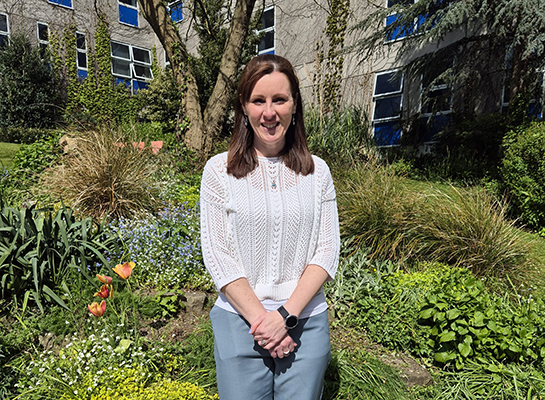
Picture: Dr Carrie Brady, Senior Lecturer in Genomics, UWE Bristol
Dr Brady’s four-year research programme will focus on the role of bacterial quorum sensing in acute oak decline
Congratulations to Dr Carrie Brady, Senior Lecturer in Genomics and member of the Centre for Research in Biosciences, who has been awarded a BBSRC New Investigator grant for a project titled “Bac-chat: Bacterial density-dependent quorum sensing mechanisms in Acute Oak Decline symptom development”. This four-year long project will build on Carrie’s previous research into the bacteria associated with acute oak decline (AOD), a disease with devastating effects on the mature native oak population in Great Britain. Three bacterial species (Brenneria goodwinii, Gibbsiella quercinecans, Rahnella victoriana) are known to play a role in development of the necrotic lesions that are symptomatic of oak suffering from AOD, and recent results have indicated that these bacteria have an endophytic lifestyle in several different parts of the oak host, as well as in other broadleaf hosts. This suggests that the AOD bacteria play the role of latent pathogens that are able to cause disease under suitable conditions.
Some bacterial phytopathogens are known to employ quorum sensing, a cell-to-cell communication mechanism used to coordinate collective behaviour and gene expression based on population density, which relies on chemical signalling molecules. The genes regulated by quorum sensing control processes and behaviours such as the production of virulence factors, biofilm formation and nutrient acquisition.
There is currently limited understanding of the interactions between the AOD bacteria and how they cooperate in symptom progression. An increased understanding lesion development by the bacteria will benefit woodland managers and foresters in the management of AOD. Stakeholders have called increasingly for strategies to deal with AOD, and projects are underway to determine how to reduce the AOD bacteria in symptomatic oak. However, if the primary AOD bacteria are endophytes, it will be of greater importance to determine how to prevent the shift of these endophytes to pathogens.
The Bac-chat project will aim to determine what causes the shift of the endophytic bacteria to pathogenesis, how bacterial density increases and consequently how symptoms develop. The chemical signalling molecules responsible for communication and interaction between the three primary AOD bacteria will be identified and examined to determine how they influence lesion development, and if they play a role in the potential shift from an endophytic to pathogenic lifestyle in the oak host.