

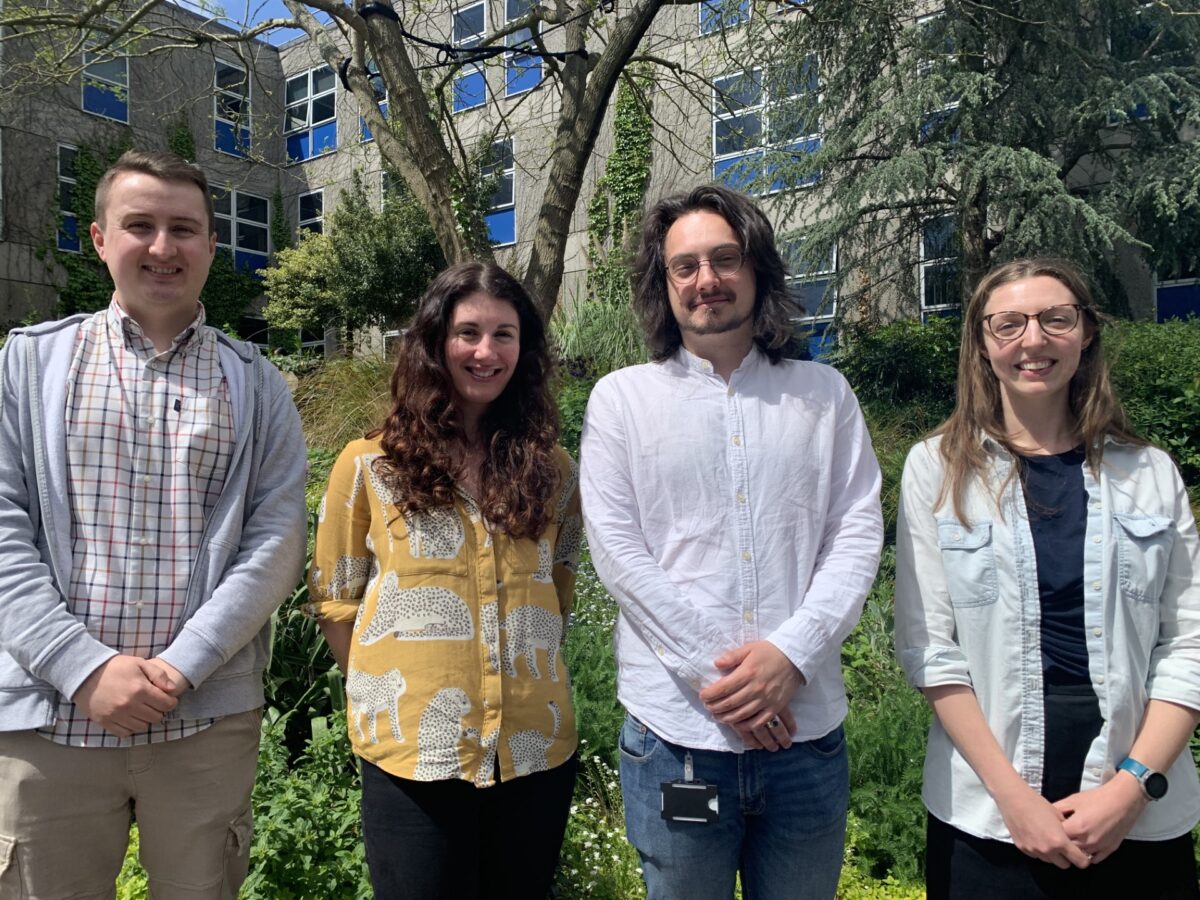
Congratulations to (L-R): Dr. James Robson, Dr. Lili Ordonez, Dr. Piers Townsend and Dr. Liana Gynn.
Four academic members of the Centre for Research in Biosciences have been awarded the Vice Chancellor Early Career Research (VCECR) award.
Dr. James Robson‘s project is entitled “Investigating tumour associated microbial communities and their virulence genes in colonoscopy polyp samples“. Colorectal cancer (CRC) is a leading cause of cancer-related death with incidence predicted to rise, specifically in younger populations. CRC development and progression are heavily influenced by dietary and lifestyle factors, which alter the composition of the gut microbiota. Microbial species associated with CRC have been identified in previous studies, but it is unclear whether these species are causative or simply enriched in the tumour microenvironment. This is further confounded by the presence of distinct microbial communities at different stages of the adenoma-carcinoma sequence. The aim of this project is to compare the microbial communities present in precancerous colorectal adenomas (polyps) isolated from patients undergoing colonoscopy and matched healthy tissue. The composition of the microbial communities within these samples will be analysed, and the presence of CRC-promoting virulence genes will be determined. This data will be supplemented by in vitro co-culture models investigating the expression and effects of these virulence genes to determine whether microorganisms contribute to development and progression of colorectal polyps. This project is in collaboration with Dr David Qualtrough and Dr Alexander Greenhough (UWE), and Dr Lee Parry (Cardiff University).
Dr. Lili Ordonez‘s received her award for a project entitled “Investigating Acquisition of Mesenchymal Features as a Mechanism of Tumour Relapse in Breast Cancer“. During therapy, cancer cells adapt in order to survive. This plasticity results in resistance to cancer therapies and ultimately contributes to relapse of the primary tumour. This means that irrespective of therapy efficiency, we can never ensure patients will remain cancer-free. Patients experiencing tumour relapse currently have very limited therapeutic options; therefore, a new strategy to overcome or prevent therapy-resistance would provide a huge impact on patient survival. Dr. Ordonez’s previous work has shown a correlation between therapy-resistance and epithelial-to-mesenchymal transition (EMT) in breast cancer. EMT is a process where an epithelial cell converts into a mesenchymal cell, resulting in a change in cell appearance, expression of proteins and cellular behaviour. However, whether EMT is a cause or consequence of therapy-resistance remains unclear. The aim of this project is to investigate if EMT is a mechanism of therapy-resistance in breast cancer. If a causative mechanism is confirmed then the development of therapies to inhibit this transition could prevent therapy-resistance, increase the efficiency of cancer therapy, and improve patient outcomes. This project is in collaboration with Dr Helen Quasnichka (UWE) and Dr Daniel Turnham (Cardiff University).
Dr. Piers Townsend‘s project is entitled “Unravelling the Mechanisms of Chemical Mutagenicity with Machine Learning (AI) and Computational Chemistry” Cancer continues to be a major public health issue, and its societal burden is set to spiral if we continue on our current trajectory. Chemical mutagenicity is known to be a good predictor of cancer-causing genetic changes, and DNA mutations have been known to occur due to the formation of a covalent bond between a DNA helix and a (potential) carcinogen; a so-called ‘molecular initiating event’. In this project, we’ll use computational chemistry to build molecular-scale models of cancer-causing molecular initiating events, and attempt to develop easy-to-use, mechanism-driven machine learning models for the prediction of chemical mutagenicity. I’m really excited to bring computational chemistry to SOAS, and I look forward to the prospect of collaborating with UWE experimentalists and external partners in the coming years.
Dr. Liana Gynn‘s research is on “Investigating the role of the secretome in the hypoxic leukaemia bone marrow microenvironment“. Leukaemia results from mutations in white blood stem cells, which accumulate in the bone marrow and blood, giving them an aggressive survival advantage contributing to therapy resistance. The bone marrow affords leukaemic cells structural support and regulation through secretion of protein signals, which leukaemic cells hijack alongside low oxygen (hypoxia) processes for a survival advantage; a phenomenon more understood in solid cancers. Dr. Gynn’s previous work has shown that when leukaemic and bone marrow cells are able to interact, DNA damage after chemotherapy is reduced in leukaemic cells, but increased in supportive bone marrow ‘stromal’ cells, accompanied by an altered secretome (all secreted proteins). This 2-year study will use SILAC-based proteomics and loss/gain of function assessments to identify mechanisms allowing leukaemic cells to thrive in the hypoxic bone marrow, and for bone marrow stromal cells to be adversely affected. This could identify targets for improved therapy outcomes with reduced collateral damage to the important microenvironment.
We wish them all well with their research projects.