When does climate risk get priced? Policy clarity and environmental trading sensitivity

Posted on

GARG Seminar

Dr Maryam Alhalboni from the University of York presented her latest research, entitled When does climate risk get priced? Policy clarity and environmental trading sensitivity, to the Governance and Accountability Research Group (GARG) on 8 May 2026.

We sincerely thank Dr Maryam for delivering an excellent presentation on our platform. Her insightful analysis and engaging delivery offered valuable perspectives and stimulated meaningful academic discussion among participants. We greatly appreciate her contribution and look forward to future collaborations.

Sanctions and spillover: analyzing Russian yield curve dynamics in the global financial markets

Posted on

GARG Seminar

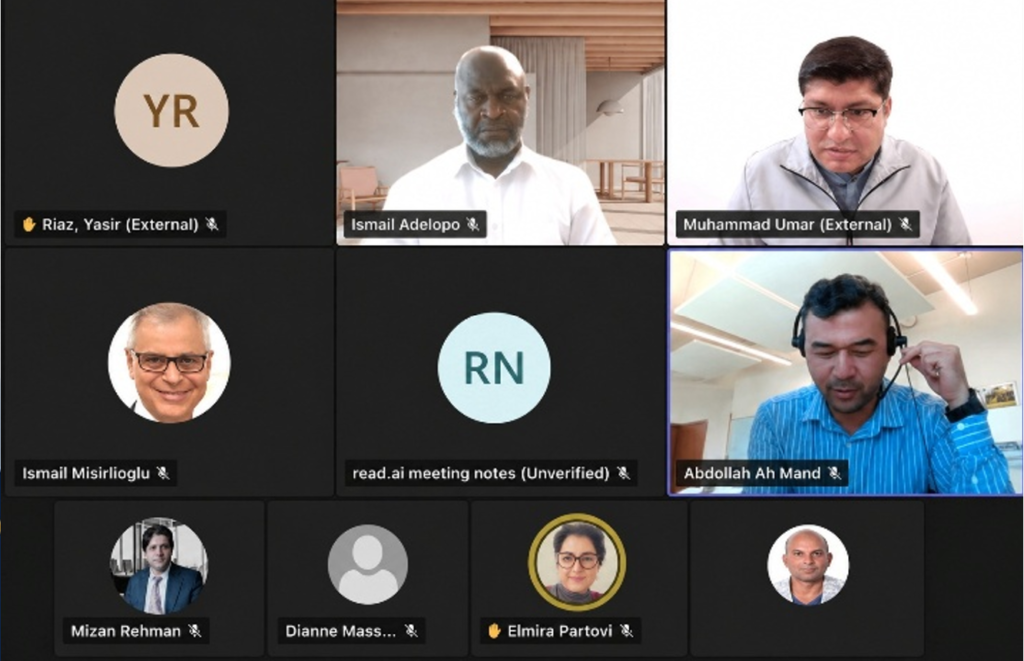
Governance and Accountability Research Group (GARG) hosted Dr Yasir Riaz from Ulster University on 1 May 2026, who presented his research on geopolitical risk and financial market connectedness using the Russia-Ukraine war as a case study.

We sincerely thank Dr Yasir for his excellent presentation on our platform. His insightful analysis and engaging delivery provided meaningful perspectives and inspired valuable academic discussion. We are grateful for his contribution and look forward to future collaborations.

CBDC types, design and architecture: impact on financial inclusion across demographics and income groups

Posted on

GARG Seminar

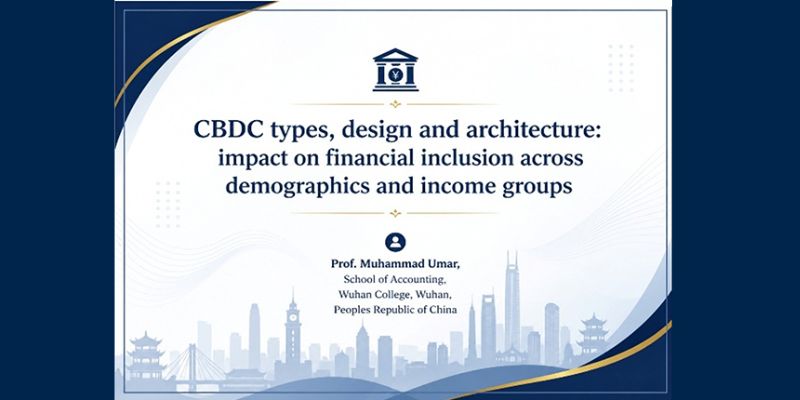
The Governance and Accountability Research Group (GARG) sincerely thanks Professor Muhammad Umar (School of Accounting, Wuhan College, Wuhan, People’s Republic of China) for his excellent presentation on Central Bank Digital Currency (CBDC) on our platform. His insightful analysis and engaging delivery provided meaningful perspectives and inspired valuable academic discussion. We are grateful for his contribution on 24 April 2026 and look forward to future collaborations.

Academic spotlight: Dr Yan Zeng

Posted on

Congratulations to Dr Yan Zeng who has been awarded the Senior Fellowship of the HEA

Dr Yan Zeng, Senior Lecturer – Accounting and Finance (Financial Technology) at UWE Bristol, has recently been awarded the Senior Fellowship of the Higher Education Academy (SFHEA). This recognition reflects sustained teaching practice and leadership in learning and teaching, including influence on the practice of others who teach and support learning.

Dr Zeng remarks, “What I value most about SFHEA is that it recognises everyday academic work that can make a real difference to students and colleagues: curriculum improvement, inclusive teaching practices, thoughtful assessment design, and mentoring. At UWE Bristol, I’ve worked with colleagues to redevelop finance modules to strengthen coherence, relevance, and fairness, and I’ve shared practical approaches that support participation in diverse cohorts – particularly simple digital techniques that give every student a voice in large-group teaching.”

“I’ve also found that teaching leadership is strongest when it is shared. Much of my work has involved creating space for reflective discussion with module teams – comparing student feedback, aligning expectations in marking and feedback, and trying small changes that improve clarity and confidence. Those collaborative habits have carried into wider conversations about responsible, ethical, and future-focused business education.”

“This connects closely with the spirit of the GARG community: sharing ideas, learning from each other, and building practice that has impact beyond our individual classrooms. I’d be very happy to exchange teaching ideas or resources with colleagues interested in inclusive, digitally supported learning in finance and business education.”

Dr Yan Zeng wins prestigious PRME Research Seed Funding

Dr Yan Zeng has been awarded Research Seed Funding from the UK & Ireland Chapter of the Principles for Responsible Management Education (PRME).

This competitive funding supports research that advances responsible management education and contributes to the UN Sustainable Development Goals, and Dr Zang’s project is among a small number of successful proposals that were selected.

The funded project examines the relationship between innovation, inequality, and inclusive growth in emerging economies. While innovation is widely recognised as a driver of productivity and long-term development, it can also contribute to widening social and economic disparities. Dr Zang’s research explores when innovation-driven inequalities can be considered just, and under what conditions innovation can meaningfully improve outcomes for less advantaged groups.

Dr Zeng elaborates, “The project takes an interdisciplinary approach, combining ethical reasoning with empirical analysis, and it aligns with PRME’s principles as well as the School’s commitment to responsible management and sustainability. It also connects strongly with the interests of the GARG community, particularly around governance, fairness, and the wider societal consequences of economic and technological change. I would be very happy to connect with colleagues in GARG who are working on related themes, or who are interested in the teaching and policy-facing outputs as they develop.”

“In addition to academic research, the project emphasises impact beyond publication. Planned outputs include policy-relevant insights, teaching materials for PRME-aligned courses, and collaborative workshops with colleagues from other UK institutions.”

“Receiving this award provides valuable support at an early stage of the project and opens up opportunities for collaboration within the PRME network. I look forward to sharing progress through future events, teaching activities, and wider dissemination within PRME, GARG, and beyond.”

Religious atmosphere and gender diversity in listed firms in China: The moderating role of firm ESG performance

Posted on

Our most recent GARG seminar presentation series was held on Friday 30 January 2026 at 11:00 am with a talk given by Dr Kenny Tee (James Cook University, Singapore).

Co-authors: Dr Longfeng Weng (University Sains Malaysia) and Dr Chee-Wooi Hooy (University Sains Malaysia)

Abstract

This study investigates the impact of regional religious atmosphere on gender diversity in corporate leadership among Chinese A-share listed firms from 2009 to 2023, with a focus on the moderating role of Environmental, Social, and Governance (ESG) performance.

Leveraging spatial data on religious venue density as a proxy for local religiosity, the analysis finds a robust negative association between religious intensity and female representation in top management, executive teams, and corporate boards. These effects are particularly pronounced in firms located in regions with strong Buddhist or Catholic presence, while Protestant and Taoist influences are associated with more gender-inclusive outcomes.

The study also reveals that firms with higher ESG scores exhibit weaker negative effects of religiosity on gender diversity, highlighting the role of corporate sustainability practices in mitigating cultural constraints. Further, the moderating effects of regional marketization and ownership structure are explored, revealing that state-owned and private firms are more affected by religious influences than foreign-owned enterprises. Instrumental variable regressions and propensity score matching confirm the robustness of the results, while additional analysis links religious intensity and gender diversity to firm risk-taking behaviour.

Overall, the findings underscore the complex interplay between cultural values, regulatory reforms, and firm-level governance in shaping gender inclusivity in China’s corporate sector.

View Dr Tee’s recent publications.

The greenium in the European equity market: evidence from portfolio sorting techniques

Posted on

Our most recent GARG seminar presentation series was held on Friday 16 January 2026 at 11:00 am with a talk given by Professor Silvia Muzzioli, entitled ‘The greenium in the European equity market: evidence from portfolio sorting techniques’.

Co-authors:

  • Professor Silvia Muzzioli, University of Modena and Reggio Emilia, Italy
  • Dr Lorenzo Vitale, University of Modena and Reggio Emilia, Italy

Abstract: 

This study explores the existence and evolution of the greenium in the European stock market from 2018 to 2023, based on EuroSTOXX 600 firms ranked annually by Refinitiv’s E-scores and ESG-scores. Equally and value-weighted portfolios are evaluated through Fama-French five-factor regressions. Findings reveal that the link between sustainability and abnormal returns is cyclical and shaped by macroeconomic conditions: a brownium dominates until 2020, while a marked greenium appears from 2021 onward, driven by growing regulatory and social focus on ESG issues and by external shocks such as the energy crisis, inflation, and the war in Ukraine. Performance gaps are not explained by firm size, indicating that sustainability premia stem from external rather than structural factors.

View Professor Muzzioli’s recent publications

UWE Bristol academics present their research at influential conference on Blockchain and Cryptocurrencies

Posted on

Professor Ismail Adelopo and Dr Xiaojun Luo from GARG joined other world leading academics at the recent 8th Cryptocurrency Research Conference held at the University of Athens between 29 and 30 September 2025. They presented their paper entitled: Tailored LSTM models for predicting prices across diverse cryptocurrency types.

The conference which included panel discussions on the pace of Crypto developments compared to regulation featured high profile participants from the financial market including Yannis Stournaras (Governor of the Bank of Greece), Vassiliki Lazarakou (Chair of the Hellenic Capital Market Commission (HCMC)) amongst others. 

Discussions touched on the most recent thinking on the subject including on the issue of regulations, fair competition, role of institutional investors, quantum computing their potential impact on finance and accounting and especially on personal finance.

Participants highlighted the need for open mindedness on the role of regulation in such a way that does not stifle innovation whilst ensuring that consumers are adequately protected.

The conference recognised the leading role of the UK in the space especially with the recent government initiatives around legislation and consumer protection.

UWE Bristol co-host the 9th International Conference on Finance and Economics with Ton Duc Thang University

Posted on

With active participation from members of the Governance and Accountability Research Group (GARG), UWE Bristol co-hosted a very successful cross-university international research conference on finance and economics between 23 to 25 September 2025 with Ton Duc Thang University (Ho Chi Minh City, Vietnam).

Professor Ismail Adelopo and Dr Xiaojun Luo were part of the Scientific Committee of the conference as well as part of the International Organising Committee. They helped the local organising committee to shape the call for papers, the planned sessions and review submissions to the conference.

The theme of the conference was: Innovating Business Analytics for a Sustainable Future. ICFE 2025 has become a prestigious academic forum, bringing together over 300 participants from various countries and regions, with nearly 50 high-quality research papers accepted at the conference.

The conference coincided with Ton Duc Thang University’s anniversary celebration and we at UWE Bristol are delighted to contribute to the success of the conference.

GARG Away Day

Posted on

We recently had our away day on the 16 July 2025 at the Engineers’ House in Clifton, Bristol.

The day started with an informal get-together over coffee and this was swiftly followed by an interesting and engaging presentation by Professor Mario Vafeas, Professor of Marketing, Bristol Business School, UWE Bristol. His presentation focused on the key success factors for Knowledge Exchange Partnership (KTP) funding success (an academic’s viewpoint). Mario reflected on the experience of his first KTP, how he got involved and how he enjoyed every bit of the whole experiences despite their ups and downs. He thought getting it right in terms of the value addition and ensuring you are involved in a project you are passionate about are key ingredients for successful KTP projects. Having a wonderful team behind you such as the Research and External Engagement team makes a world of difference. According to him, there would be some challenging points, but overall, it is well worth the efforts.

We then had a group engagement led by Professor Ismail Adelopo, Professor of Accounting and GARG Leader, on the importance of disseminating our research and enhancing the visibility of our activities. Ismail stressed the importance of making our research accessible to the public. The Group explored the current state of the GARG’s blog which has been gaining momentum recently. We also explored having a LinkedIn page for the Group. The discussions led to some action points which should lead to more visibility of our research within and outside the University. 

Group engagement session led by Professor Adelopo

Ellen Parkes, UWE Bristol’s KTP Development and Growth Manager, Research and External Engagement (REE), gave a talk on Understanding the key success factors in Knowledge Transfer Partnership. Ellen assumed a zero knowledge on the topic and provided the most basic information, building on this to then explore the key success factors and how to navigate the KTP landscape especially for accounting and finance academics. She noted the peculiarities of our discipline and highlighted the limited number of KTPs in the subject area but nonetheless provided invaluable tips on cross disciplinary and multi-disciplinary approaches to KTP. Her interactive approach made the session engaging with a variety of questions and scenarios which she competently handled, thereby demystifying KTP.

Knowledge Transfer Partnership session led by Ellen Parkes

Tony Higson, UWE Bristol’s Impact and Commercialisation Manager, then took the stage to talk about impact and commercialisation of our research. What these could look like and how we may want to go about doing these. His session provided important information about spinoffs from research activities and the whole raft of support the University can provide in this space. If not sure about anything, get in touch, was his parting message!

Commercialisation and Impact session led by Tony Higson

The afternoon session started with a panel presentation by Professor Cherif Guermat, Dr Ghulame Rubbaniy, Dr Yan Zeng and Dr Ismail Misirlioglu. They shared their publishing experiences including collaborating with colleagues withing and outside the university and the tricks that underline success. Some of the highlights were captured below:

Panel presentation by Dr Rubbaniy, Professor Guermat, Dr Zeng and Dr Misirlioglu

Building on the panel discussion, Professor Ivlevs, Professor of Economics at Bristol Business School, then provided useful insights into publishing in 4* and 4 rated journals in Economics and the transferrable skills that could be applied to the Accounting and Finance disciplines. He divided his presentation around three main themes – what, how and where – what to write, what journal to publish in and what topic to focus on. How addresses the writing skills. The unique styles that 4* and 4 rated journals require and lastly where- focuses on understanding your own internal preferences about where to write. We know now that Tom likes writing in the library or in a café. His presentation was lively and engaging. We then had general discussion about publishing with further insights from colleagues.

Session led by Professor Ivlevs

Professor Adelopo used the remaining half hour to talk about ethics within accounting and finance research. He focused on the ethics application process and the approval procedures. He highlighted the key factors to consider when putting in an ethics application bearing in mind to leave sufficient time for the application and not leaving it to the last minute which often leads to mistakes in the applications resulting in delay to gaining ethical approval. Professor Adelopo serves on the College Research Ethics Committee and is happy to give feedback on pre-submitted ethical applications.

GARG event: Blockchain technology – use cases, opportunities and challenges

Posted on

On 19 March 2025, Professor Ismail Adelopo (Professor of Accounting, UWE Bristol) and Dr Xiaojun Luo (Senior Lecturer in Financial Technology, UWE Bristol) organised a workshop on blockchain technology exploring its use cases, opportunities, and challenges. The one-day event held at UWE Bristol attracted over 20 lecturers and students.

Blockchain technology (BT) is rapidly evolving, enabling decentralised, transparent, and borderless processes in industries such as healthcare, logistics, finance, and education. It holds vast potential to foster financial inclusion, open access, and innovation. However, challenges such as misuse for fraud and money laundering highlight the need for balanced regulatory frameworks and further research.

This workshop explored cutting-edge decentralised business models, discussed benefits and challenges, and addressed the employability gap in blockchain technology.

Steve Nicholls

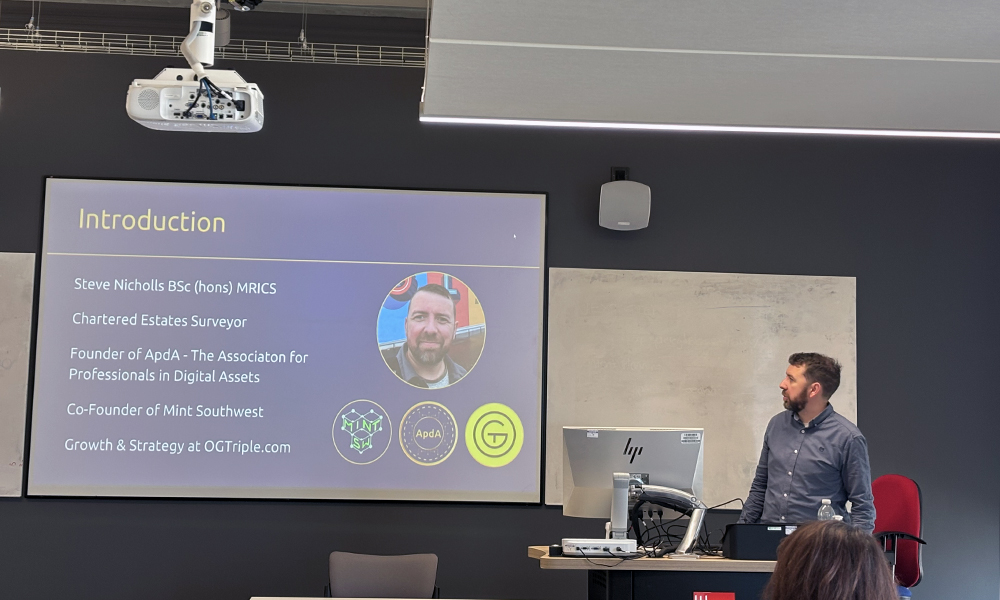
Steve Nicholls from ApdA (Association for Professionals in Digital Assets) discussed real-world blockchain applications and its future potential, while Lloyd Nethercott from the South West Cyber Crime Unit shared insights into cryptocurrency-related law enforcement investigations.

Dr Christopher Carr

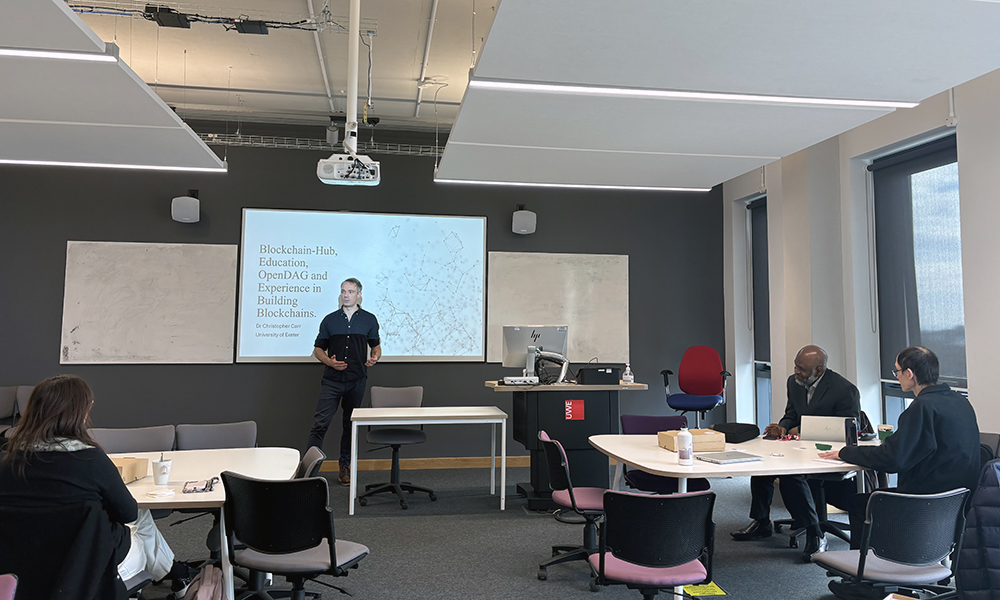
Dr Christopher Carr from the University of Exeter presented his work on blockchain-hub and OpenDAG, and Ben Bonner from Zero Citizen shared his industry experience on leveraging blockchain to revolutionize renewable energy accessibility.

Ben Bonner

Professor Ismail and Dr Xiaojun also presented their latest research on the relationship between cryptocurrencies and the stock market.

The workshop sparked engaging discussions and generated valuable ideas, making it a highly insightful event.

Back to top