

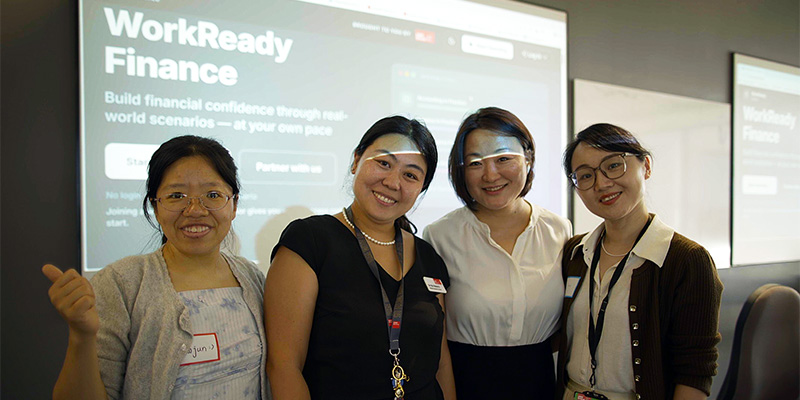
Left to right: Dr Xiaojun Luo, Dr Rui Roberts, Dr Yan Zeng, Dr Helen Zhang
In the first week of July, members of the Governance and Accountability Research Group (GARG) took finance education out of the lecture theatre and onto people’s phones. WorkReady Finance, a gamified learning platform still in development, ran its first two free pilot workshops: on Thursday 2 July at Bristol Business School (UWE Bristol Frenchay Campus) and on Saturday 4 July at the Spitfire Hangar, Brabazon. The pilots put GARG’s core themes of governance, disclosure and accountability to work in everyday decisions.
The project is a UWE Bristol Knowledge Exchange initiative, funded by the Higher Education Innovation Fund (HEIF). It is built collaboratively by a Bristol Business School team, each member developing a learning module in their own field: Dr Helen Zhang (Investment in Practice), Dr Rui Roberts (Accounting in Practice), Dr Xiaojun Luo (FinTech in Practice) and Dr Yan Zeng (Finance in Practice). The whole platform rests on a simple idea: money is easier to understand when it is about something real.
Three perspectives, one game
Three keynote voices framed the pilots, and each perspective is visible inside the game itself. Saad Saihi of EdTechLab showed how responsible AI can turn static material into interactive learning; that thinking runs through the game’s short learn-then-decide activities. Mike of Redcatch Community Garden, a Bristol social enterprise that runs its own café, described real funding, spending and risk decisions; exactly the decisions players face on screen. Professor Haiming Hang (University of Bath) explored how AI could reshape education itself, and what that shift asks of educators; the game offers one careful answer, putting AI in service of active learning rather than in place of it. Three angles, one conclusion: financial confidence is built by doing, not by being told.
One game, two rooms
Both pilots followed the same recipe: no slides, no lecture, no personal details collected. Dr Yan Zeng gave a live demonstration of the Coffee Shop scenario while a lively mix of participants, from jobseekers and women returning to work to small-business owners, played along on their own phones: choosing a location, building a funding package, spending the money wisely, then surviving a quiet launch as the results played out month by month in cash, sales and costs. There is deliberately no single right answer; different mixes simply create different levels of debt, ownership and risk. Everyone left with free app access, a certificate, and a personalised business plan built from their own decisions.
Participants called the sessions “very useful” and “extremely useful”, said they would pass the game on to friends, and several organisations have already asked about running collaborative workshops with the team.
Governance and accountability in action
The pilot sits squarely within GARG’s agenda of corporate governance, disclosure and accountability. The game’s central trade-off, debt and control versus ownership and shared risk, is the corporate governance question in miniature. Its plain-English explanations practise what the disclosure literature preaches: financial information only creates accountability when people can understand and use it. And free community delivery is a university being accountable to its region. The project also extends GARG’s SME practitioner forum: where the forum listens to small businesses, WorkReady Finance builds capability with them.
What happens next
Feedback from the pilot workshops will inform the next stage of development, which will expand the platform to include three scenarios: a coffee shop, a cleaning company, and a personalised gift business. The platform will also be embedded in teaching across modules at Bristol Business School. For example, Dr Xiaojun Luo is developing a Sustainable Financial Planning app as part of the next phase.
Further community workshops will follow as the platform continues to develop, including an additional workshop planned by Helen at Xi’an Jiaotong-Liverpool University, which will help extend the project’s international impact.
To follow the project or ask about a future collaborative workshop, visit finreadylab.org or contact the team (rui.dai@uwe.ac.uk).