Portrait of young Black woman sitting on the sofa, hand under chin, looking away, contemplating
Black History Month is not just a month for me, it’s my lifestyle – I know nothing else. Although designed to be a time for celebration, I experience a range of mixed emotions at this time of year.
I’m very proud of who I am, my heritage and the great things Black people have and continue to do and contribute towards society. Yet I feel exhausted and overwhelmed because many organisations along with the mainstream media, suddenly focus their attention and recognition on Black people when it isn’t there authentically the rest of the year, and when it is, it’s often through a negative lens.
Over the years, I’ve had many conversations with people who feel like Black History Month is a tiresome tick box exercise. As a result, I’m intrigued to know what Black History Month means to everyone else BUT Black people. I’d also like to see Black people being acknowledged and celebrated, without them having to do the majority of the organising, facilitating and educating themselves.
Growing up Black in the UK has been and still is very heavy, but I wouldn’t change it for the world. I love the skin I’m in but want to be able to live and work in a society where I’m free to be me and don’t have to suppress my thoughts, feelings and emotions in order to cope with everyday life.
Although there continue to be great improvements in some areas, there is a long way to go and it’s frustrating to still experience and witness micro-aggressions and ignorant comments within the workplace, frequently reminding me that I don’t quite belong.
When engaging in this month’s activities around Black History Month, please remember that a good time for some can be very challenging for others who work and live in spaces where they endure being gaslighted, dismissed or completely ignored when issues around race arise.
Be curious and seek to understand, but also be sensitive and mindful, as many people will be re-opening some very painful wounds that still remain, long after the conversation has finished.
October shouldn’t just be a time to ask Black people to share their lived experiences. It should be a month of reflection for all, and particularly for organisations to reflect on what they are consistently doing to combat racism and ensure working environments where discrimination doesn’t exist at any level.
Lisa Fortier (Pam Grier) in Scream Blacula Scream, directed by Bob Kelljan, American International Pictures, 1973.
There has been a shift in horror in recent years with filmmakers like Jordan Peele flipping the script and writing horror with fully fleshed out Black protagonists. In his work, Peele often depicts Black people being misled or tricked by their white counterparts, as in the modern classic Get Out (2017). His stories are radical, highlighting the scary reality of living as a Black person in America. This wave of revisionist Black horror has been seen before with blaxploitation horror movies made in the 1970s – a genre of films influenced by the Black Power movement and with predominantly African American casts. Although controversial for their representation of crime, the films make a point to lean into and reclaim stereotypes that the white media projected onto them.
Perhaps the most important actress in the blaxploitation genre, Pam Grier played the powerful heroines in Coffy (1973) and Foxy Brown (1974) – and inspired Tarantino’s Jackie Brown (1997). By taking on these roles, Grier challenged both the racial stereotypes and sexism that Black actresses faced at the time. In Scream, Blacula, Scream (1973), the sequel to Blacula (1972), she plays Lisa Fortier, the apprentice of the Voodoo queen, Mama Loa. Recognising her rare combination of intelligence, strength, and respect for the traditions of their craft, the dying queen chooses Lisa as her successor. Lisa goes through an empowering narrative arc that symbolises the passing of knowledge and responsibility between women, one generation to the next. Pam Grier is fantastic: her portrayal of Lisa is fearless and sexy, and she brings both beauty and resilience to the heroine. Carving her own mark onto a genre that was pioneering in its own right, Grier is an icon you should definitely watch on screen this Black History Month.
Content warning – experience of infertility and pregnancy loss
I write this as fertility awareness week approaches and find myself reflecting on the past seven years. How did that happen? My primary reason for sharing my experience is to raise awareness and because although it was painful, I feel I can share it, whilst others cannot. I feel like being more open about what infertility was like for me will help destigmatize it; and maybe someone going through a similar journey will feel less alone.
Spoiler alert – I now have a turbo-charged, head strong toddler after IVF eventually resulted in a successful pregnancy. If you need to stop reading because this is now one of many infertility stories that includes success, then I 100% support that choice. One source of frustration for me during infertility was the absence of stories from people who underwent years of treatment and chose to stop without having a child. It felt as if these people didn’t exist, yet I felt they must (they do!) and I wanted to hear how they scaffolded their way out of the sinking sand of infertility treatment. Their stories are so important in a society which seems to ask women at every turn when they are having children or why they haven’t had them yet. (If this is something you think you might be guilty of doing, even with close friends or family, please stop) The weight of expectation from society is a lot to carry on top of the ache from within to become a parent.
A photograph of Llansteffan beach, showing a blue sky and the sea breaking over a sandy beach
This is Llansteffan beach. It was here, settled on the same bench, that I realised I had visited for the past 4 years, almost to the day, each year. I would sit here gazing at the water, fiercely close to bursting with emotion, an outward calm belying what I now recognise as a response to trauma. As a write I feel this is sounding a little dramatic, but I am working on being kind to myself; a part of that is being honest about what a destructive experience it was to go through infertility and subsequent treatment, in order to carry and give birth to a child.
One thing which is helping me process the experience is recognising that not getting pregnant every cycle, over years, became a monthly hop on the grief train. Grief, with all its stages and visceral extremes, was triggered each time I was not pregnant. The hope attached to the possibility that this might be the time my period wouldn’t come and I could take a test, was lost each time. The meaning held within that, the imagined future that disappeared with a grimly comic ‘POP!’ every month. I am not a particularly superstitious person, but it became very difficult to shush the thought that this was punishment for something, that the universe had somehow found me not deserving of becoming a parent. That self-kindness, I mentioned earlier? I am trying to apply it to those sorts of thoughts.
After not being pregnant for a long time and after repeat trips to the GP, I was referred to a fertility clinic for further investigations, along with my partner. After several procedures, including surgery, we were given a diagnosis of ‘unexplained fertility’– yes that is an actual diagnosis – with a 13% chance of successful conception with treatment. I want to say that hearing that percentage was a hammer blow, but in reality I was so worn down and used to the loss of hope by this point that I don’t think I engaged with the bleakness of it until much later.
Having already spent years trying to start a family by this point, and after the invasive procedures for diagnosis, we decided to give IVF a try despite the low likelihood of success. Living in Bristol we were entitled to one round of treatment on the NHS. This started in early 2020, so I was administering the hormone cocktails by daily injections while watching our government pretend there wasn’t an incredibly worrying virus sweeping across the world. I started working from home during this time as I was worried about getting unwell while in treatment. This was coupled with regular visits to the clinic to check how my ovaries were responding.
After the course of hormones came to an end, I had the procedure to harvest eggs; the embryologists did their (amazing) thing and an embryo started to develop in the lab, and I went back in to have it implanted. Two days later, the country went into lockdown and everything stopped. I was lucky that I had been able to get that one embryo implanted before the clinic had to close. What followed was the ‘two week wait’ – the window after the embryo transfer when you wait to take a pregnancy test to see if it has implanted.
You’re meant to spend that time doing nice relaxing things, such as being creative, and distracting yourself. Like everyone else at this time my main distraction was watching the government bungle its way through how we should be behaving, how we could protect ourselves and one another, and how we must stay at home. Work turned out to be a great way to occupy my mind since there was so much opportunity to pitch in and do whatever needed doing to help teaching move online – it was far from relaxing though.
The two weeks passed painfully slowly, before test day eventually rolled around. It was negative. It ‘doesn’t count’ as a loss, but after two weeks of behaving like I could be pregnant it certainly felt like one. That loss of hope emerged again; the single funded cycle was now complete with nothing to show from it. The other two embryos that had started to develop in the lab had stopped a day later – the day before lock down – so there was nothing in the freezer to transfer. That was it.
We let the clinic know by email and were given a phone appointment with a consultant at the clinic. She was clinical about it all and explained that the first cycle was often more diagnostic than anything, and on average they advised people to try at least three cycles of treatment with adjustments based on what they learned from previous ones. This was news to me! I felt like I’d been duped into some medical (and financial) lottery where if I just tried once more it might just work out. You’ve had the first go, keep going!
The clinic could not open for further treatments until four months later so we had some time to think about what to do; we decided we could afford to fund one more cycle ourselves, so we contacted them in July and started the process again. This time, the doses of hormones was changed to increase the chances of having more eggs to harvest, which worked. A bit too well.
I started to feel unwell with six days left of treatment. The clinic ordered blood tests which showed my hormone levels were higher than they should be. My treatment was tweaked but I was advised to keep injecting the hormones and go for egg retrieval on the planned day. This time, they got more eggs and were really pleased but I had to be helped out of the clinic to the car with a lovely cardboard bowl to throw up in on the way home. Over the next two days at home, I felt even worse. It then became clear I had ovarian hyperstimulation syndrome (OHSS), which meant I could not have any of the three embryos that had developed transferred and they were all frozen instead.
The COVID-19 measures were still in place at this point so my partner was not allowed into the clinic, and they didn’t want to admit me to hospital if they could avoid it because of the COVID risk at Southmead. As a result, my partner drove me to the clinic every morning for observation, and blood tests. In addition to this exhausting routine, we had to be on standby to go into hospital each day depending on the test outcome which came at lunch time. After five days of this, I was starting to feel better and was cleared to rest and relax until I felt back to full health, which I chose to go and do in Llansteffan.
After a couple of normal menstrual cycles, I was allowed to have an embryo transfer in early December 2020. The best graded embryo was defrosted and transferred, starting that two week wait period again. I was resigned to it not working this time so was absolutely floored to be staring at my first ever positive pregnancy test two weeks later. I lived in a weird daze, keeping away from people as COVID surged again and not quite believing I was finally pregnant. On 22nd December I started bleeding and called the clinic, who said it sounded like a chemical pregnancy. A chemical pregnancy isn’t considered a miscarriage, but to me it was (and is). Because of it being by IVF, I know the would-have-been due date for that embryo and that day will never pass without me thinking of what may have been. Christmas was shit.
We had another decision to make. Our remaining embryos were frozen and stored at no cost for one year, but we had to fund any further transfers, so we decided we would transfer those embryos before the year was up and then call it a day. In early April, after further normal menstrual cycles, we had the best graded embryo of the remaining two transferred and started yet another two week wait. It passed much more quickly this time and I found myself staring, once again, at a positive pregnancy test. I felt numb, until a couple of weeks later, when I suddenly lost my appetite, developed a strong aversion to any food with flavour, and started to consider that this might actually be a real pregnancy. A seven-week scan at the clinic showed that everything was as it should be at that stage – a blob of grey fuzz on a screen as far as I could tell – and my morning sickness continued. I was released from the clinic’s care and entered the care of midwifery, the most wonderful women and best medical care I have experienced. After the occasional event during the pregnancy, my son was born on Christmas Day 2021.
This is one woman’s experience of infertility and IVF, statistically unremarkable, as according the NHS ‘1 in 7 couples struggle to conceive’. I’m conscious that my experience as a cis, white woman in a heterosexual relationship – and that 1 in 7 statistic on the NHS site – only shows a small part of the picture of infertility, a subject that is so infrequently discussed with much feeling and one that brings plenty of other challenges – and battles – for people in different circumstances. That said, more people sharing their stories can only be a good thing and this is mine.
As you can probably tell this experience still feels very raw for me and raises resentment, confusion, guilt, sorrow – to name a few of the complex range of emotions I am slowly working through. Having my son had an amazing shrinking effect on the space that it takes up inside me, and he brings me joy every day. Imagining becoming a parent was something I stopped myself from doing when it became too painful, but occasionally my son will do something, or we will be in a moment together, and I will realise I had daydreamed about it years ago. That is a warm feeling.
Photograph of Dan Wood, Chief People Officer at the University of the West of England, sitting at a table in a walled garden
Content Warning: This text discusses homophobia and mental health.
My journey of coming out has been a path of self-discovery, self-acceptance, and, ultimately, self-love. In some ways, this process of “coming out” continues even today. Just last Christmas, a checkout attendant assumed my “wife” might be upset about my shopping spree and was surprised when I explained he would be delighted with the extra wine! While these assumptions can be uncomfortable, they pale in comparison to the more severe prejudice I’ve encountered in the past.
I grew up in the 1980s and 90s, when the shadow of Section 28 loomed large, campaigns stigmatised the gay community during the HIV/Aids crisis, and casual homophobic verbal and physical abuse were distressingly common. I vividly remember my first Pride in London when parents quickly moved their children away from us and when I became the target of hateful slurs and was spat at.
Even in the confines of my family and a circle of friends who loved me, homophobic attitudes and language created a climate in which I felt it impossible to be openly or fully me. For many years I lived a kind of double life trying to hide my sexual orientation. It was torture. It became hugely stressful as I navigated a complex web of telling different people at different times. The self-editing and sense of deceit was exhausting and took a huge toll on my physical and mental health.
Over twenty years on it saddens me to still hear about the homophobia that exists both here and around the world, but at the same time I am very proud to know that our country has come so far in embracing equality and valuing our human diversity. When I watch the news, I worry that we mustn’t allow this to backslide. This is hard-won progress and a continuing struggle. I never underestimate the important role of allies and activists who work for change – not just in our interpersonal behaviours and societal culture but also in dismantling the systemic and institutional forms of discrimination that can hold us back and which diminish us all. Those champions of equity and inclusion are needed throughout society more than ever.
In my professional life, I’ve seen the positive impact of inclusive policies and a welcoming environment. Our university is dedicated to creating a space where people of all sexual orientations and gender identities feel valued and supported. We recognise that diversity enriches our community, sparks creativity, and enhances everyone’s educational experience. I know not everyone experiences this and until they do, we must work hard to make improvements. The responsibility for change, however, should not rest disproportionately on the shoulders of those most affected by discrimination.
World Coming Out Day reminds us of the power of visibility and representation. By sharing our stories, we break down barriers, challenge stereotypes, and dispel misconceptions. When we come out, we not only honour our true selves but can also offer hope to others.
In academia, diversity and inclusivity are fundamental to our mission. It is through the exchange of ideas and perspectives that we push the boundaries of knowledge and foster understanding among all members of our community. Stonewall has conducted research that found two in five LGBT+ students (42%) have hidden their identity at university whilst more than a third of LGBT+ staff (35%) have hidden that they are LGBT+ at work for fear of discrimination.
In my role, I am committed to ensuring that every student, academic and staff member feels safe, valued, and respected, regardless of their sexual orientation or gender identity. More than a quarter of LGBT+ students (28%) say they were excluded by other students for being LGBT+. We clearly have some way to go yet but it is only through us acting to bring about change at all levels that progress can be made.
To those who are considering coming out or choosing to keep their identity private for now, please know that you are not alone. There are supportive communities here who are ready to embrace you for who you are. Embrace your truth and remember that you are deserving of love and acceptance just as you are.
On this World Coming Out Day, let us celebrate the progress we’ve made in promoting acceptance and inclusion, but also recognise the work that lies ahead. Together, we can create a world where everyone can live their lives authentically and without fear. A world where every day is a celebration of our diverse identities, marked by acceptance, love, and celebration.
Photograph of Dr Roger Griffith MBE, UWE Bristol Lecturer, Author and CEO Creative Connex CIC and Bristol Bus Boycott campaigner Dr Roy Hackett MBE.
For a variety of reasons each year Black History Month arrives with controversy. I agree with those who bemoan the packaging of Black history into one month. To us it can feel like it is too neatly commodified and just like a Christmas tree put back into a box for the rest of the year. At these times I reflect on several conversations that have helped me to put Dr Carter G Woodson’s words into action.
In Bristol we have a vibrant Black community who this year honoured the Bristol Bus Boycott, the 75th anniversary of Windrush and St Pauls Carnival. Our communities across the African diaspora have centuries of contribution, connections and activism from their diverse histories across continents.
Every year I meet people without that rooted knowledge to their Black heritage. For them Black History Month (BMH) provides a gateway of entry. A white parent who raised their dual-heritage child once pointed out to me that there was nothing in the curriculum to help their child deal with their self-esteem following a bout of racism. One young Black man, who had grown up in the countryside once confided to me that BHM had helped him better understand his identity. Through BHM both found new networks, support and cultural reference points. Windrush 75 Chair Patrick Vernon OBE said ‘BMH has influenced and inspired the equalities world to organise similar months, exposing hidden and excluded histories.’ These include LGBTQ, Disabled and Women’s History Months.
Of course, we can’t confine anybody’s history to a day, week or month one month. I respect anyone taking the knee and sitting out BHM 2023, whilst they ensure Black history is represented throughout the year. For me, there is a practical and pragmatic need to do both. To ensure that the culture that gives us all so much inspiration and pride reaches as many influencers and audiences as possible. Post pandemic and with those seeking to divide, we need every opportunity to bring us together. United we can tackle new emerging themes of intersectionality and demographic changes within and beyond our communities.
The Rewarding Gap is just one area UWE Bristol and academia need to address in tackling structural racism in Britain. BHM on its own isn’t going to overturn decades of injustice but we can make a compelling case for achievement and celebration. At a recent community conference our communities bemoaned that too many of our Black and Brown young men are in enrolled in the judicial system than studying in higher education. Until that set of circumstances changes every action and every opportunity must be tried and taken. Black History Month can build awareness and as an engagement campaign to fight against the daily injustices of racism during October and …all year round!
Dr Roger Griffith MBE, UWE Bristol Lecturer, Author and CEO Creative Connex CIC
This picture depicts a person walking on a muddy path. the picture is taken of the trainers and lower legs.
On Thursday 27th April it is On Your Feet Britain’s national activity awareness day encouraging office workers to #SitLess and #MoveMore with the #BigWiggle! On Your Feet Britain (yo-yodesk.co.uk)
This awareness day is to encourage office workers to get active and energize their workplace habits. There is strong scientific evidence that being physically active improves both physical and mental wellbeing and helps you lead a healthier and happier life.
It can reduce your risk of major illness like heart disease, reduce your risk of osteoarthritis and falls but also help boost self-esteem, mood, sleep quality and energy. Benefits of exercise – NHS (www.nhs.uk)
As well as being physically active it is also important to spend less time at your desk, but finding time to get active in a busy week can be a challenge. Government guidelines state we should try and be active for 150 minutes of moderate or 75 minutes of vigorous activity a week with some strengthening activities at least 2 days a week. Even a few minutes’ exercise is good for you, new guidelines state | Health | The Guardian
This picture depicts two people riding bicycles at the top of a green hill and looking at surrounding trees and mountains.
New UK guidelines state that even a few minutes of exercise at a time is good for you, making it easier to fit into your day. This can be done in small bitesize activity ‘snacks’ to help you build them into your daily workplace habits. Why not include some short bursts of exercise in your day to help get your heart rate up and release some feel-good endorphins to help you feel refreshed.
Some things you may want to consider:
Stretching
Take the scenic route to work
Deskercise
A short walk during your lunch hour
This picture depicts the UWE Frenchay Centre for Sports.
UWE Bristol Sport have lots of activities available to staff, including:
On Thursday 27th April for the #BigWiggle we will be promoting some of our MOVE activities during the day. We have a wide range of MOVE sessions available to our members, this is just a selection.
MOVE sessions:
12:30-13:30 – Tai Chi and Qi Gong at CFS
15:30-16:30 – Yoga at The Wild Box, Southville
17:15-18:00 – Yoga at Arnolfini
19:30-20:10 – Dancefit at CFS
20:00-20:45 – Yoga at CFS
There is also the Feel Good lunchtime walk:
12:30-13:00 – Staff walk and talk
Some sessions are free and some require a MOVE membership (or £5 pay as you go). Sessions need to be booked via the UWE Bristol Sport app, if you are not a member you need to join as a pay as you go member to get a PIN. Join@home with University of the West of England (leisurecloud.net)
Easter is a Christian festival and properly begins on Ash Wednesday and has the 40 days of Lent (a time of fasting or giving up something for many) leading up to Holy Week, for Easter is actually a whole week-long festival in many churches across the world.
During Lent the act of alms giving is also very important for many Christians with financial, food and other giving increased for the duration of lent.
In our modern society it must be admitted that the commercialisation of Easter is fully established, and the eggs are in supermarkets from the start of January. Sending of cards is also now a popular event, a little like the Christmas cards which rose to eminence in Victorian society.
Eggs have been used for thousands of years to indicate the hope of new life and hope as the (northern) world gets lighter and warmer. Flowers begin to spring and young animals are born. Probably where the easter bunny comes from.
Records indicate that as early as 200 years after Jesus’ life the early church decorated eggshells red to signify the blood and empty tomb. This may also have “appropriated” earlier festivals and easter also coincides with the Jewish Passover festival. All however relate to the new life experience, and this is what the Christian church wished to use in its festivals, as we believe Jesus gives new life by what was accomplished at the cross.
In the earlier church, eggs were also one of the foods “given up” for lent as a part of the fasting. So the return of eggs to the menu (having allowed the chickens to ‘rest’) was a very important part of the feast that followed the Lenten time.
Easter is an important Christian festival – it’s when Christians celebrate the resurrection of Jesus Christ. The Bible says that Christ died on a cross on a day called Good Friday. Was buried for three days. According to the Bible, Jesus was then resurrected and came back to life on Easter Sunday.
This significant event, historically attested to outside the church by many, is still having a great impact on our world 2,000 years later. It is this which gives Christians their hope.
After His resurrection, Christ ate and drank in the company of His disciples. “We, who ate and drank with Him after His resurrection…” In our festivals, and the communion that is involved, we join in this remembrance and look forwards to His kingdom.
The Easter story is the decisive move of God in saving humankind from sin and restoring all things to Himself.
So convinced were the apostles of the reality of Christ’s resurrection, that they almost all met a martyr’s death for the sake of their faith.
Easter is a time for joy, feasting and love to all as we recall the steps God took to allow us all to approach and be reconciled to Him.
May your Easter, however you celebrate it, be one of rest, joy and hope for a brighter future.
There are two pictures. Picture one states ‘Happy Easter’ with grass and eggs either side of the writing and a bird perched above the first P. The second photo is of a small wooden block etched with three crosses. It is surrounded by tealight candles and a small globe is above the wooden block.
On March 8th we celebrated International Women’s Day, as well as the 10th anniversary of the Bristol Woman’s commission chaired by Penny Gane.
Attending the commission was a wonderful experience, surrounded by an incredible and diverse group of people from many networks around Bristol acting on national and international levels collaborating together to help deliver the European Charter for Equality of Women and Men in Local Life. The commission reflected on the past 10 years of work, highlighting their significant accomplishments. One of their achievements was improving the inclusion of women’s health into national and regional policy, increased the number of women in Bristol City Council and launching a successful Bristol Women in Business Charter to improve the lives of women in the workplace, of which UWE is a signatory.
The commission also recognised the pressing concern for women’s safety and worked with partners, including the police, to address male violence against women. Additionally, we heard from Oona Goldsworthy, Chief Executive of Brunelcare and Co-Chair of the One City Homes and Communities Board, who addressed the issue of homelessness and unaffordable housing, which significantly affects women. Since the BWC began working on this, women that are in danger of violence and abuse have been put into the first category for accessing social housing.
It was an honour to be involved in the 10th anniversary of the Bristol Women’s commission, surrounded by inspirational women who are making progress in tackling the challenges faced by women and celebrating the commissions accomplishments over the years!
Screenshot of Christa Wolf, from Time Loops: In Conversation with Christa Wolf (1990), directed by Karlheinz Mund, DEFA Film Library.
Christa Wolf was a revolutionary German novelist whose personal writings empowered the German people to stand up against oppression and the patriarchal society. In Time Loops: In Conversation with Christa Wolf (1990), we are allowed into Wolf’s home as she tells us of her involvement within the political sphere and the change she helped to enact.
We are shown archive footage from political and literary meetings alongside in-home interviews. Some of this is interlaced with Wolf’s voice-over reading from her novels and speeches. Through this we gain understanding of what inspired her artistic work.
She explains that she writes from a very personal place and is constantly questioning herself, which she brings into her writing. She talks about the effect growing up in Nazi Germany had on her writing and how she always advocated for a better government. Wolf is also inspired by love in her writing, stating that writing would suffer without love and that you need love to be able to write.
Wolf also advocates for women’s rights and the importance of women having a voice. This led her to founding a woman’s writing club in the 1980s where they would meet and discuss politics and their artistic work.
This film brings a voice to a great woman whose involvement in politics and writing changed Germany for the better. She decided to take action even when she felt that everyone was against her.
You can watch Time Loops: In Conversation with Christa Wolf on Kanopy
Further viewing:
Divided Heaven (1963) – based on Wolf’s novel, Der geteilte Himmel, directed by Konrad Wolf
Ramadan is a month of worship and generosity. It is the ninth and holiest month of the Islamic lunar calendar. It’s a month in which you can break bad habits and strengthen your iman (faith) in order to build a stronger relationship with Allah (God) the Almighty. It is the month where the holy book was revealed (Qur’an). Good deeds are multiplied and bad deeds too.
The picture displays eight facts about Ramadan under related imagery/icons. The facts read as follows: Fact 1. 9th Month of the Islamic Lunar Calendar, Fact 2. Angel Gabriel commences the revelation of the Quran to Prophet Muhammad (pbuh) in this month, Fact 3. Healthy/mature Muslims fast between Dawn and Sunset, Fact 4: Fasting includes abstaining from food, water and desires, Fact 5. To express well-wishes, you can say “Ramadan Mubarak” (Happy Ramadan), Fact 6. It is a month to improve your relationship with God, family, and your community, Fact 7. Ramadan moves 10-12 days forward every year due to the lunar calendar, Fact 8. When Ramadan finishes, Eid-ul-fitr is celebrated (festival of breaking fast)
What is Ramadan?
Ramadan is a month where Muslims fast from sunrise to sunset for 29/30 days. This allows Muslims to devote themselves to Allah in order to build and develop their relationship with Him. They can do this by fasting, reading the Qur’an (holy book), reading salah (praying), showing generosity, calling upon Allah (Dua) and giving Sadaqat (charity). Ramadan is also a month of charity and spirituality. Ramadan helps Muslims empathise with the less fortunate and to give to charity for the sake of Allah. Ramadan is also about learning discipline and self – control as you abstain from drinking, eating and sinful acts.
The first picture depicts the sharing of food. The second picture has three images within all depicting community, family and charity.
What happens after Ramadan?
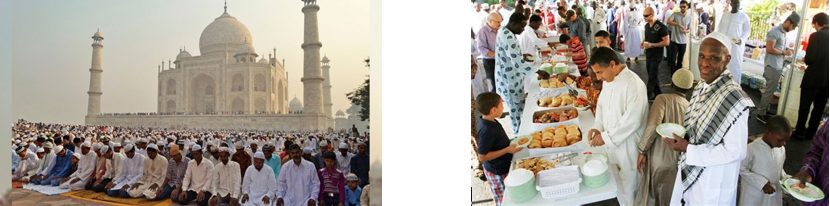
Eid ul-Fitr (festival of the breaking of the fast) is the celebration after Ramadan. it lasts three days (three days of shawwal). Eid is celebrated with family and friends. It is a chance for communities to celebrate together. Many gifts are given during Eid as part of the celebration. Mosques hold a communal Eid salah (prayer) and Muslims wear their best clothes.
Eid is a reminder for Muslims of what Allah has given them and to be grateful. It reminds Muslims to give to the less fortunate all year round.
Picture one displays Communal Eid salah (prayer) outside a Mosque. Picture two displays Eid ul-Fitr (festival of the breaking of the fast) with people gathered around a table of food.
Why is Ramadan special to me?
Ramadan is special to me as it allows me to build and strengthen my relationship with Allah. It reminds me to be grateful and to remember Allah. It reminds me to constantly give to others that are less fortunate. It reminds me the importance of family and friends. Ramadan helps me break bad habits and learn more about my religion. Ramadan teaches me patience, humility, and empathy. During and after Ramadan I feel as if I have accomplished many things such as self- discipline and self-control. I further, feel as if I have found peace within myself and I have learned something new each year. Ramadan is special to me as I can work on my spirituality and myself as a person to become a better version of myself.
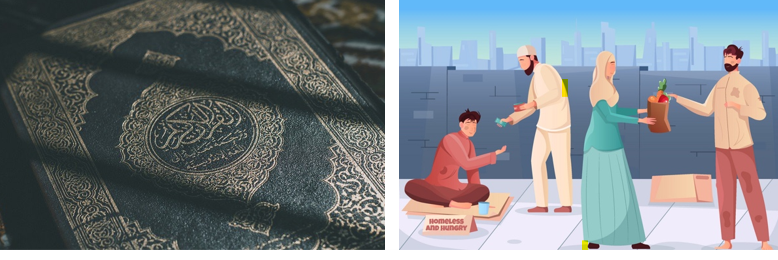
Picture one is a picture of the Quran. Picture 2 emulates a previous picture but focuses on charity; the picture displays charitable work with the homeless.